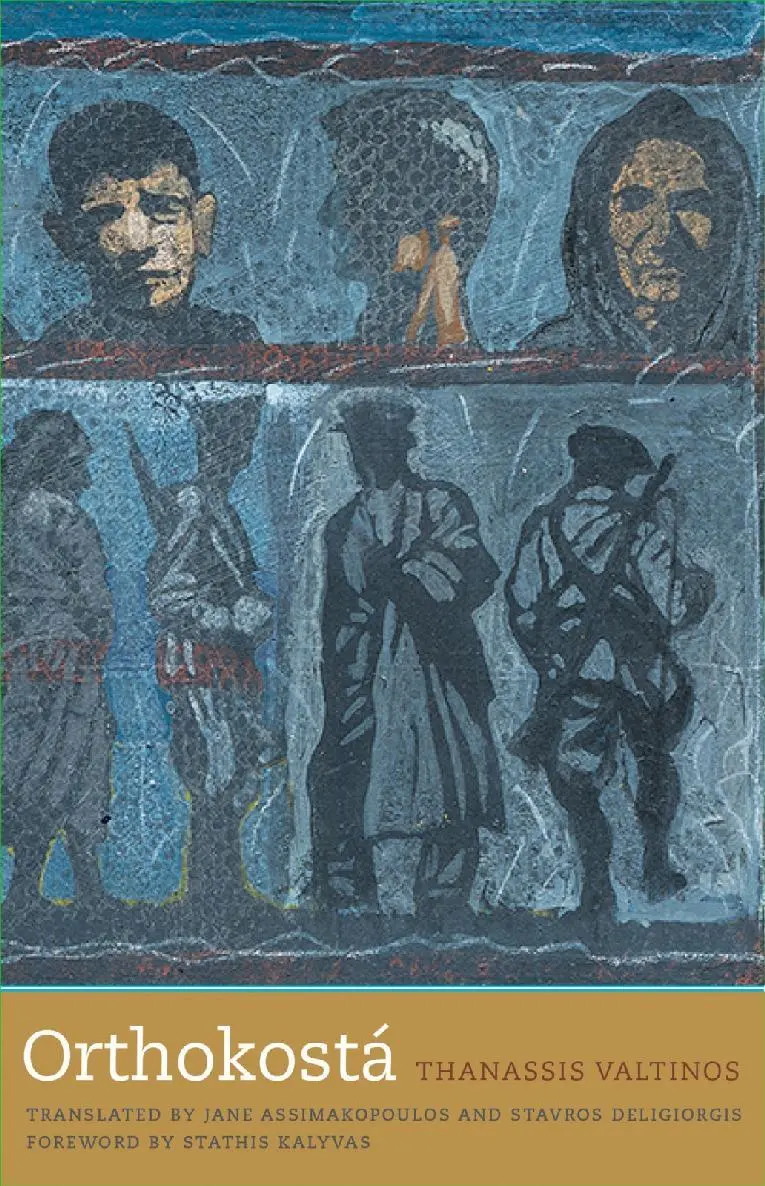
Thanassis Valtinos - Orthokostá
Здесь есть возможность читать онлайн «Thanassis Valtinos - Orthokostá» весь текст электронной книги совершенно бесплатно (целиком полную версию без сокращений). В некоторых случаях можно слушать аудио, скачать через торрент в формате fb2 и присутствует краткое содержание. Год выпуска: 2016, Издательство: Yale University Press, Жанр: Современная проза, на английском языке. Описание произведения, (предисловие) а так же отзывы посетителей доступны на портале библиотеки ЛибКат.
- Название:Orthokostá
- Автор:
- Издательство:Yale University Press
- Жанр:
- Год:2016
- ISBN:нет данных
- Рейтинг книги:5 / 5. Голосов: 1
-
Избранное:Добавить в избранное
- Отзывы:
-
Ваша оценка:
Orthokostá: краткое содержание, описание и аннотация
Предлагаем к чтению аннотацию, описание, краткое содержание или предисловие (зависит от того, что написал сам автор книги «Orthokostá»). Если вы не нашли необходимую информацию о книге — напишите в комментариях, мы постараемся отыскать её.
defied standard interpretations of the Greek Civil War. Through the documentary-style testimonies of multiple narrators, among them the previously unheard voices of right-wing collaborationists, Valtinos provides a powerful, nuanced interpretation of events during the later years of Nazi occupation and the early stages of the nation’s Civil War. His fictionalized chronicle gives participants, victims, and innocent bystanders equal opportunity to bear witness to such events as the burning of Valtinos’s home village, the detention and execution of combatants and civilians in the monastery of Orthokostá, and the revenge killings that ensued.
As a transforming work of literature, this book redefined established methods of fiction; as a work of revisionist history, it changed the way Greece understands its own past. Now, through this masterful translation of
, English-language readers have full access to the tremendous vitality of Valtinos’s work and to the divisive Civil War experiences that continue to echo in Greek politics and events today.
Orthokostá — читать онлайн бесплатно полную книгу (весь текст) целиком
Ниже представлен текст книги, разбитый по страницам. Система сохранения места последней прочитанной страницы, позволяет с удобством читать онлайн бесплатно книгу «Orthokostá», без необходимости каждый раз заново искать на чём Вы остановились. Поставьте закладку, и сможете в любой момент перейти на страницу, на которой закончили чтение.
Интервал:
Закладка:
— Márkos fired his pistol: Long live the revolution.
— Yes.
— And then he says, I’m going to meet Látsis, my koumbáros.
— Yes.
— On Mount Parnon. So, when he went up there he confided his plans to them. There were three of them on the road with him. Three rebels escorting him. I don’t know the spot where they hit him. Where they slaughtered him. They didn’t shoot Márkos. They stabbed him from behind, with a knife. His koumbáros tells him, Keep going till you meet the other men farther down. The three of them escorting him. One of them stayed behind to take a leak, and as they were talking off to the side, they stabbed him. At that time we couldn’t get through. We couldn’t leave. We wanted to leave. Yiannakópoulos had signed the agreement. Not to attack each other. But we couldn’t do any recruiting, none at all. We weren’t allowed to. And they gathered us all at Prophítis Ilías, on Mount Taygetus. Just above Goránoi.
— What time of year did you leave from here?
— In the summer, I told you.
— And how long did you stay with Yiannakópoulos?
— Two months. Two and a half.
— Did ELAS attack you after that?
— No. They couldn’t attack us. But the English were making drops. They would drop things, and the others would get them. They’d drop arms and automatic weapons, and knapsacks full of sovereigns. The kapetanaíoi pocketed them. We went to catch a caïque in Kalamáta, to leave. Later on we fought the rebels. In Rahoúla. Vrettákos the cavalry captain was there. We split up, to leave. And they got him.
— To leave for where?
— To finally leave the country. Tsirígo, 1Crete, Africa. Where could we go? And that son of a bitch the boat captain sinks the caïque and leaves us stranded. We got our bearings. We got ourselves to Kaltezés. From there we came to Vlahokerasiá, and we joined the others. Vazaíos and Tsígris. Vazaíos was in charge at Artemísion. With two of the Kokkiniás brothers. Officers in the Greek Army.
— Where were they?
— In Pyramída. Just above Ellinikó. Not the Ellinikó in Astros. I’m talking about Kefalári.
— In Argos?
— In Argos. High up on the left. Some distance away. It’s the border, at Pyramída. So the Kokkiniás brothers were there, both of them. Tsígris was there.
— Tsígris, the one Mihális killed?
— Yes, him. And he says, Clear out or I’ll order them to fire.
— Order them to what?
— To fire.
— Tsígris told you that.
— Yes.
— Why?
— Because we broke the agreement. Because we wanted to fight. We went there to see what we could do and he told us to clear out. If you don’t clear out, I’ll order them to fire. I ask Sakellaríou, What should we do, Státhis? What should we do?
— How many of you were there?
— There were about fifty of us. What do we do now? Yiannakópoulos had agreed that we should work together.
— And he’d sent you there?
— No, we went by ourselves. Mílis stayed behind. With no shoes. They kept him. Then Sakellaríou says. Sakellaríou from Vytína. Whoever wants to can stay with me.
— On Mount Taygetus all this?
— Yes, because they had us surrounded. They would have wiped us all out. They would have taken us prisoner.
— Yiannakópoulos?
— Yiannakópoulos was there. Then he left, I don’t know where the devil he went. He went over to ELAS, he sold us out. With the agreement he made. He betrayed us. That’s why we had to join the others. In Artemísion. And the others were even worse. He had sent word to them. We arrived, they wouldn’t have us. Wouldn’t have us .
— What time of year was it there?
— It was fall. Fall was just coming on. And we went down on foot, me, Sakellaríou, and four or five others. We would tell people we were butchers. Animal traders. We went down to Stérna, above Argos. We got to Koutsopódi. And there we split up. Poor Sakellaríou stayed behind. I came back here. We all split up.
— And you came to Kastrí?
— I came to Kastrí. I came and all this happened. Let me finish, the Germans were still around, after 1944, the Germans were there.
— Wait a minute. You came to the village.
— Yes.
— It’s still 1943.
— 1943.
— And what did you do when you got to the village?
— What did I do, I went to my car.
— To your car.
— But I was under surveillance. One day they say, Take the car. Mávros’s car, God rest his soul.
— The doctor?
— Yes. Kóstas Tsourapélos and the doctor had a car. A Farkó. 2A truck.
— Mávros the doctor.
— Yes, the doctor.
— Jointly owned?
— Yes. A Farkó. A truck. They come down to Haloúlos’s taverna and give me an order. To go to Aráhova and bring back a dead rebel. I tell Tsourapélos, Kóstas, what are we going to do?
— How would you go to Aráhova? Through Voúrvoura?
— Through Trípolis. Trípolis. They would give us passes.
— Yes.
— Kóstas, what are we going to do? He tells me, I don’t know what we’ll do. I tell him, We’re not going. The way things are now, they’ll burn our car. He says, Let them burn it. They didn’t burn it. We’re going. We went and brought back the dead man. And the next day we abandoned our homes. We got up and left, on foot. Finally in March the Security Battalions came. And on February 2, the Day of the Presentation at the Temple, I was freed.
— From where?
— From Mávri Trýpa. There were 258 prisoners there.
— Hold on. The Battalions were formed in March.
— In March. They were formed in March.
— Okay, you were in the Battalions, you joined the Battalions.
— I joined as soon as they were formed. Before that I was with X. From the day I was freed on February 2. In X with Konstantakópoulos, who they called Tsékeris. He had an office in Kolokotróni Square. With Thémis Iatroú. On the lower side of Kolokotróni Square, where the pharmacy is today. And they gave me a pistol. A pistol with one bullet.
— The men from X?
— Konstantakópoulos or Tsékeris. But I was half-dead from the detention camp.
— When did they arrest your brother?
— They killed him on July 29.
— In 1944.
— Yes.
— They killed him on July 29. When did they arrest him?
— Five days before. Ten. Something like that.
— When did you join the Battalions in Trípolis?
— As soon as they were formed. I went first. In March. On February 2 I was freed from the detention camp. The evening before, when the sun went down, just after that, the Germans surrounded us. They arrested us all.
— When did the rebels take you prisoner?
— In November.
— In ’43.
— In ’44.
— But you said you were freed on February 2, 1944.
— Yes. October, November, December. They took me prisoner in November. I stayed in the detention camp for three months.
— In ’43.
— Listen.
— In ’43. November, December.
— Hang on. ELAS arrested me in November in Parálio, Astros.
— Yes.
— They took me there.
— Tell me one thing: When did they arrest you in Parálio, Astros?
— Three months, two and a half months exactly before February.
— Did they kill your brother before that or later on?
— Later on.
— So they arrested you in 1943.
— They killed Panayótis in 1944.
— In the summer.
— In the summer, on July 29.
— So they arrested you in 1943 then.
— They arrested me — how many months are there before February? In 1944.
— It was after February of 1944. Since it was July when they killed Panayótis.
— It was me in February, it was February when I was freed. On February 2.
Читать дальшеИнтервал:
Закладка:
Похожие книги на «Orthokostá»
Представляем Вашему вниманию похожие книги на «Orthokostá» списком для выбора. Мы отобрали схожую по названию и смыслу литературу в надежде предоставить читателям больше вариантов отыскать новые, интересные, ещё непрочитанные произведения.


Обсуждение, отзывы о книге «Orthokostá» и просто собственные мнения читателей. Оставьте ваши комментарии, напишите, что Вы думаете о произведении, его смысле или главных героях. Укажите что конкретно понравилось, а что нет, и почему Вы так считаете.