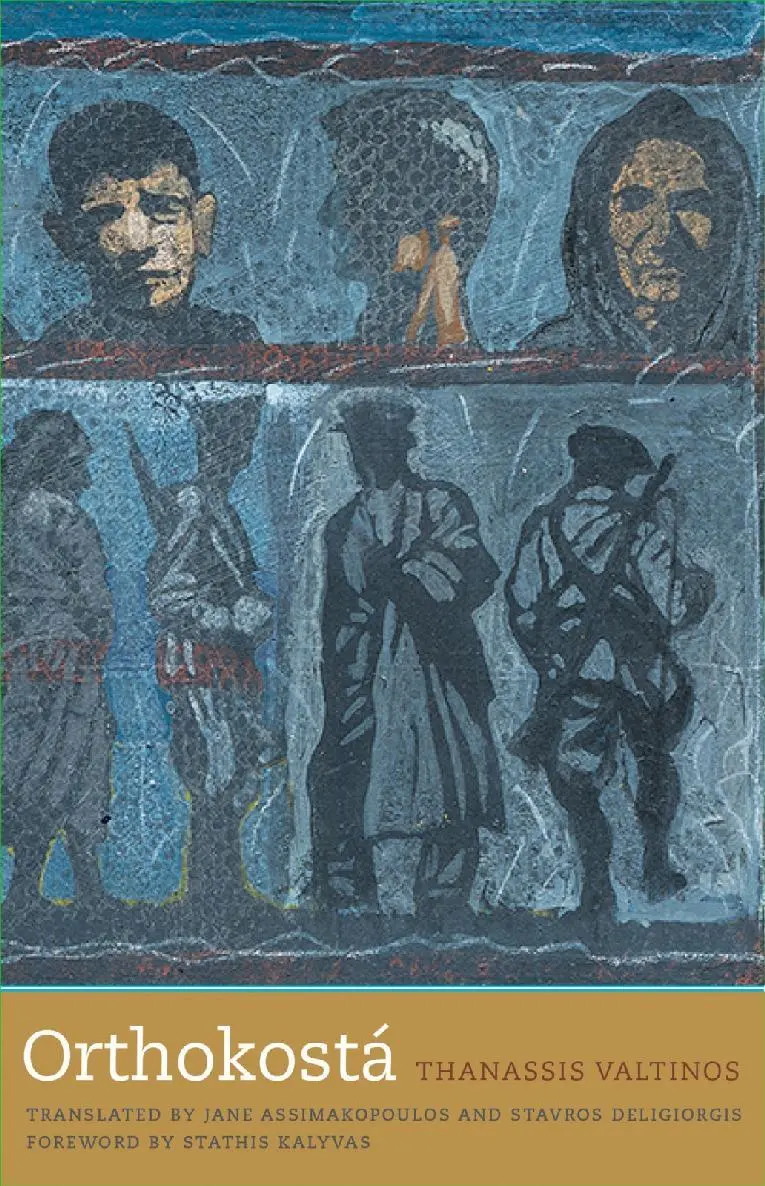
Thanassis Valtinos - Orthokostá
Здесь есть возможность читать онлайн «Thanassis Valtinos - Orthokostá» весь текст электронной книги совершенно бесплатно (целиком полную версию без сокращений). В некоторых случаях можно слушать аудио, скачать через торрент в формате fb2 и присутствует краткое содержание. Год выпуска: 2016, Издательство: Yale University Press, Жанр: Современная проза, на английском языке. Описание произведения, (предисловие) а так же отзывы посетителей доступны на портале библиотеки ЛибКат.
- Название:Orthokostá
- Автор:
- Издательство:Yale University Press
- Жанр:
- Год:2016
- ISBN:нет данных
- Рейтинг книги:5 / 5. Голосов: 1
-
Избранное:Добавить в избранное
- Отзывы:
-
Ваша оценка:
Orthokostá: краткое содержание, описание и аннотация
Предлагаем к чтению аннотацию, описание, краткое содержание или предисловие (зависит от того, что написал сам автор книги «Orthokostá»). Если вы не нашли необходимую информацию о книге — напишите в комментариях, мы постараемся отыскать её.
defied standard interpretations of the Greek Civil War. Through the documentary-style testimonies of multiple narrators, among them the previously unheard voices of right-wing collaborationists, Valtinos provides a powerful, nuanced interpretation of events during the later years of Nazi occupation and the early stages of the nation’s Civil War. His fictionalized chronicle gives participants, victims, and innocent bystanders equal opportunity to bear witness to such events as the burning of Valtinos’s home village, the detention and execution of combatants and civilians in the monastery of Orthokostá, and the revenge killings that ensued.
As a transforming work of literature, this book redefined established methods of fiction; as a work of revisionist history, it changed the way Greece understands its own past. Now, through this masterful translation of
, English-language readers have full access to the tremendous vitality of Valtinos’s work and to the divisive Civil War experiences that continue to echo in Greek politics and events today.
Orthokostá — читать онлайн бесплатно полную книгу (весь текст) целиком
Ниже представлен текст книги, разбитый по страницам. Система сохранения места последней прочитанной страницы, позволяет с удобством читать онлайн бесплатно книгу «Orthokostá», без необходимости каждый раз заново искать на чём Вы остановились. Поставьте закладку, и сможете в любой момент перейти на страницу, на которой закончили чтение.
Интервал:
Закладка:
— Revenge, yes. Then from Eleohóri they sent word to us to go after someone named Mathés. An important Party cadre. We left and went to Ayiasofiá, traveled all night. At the railroad tracks Antonákos the doctor was waiting for us. He got us and took us back to Samóni. He was an important cadre, that Mathés. I don’t know how that man stayed alive. There were seven men from Másklina and us. He was a murderer. A murderer. Just like those other men who are getting pensions today. Who took part in the Resistance and are getting pensions. Murderers’ Resistance.
Chapter 42
And that’s how the wife of the justice of the peace lost her things. Manolópoulos was the justice of the peace in Kastrí. Pavlákos let it slip somewhere that they were going to arrest him. Vasílis goes and tells him, Take your wife and get out. I don’t remember if they had children, they were both young. They were staying at Horaítis’s place. Did I hear you right, Manolópoulos says to him. Don’t ask me anything else, Vasílis says, I can’t talk to you. They’re following me. You didn’t dare talk to anyone back then. The court clerk lived right above our house. Konstantinídis. He had a sister named Vasilikí. Manolópoulos’s wife called her and said, Come and pack up the house if you can. And I’m leaving a present for you on the table. Take it, I’m leaving. She told her that and she left. She and her husband left at night. She went the next morning, she tidied up the house, and she took a very lovely nightgown the other woman had left for her. She supposedly closed up the house and left. A few days later they supposedly got her things and took them to some shelter. Then Harís arranged things the way he wanted. And later, when he would quarrel with Kouroúnis, every time they had a spat, he’d say: You took those things and you sold them in Megalópolis. All Manolópoulos’s wife’s clothes.
— Who said that to whom?
— Kouroúnis said that to Harís. Because it was Harís who was going and selling them.
Chapter 43
Our legislature provides for the mutual exacting of oaths. As do all legislatures. A person may establish the truth of all his allegations by the negative process of challenging his opponent to take an oath. I say, You owe me a hundred. You say, I don’t owe you anything, because I never borrowed anything. I enter a sworn statement against you. Legally, you can either take an oath or exact one from your opponent. The tug-of-war ends there. No further challenges are allowed. And then, of course, come the penalties for perjury. The process is called the mutual exacting of oaths. It is exacted by one litigant of another, the judge being obligated to administer it. But only in certain kinds of disputes. In trials regarding marital disagreements, for example, the exacting of oaths does not apply. In trials that tend toward the breakup or annulment of the marriage, oaths cannot be exacted for the simple reason that there is a lack of material evidence. In the old days cases of this sort were frequently heard by the Supreme Court. Suddenly the question arose as to whether the fact of not being a virgin constituted “lack of material evidence.” Because in those days a woman’s chastity was given paramount, statutory importance. Which could be proven only by the presence of an intact hymen. Or again in cases of deception concerning a person’s identity. I know that that’s how they married off the Manavélas girl. Because people in those days were more than just simple-minded. They were sneaky. The bridegroom was only supposed to see the bride at the church on their wedding day. All made up and decked out and covered by a veil. And they usually put the elder daughters there, the ones they wanted to get rid of. They showed me one daughter and they gave me another. That’s how that practice came about.
Chapter 44
— I want you to tell me that story.
— No. You ask and I’ll answer.
— Fine. When did they arrest you?
— Okay, they arrested me in February. Not February. They arrested me in 1944.
— Do you remember what month?
— That’s easy. They arrested me in October. In November to be precise.
— In 1944?
— In 1944. They arrested me in Astros, Kynouría.
— Had the Germans left?
— The Germans had left. I wanted to get out of the country. To go to the Middle East.
— Hold on a minute.
— I wanted to leave.
— Wait a minute.
— So. Triantafýllis tells me. And Matsiólas. Matsiólas the colonel. And Yiánnis the air pilot, Yiánnis Logothétis.
— No, Yiánnis Konstantélos.
— Oh yes, Konstantélos. They tell me, Stay put and see if you can help us, so we can all leave on the Papanikolís . The submarine.
— When was that?
— In 1944, in the month of October.
— No, it must have been earlier. In October 1944 the Germans were gone. You wouldn’t have left then.
— The Germans had left. They’d gone, because they had to leave. The rebels were in control of everything. The Germans left on October 12. They left on October 12.
— Yes.
— Exactly. And the authorities agreed to say it happened on the seventeenth. But they left on October 12.
— All right.
— They left straight from Trípolis.
— Right. And where were you then?
— I was here. I’d gone up to Mount Taygetus. Then I came back, and I was in Trípolis in 1944. But it was before I went to Trípolis — on February 2, the Day of the Presentation at the Temple.
— In 1943?
— In ’44. It was in 1944 on February 2 that the Germans arrested us in Mávri Trýpa. Two hundred fifty-eight prisoners we were.
— In hiding?
— No. Prisoners.
— Tell me about that.
— Yes. Prisoners. But before that I sent those officers out of the country. To the Middle East. I went to Fokianós. In Leonídio. Very rough sea there. The Papanikolís arrived, the submarine, it surfaced, and it picked them up, five of them. Matsiólas, Yiánnis Konstantélos, the air pilot from Karátoula, Stámos Triantafýllis.
— Was all that before then?
— Yes, I told you, before.
— They left before 1944.
— They left in ’43. In 1943.
— In October?
— Yes. In 1943 I was still on Mount Taygetus. And in 1944 we mounted our major operation. So to speak.
— Wait, you’re confusing me. When did they kill your brother?
— On July 29 of 1944.
— In 1944.
— July 29.
— Where were you then?
— The Germans were still here.
— Yes.
— July 29.
— Yes. Where were you?
— I was in Meligoú.
— I see.
— We’d gone on a raid, I was freed in February, on February 2.
— Had they captured you before that?
— Of course, before that. They captured me before that.
— Tell it to me from the beginning. Tell me. It began in 1943. No. It began in 1940. Did you see action in Albania?
— Of course.
— Where did you fight in Albania?
— In all the theaters of operations of the Second Front.
— The Second Front.
— All the way to the lake in Ochrída. To the lake there. That’s how far I went.
— And on your retreat?
— On our retreat I was last. The very last one.
— And you came to Kastrí?
— We got ourselves to Corinth. They took my car, outside Thebes. The Germans.
— Were you a driver?
— Yes.
— And you were coming by car?
— I was coming down — and I was bringing some soldiers with me. Stratís Perentés, Yiórghis, Kyriákos Doúmos’s boy, Leonídas Méngos, God rest his soul. Polyánthi’s son Yiórghis, and Tsarnákos. The Germans made them get out. We started out from Koritsá. I wanted to get my brother, and Vasílis Méghris, and someone named Ilioúpoulos from Kerasítsa. They didn’t come with me. I tell them, I’m the last one, the last car. They wouldn’t come along, they were blowing up bridges. I picked up a girl from northern Epirus, I took her to Yiánnina. In the front, with me and the captain. The captain didn’t want us to take her. At any rate, the bottom line is that we took her. I arrived in Lidoríki. In Ámfissa. And from Ámfissa I went to Thebes. There the Germans requisitioned my car. Then we went across to Perahóra. In Loutráki. We took the train. It took us an hour and a half to get there. We got off at Eleohóri. From Eleohóri we came to Kastrí. I brought my rifle here from Albania. My automatic rifle.
Читать дальшеИнтервал:
Закладка:
Похожие книги на «Orthokostá»
Представляем Вашему вниманию похожие книги на «Orthokostá» списком для выбора. Мы отобрали схожую по названию и смыслу литературу в надежде предоставить читателям больше вариантов отыскать новые, интересные, ещё непрочитанные произведения.


Обсуждение, отзывы о книге «Orthokostá» и просто собственные мнения читателей. Оставьте ваши комментарии, напишите, что Вы думаете о произведении, его смысле или главных героях. Укажите что конкретно понравилось, а что нет, и почему Вы так считаете.