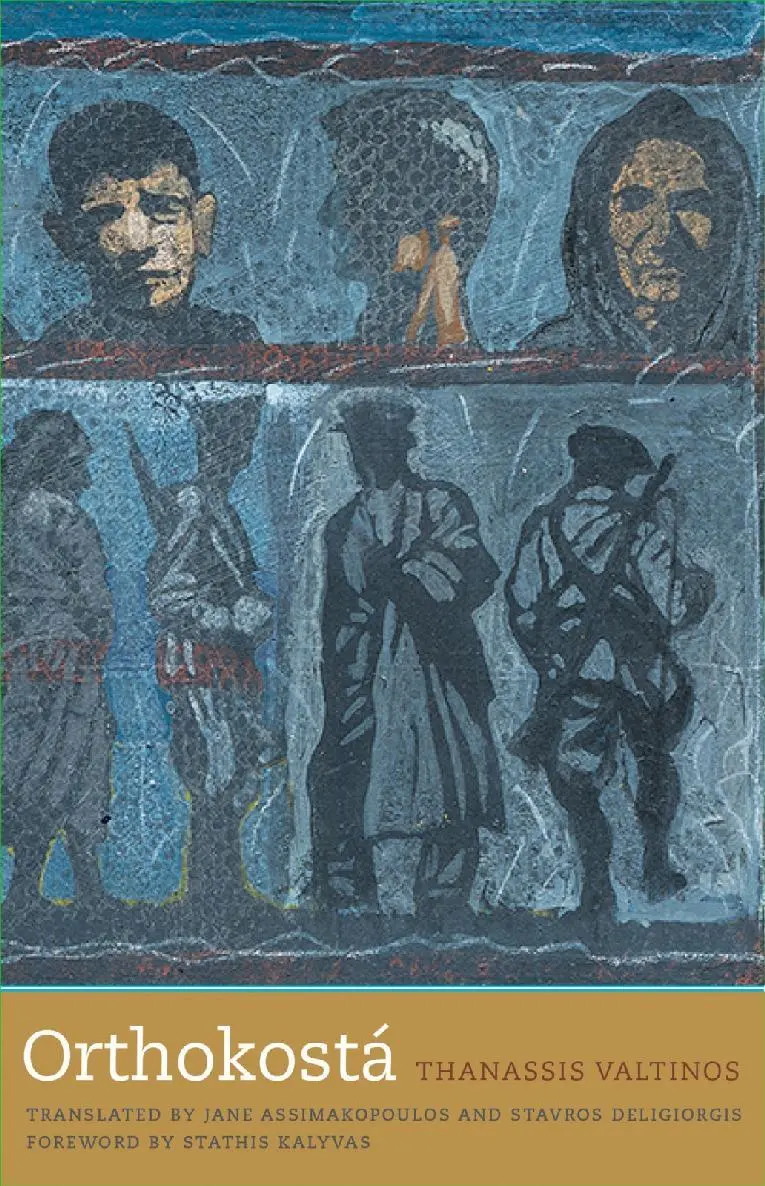
Thanassis Valtinos - Orthokostá
Здесь есть возможность читать онлайн «Thanassis Valtinos - Orthokostá» весь текст электронной книги совершенно бесплатно (целиком полную версию без сокращений). В некоторых случаях можно слушать аудио, скачать через торрент в формате fb2 и присутствует краткое содержание. Год выпуска: 2016, Издательство: Yale University Press, Жанр: Современная проза, на английском языке. Описание произведения, (предисловие) а так же отзывы посетителей доступны на портале библиотеки ЛибКат.
- Название:Orthokostá
- Автор:
- Издательство:Yale University Press
- Жанр:
- Год:2016
- ISBN:нет данных
- Рейтинг книги:5 / 5. Голосов: 1
-
Избранное:Добавить в избранное
- Отзывы:
-
Ваша оценка:
Orthokostá: краткое содержание, описание и аннотация
Предлагаем к чтению аннотацию, описание, краткое содержание или предисловие (зависит от того, что написал сам автор книги «Orthokostá»). Если вы не нашли необходимую информацию о книге — напишите в комментариях, мы постараемся отыскать её.
defied standard interpretations of the Greek Civil War. Through the documentary-style testimonies of multiple narrators, among them the previously unheard voices of right-wing collaborationists, Valtinos provides a powerful, nuanced interpretation of events during the later years of Nazi occupation and the early stages of the nation’s Civil War. His fictionalized chronicle gives participants, victims, and innocent bystanders equal opportunity to bear witness to such events as the burning of Valtinos’s home village, the detention and execution of combatants and civilians in the monastery of Orthokostá, and the revenge killings that ensued.
As a transforming work of literature, this book redefined established methods of fiction; as a work of revisionist history, it changed the way Greece understands its own past. Now, through this masterful translation of
, English-language readers have full access to the tremendous vitality of Valtinos’s work and to the divisive Civil War experiences that continue to echo in Greek politics and events today.
Orthokostá — читать онлайн бесплатно полную книгу (весь текст) целиком
Ниже представлен текст книги, разбитый по страницам. Система сохранения места последней прочитанной страницы, позволяет с удобством читать онлайн бесплатно книгу «Orthokostá», без необходимости каждый раз заново искать на чём Вы остановились. Поставьте закладку, и сможете в любой момент перейти на страницу, на которой закончили чтение.
Интервал:
Закладка:
Chapter 40
I saw Sophia in the summer. She came to her nephew’s wedding. She came from Kefalári, by herself. I tell her, Do you remember it all, do you remember when you hid Loukás in the trunk? And she started to cry. Poor thing, she’s an old lady now, all shriveled up.
Chapter 41
Rebels had come here to Xerokámpi. And some people from the village went and gave them a list of seventeen people to execute. From Perdikóvrisi. An uncle of mine had married a woman from Mánesi. He was also named Nikoláou, a field watchman. Nicknamed “The King.” One day he goes to his wife’s village, Pávlos Bouziánis was there. All of this back in 1944. Bouziánis tells him, Come here. We have a list here to execute some people from Perdikóvrisi. Perdikóvrisi, used to be called Tservási. Should they be executed, he says to him, or is it unjust? And the King, the field watchman, tells him, No, it’s unjust to do that. Among the seventeen were two brothers of Christofílis, my father, and me. The King comes back, he tells us this. We leave immediately then. We go to Eleohóri. The Battalions were there. In 1944 I was twenty, twenty-two years old. Just married. I was born in 1922. My wife was pregnant. I left her behind. We left for Eleohóri. The rebels come down, as they had planned. They come down to the village, they don’t find us seventeen men there. They find Christofílis’s brother Yiánnis. Yiánnis had been drafted in 1941. And they find a first cousin of mine, Kóstas Nikoláou. Also about twenty years old. They didn’t find me and my father, they set fire to our house. Ours and someone named Baziános’s. Burned them down. In the meantime they took my cousin and Christofílis to Kótronas. Two rebels from somewhere else, strangers. In Kótronas they found a stream. They were good souls, those rebels. They left the others and sat down to wash their feet. Our men could have gotten away, but they didn’t. My cousin had a brother-in-law, a man called Kakaviás. From Ayios Yiánnis, he was a kapetánios. A Party cadre. He felt safe.
My brother told him, Let’s go, Kóstas. My brother realized they were going to kill them. Those two rebels were strangers. Men we didn’t know. They sat down there by the stream and took off their shoes. As if they were telling them, Make a run for it. But they didn’t leave. And they brought them to Kastrí. Haroúlis Lenghéris went there and said, Why are you keeping those vermin? And they took them the next day and executed them. Later two men from our village went there, Nikoláou’s brother-in-law and a neighbor, Diamantís Diamantákos, and they found them in some sinkhole on Doúmos’s land.
— In a ditch.
— In Ayiliás. They found them there, they’d left them stripped bare. Taken their clothes. The others got them out, they hoisted them over their shoulders. One each. With rebels all around there, and in Kastrí the villagers scared they too would be killed. They carried them up to Ayiliás, they dug out a space right in front of the sanctuary, they put them in. And they came back to the village.
— They had shot them. And Nikoláou, they’d put a bullet in his head.
— An act of mercy.
— Then we men from Eleohóri, my father, a man named Baziános, and another named Karábakas, went to Trípolis. When the Security Battalions were breaking up. And the rebels arrived and arrested us. They took me to the First Police Precinct. Someone named Karamítzas came in, he’s a lawyer now in Káningos Square, downtown Athens. Yiánnis Karamítzas from Perdikóvrisi. Same age as me. His father was with ELAS. He came there as a commander, he says, Kill that one, he was with the Gestapo. About me. But they let me go. They put my father and some others in jail.
— They didn’t leave for Spétses, that was their mistake.
— Then they took them to be killed. Tied their hands together, about twelve men. They had tied my father to Papahálias, the priest. From Roúvali, Néa Hóra. They took them out a ways, to a small pine grove. The priest keeled over, he couldn’t take all the walking. And they beat him with their rifle butts. Then they received a new order, and they brought them back. They didn’t execute them. They put them back in jail. In the meantime the Red Cross arrived. And my father was the interpreter. He had spent a few years in America as an immigrant, he knew English. Then Bárlas’s wife brought them a pot of boiled wheat. Bárlas was from Bertsová. A lawyer. A good lawyer. His wife took them the boiled wheat, they didn’t inspect it at the entrance. And she bent a blade from a metal saw around the inside of the pot. That night they cut through the window bars and left. Bárlas, a fellow villager named Koïtsános, and some others. All of them lifers, they were going to butcher them. Right after they leave the rebels get my father and the priest and beat them to a pulp. Because they hadn’t told on the others. Then the Várkiza Treaty was signed, and things changed. We went back to the village. Our house burned down, Baziános’s house too. And Karíbakas’s house.
— They didn’t burn down our house. It was jointly owned by my father and an uncle of mine, so they didn’t burn it down. But they looted it, didn’t leave us a thing. Some men from Dragálevo came, and they took everything. Sewing machines, my sisters’ dowry linens and clothes, everything. Even wires and the nails in the walls. They didn’t leave a thing.
— And there was a kapetánios there from Ayiórghis.
— Sotíris, our old friend.
— He was the one who told my cousin, You’re going to be executed. Kóstas didn’t believe him. He’d put his trust in his brother-in-law Kakaviás.
— They rounded them up right in front of our house. The priest was there too. Yiánnis climbed up a mulberry tree. Just before that. Someone saw him there, he was a smoker. Since they’d seen him he climbed down and asked for cigarettes. And that’s how they caught him. They brought him to the group in front of our house. That’s where they took him from.
— They arrested him because he supposedly talked about Papadóngonas.
— Unfounded accusations. It was because of my other brother. During the big blockade he made himself scarce. He wound up in Xerokámpi. Like all the others. The Germans and the Security Battalions left, and the rebels came in. They took everything the others had left behind, cheese and all that. At our house only me, my little sister, and my mother were left. And my brother’s wife, she was pregnant. The rebels would leave, and he would come to see how we were doing. He runs into two of them. Where are you going, Vasílis, you traitor, and they began firing at him with their pistols. Vasílis got out of there, he arrived at the village in a fright. He says, We’re leaving for Másklina. And he took his wife and went to Másklina. The Battalions were in Másklina. In Eleohóri, that is. Instead of him they arrested Yiánnis. Right in front of our house. They brought the priest there too. He was trembling, the priest. He was not from our village but he performed services there. Now he’s in Náfplion, Doukákis. He says, Tell me, Priest, should traitors be executed? What could the priest say? I was very young then but I remember it all. Should the traitors be punished, should they be hanged? They should, the priest says. He was very shaken, he’d gone pale with fear. So they got the men and they took them away. The next day we found out they’d killed them. Yes, it was the next day. Some people from Kastrí came and told us. Then they wouldn’t let us bury them. So we sent one of our relatives, with a cousin of Kóstas Nikoláou and one of the Baziános lot, and they took them up to the church in Ayiliás. And they buried them. Without a proper funeral ceremony. We had goats, and we’d hired a young shepherd, the same day we heard the news they went to our sheepfold, they stole two goats. They’d been sent there by Nikólas Pavlákos and a man from our village. They brought them down, they slaughtered them. Right below our house. And they were dancing and singing.
Читать дальшеИнтервал:
Закладка:
Похожие книги на «Orthokostá»
Представляем Вашему вниманию похожие книги на «Orthokostá» списком для выбора. Мы отобрали схожую по названию и смыслу литературу в надежде предоставить читателям больше вариантов отыскать новые, интересные, ещё непрочитанные произведения.


Обсуждение, отзывы о книге «Orthokostá» и просто собственные мнения читателей. Оставьте ваши комментарии, напишите, что Вы думаете о произведении, его смысле или главных героях. Укажите что конкретно понравилось, а что нет, и почему Вы так считаете.