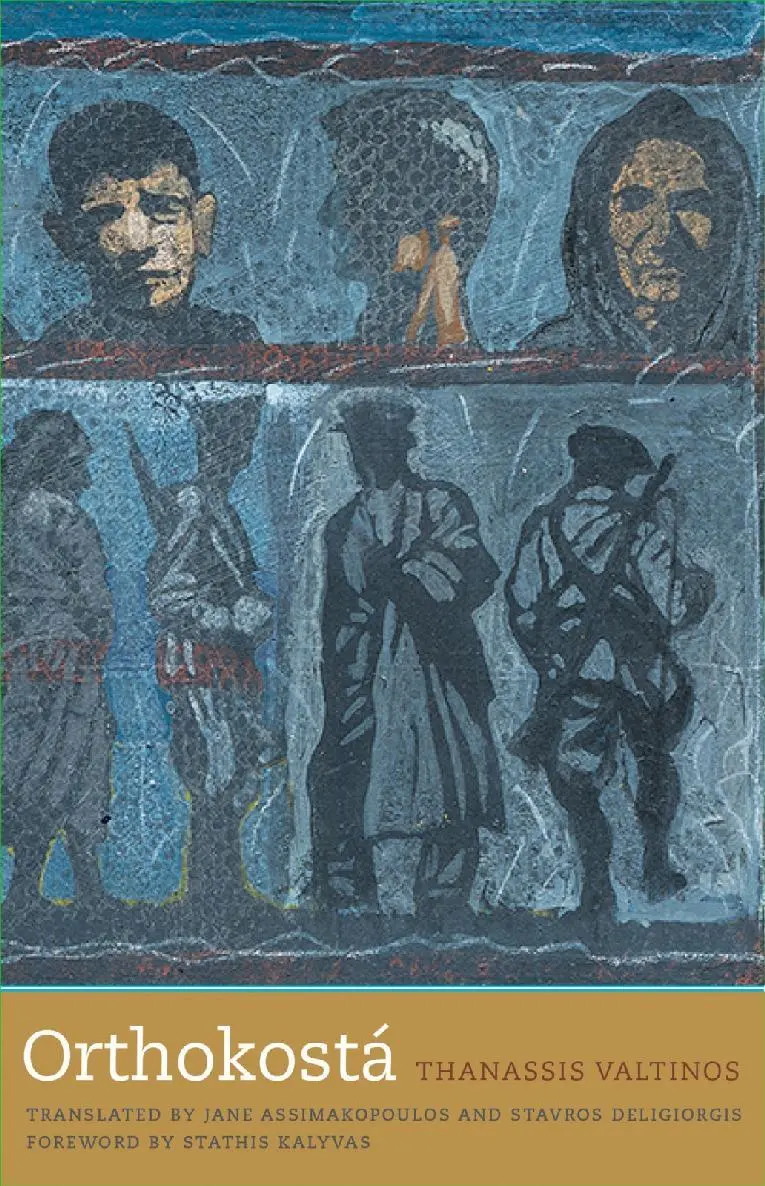
Thanassis Valtinos - Orthokostá
Здесь есть возможность читать онлайн «Thanassis Valtinos - Orthokostá» весь текст электронной книги совершенно бесплатно (целиком полную версию без сокращений). В некоторых случаях можно слушать аудио, скачать через торрент в формате fb2 и присутствует краткое содержание. Год выпуска: 2016, Издательство: Yale University Press, Жанр: Современная проза, на английском языке. Описание произведения, (предисловие) а так же отзывы посетителей доступны на портале библиотеки ЛибКат.
- Название:Orthokostá
- Автор:
- Издательство:Yale University Press
- Жанр:
- Год:2016
- ISBN:нет данных
- Рейтинг книги:5 / 5. Голосов: 1
-
Избранное:Добавить в избранное
- Отзывы:
-
Ваша оценка:
Orthokostá: краткое содержание, описание и аннотация
Предлагаем к чтению аннотацию, описание, краткое содержание или предисловие (зависит от того, что написал сам автор книги «Orthokostá»). Если вы не нашли необходимую информацию о книге — напишите в комментариях, мы постараемся отыскать её.
defied standard interpretations of the Greek Civil War. Through the documentary-style testimonies of multiple narrators, among them the previously unheard voices of right-wing collaborationists, Valtinos provides a powerful, nuanced interpretation of events during the later years of Nazi occupation and the early stages of the nation’s Civil War. His fictionalized chronicle gives participants, victims, and innocent bystanders equal opportunity to bear witness to such events as the burning of Valtinos’s home village, the detention and execution of combatants and civilians in the monastery of Orthokostá, and the revenge killings that ensued.
As a transforming work of literature, this book redefined established methods of fiction; as a work of revisionist history, it changed the way Greece understands its own past. Now, through this masterful translation of
, English-language readers have full access to the tremendous vitality of Valtinos’s work and to the divisive Civil War experiences that continue to echo in Greek politics and events today.
Orthokostá — читать онлайн бесплатно полную книгу (весь текст) целиком
Ниже представлен текст книги, разбитый по страницам. Система сохранения места последней прочитанной страницы, позволяет с удобством читать онлайн бесплатно книгу «Orthokostá», без необходимости каждый раз заново искать на чём Вы остановились. Поставьте закладку, и сможете в любой момент перейти на страницу, на которой закончили чтение.
Интервал:
Закладка:
— To make them suffer even more.
— They gave away the liver of one of the slaughtered animals, and someone gave it to my father. Someone. How could he eat anything, my father? With one son killed and his house looted. That Pavlákos comes round, he asks, Where’s the other liver? They say, We gave it to the old man. He calls my father. Okay, where’s the liver? Comrade, the old man says to him. Your men gave it to us. We didn’t eat it. I’ll tell them to bring it. Pavlákos gives him a slap. The old man goes tottering and hits himself on an acacia tree we had outside. I remember it, I was young. With my brother killed and everything, just like I told you. I was fourteen, fifteen. And that’s why I took care of Pavlákos later on. I beat him for one whole day and one night.
— And word got out that Anéstis Poúlios was also at the execution.
— No. Anéstis and someone called Balátsas. Both from Mesorráhi. They didn’t take part in the execution. But they were there. They watched. And they were the ones took their clothes, so it seems. Because later on I spoke to someone called Sarántos. Then I went to Trípolis. Two years later. During the second insurgency. I had started beating people. I couldn’t control myself. And I left. They would have killed me. Because I was a documented victim of the insurgency. Well, we were eating one day at Antonákos’s place, and that Dakourélis comes in. He sits down there. He says, I have to tell you something. And you have to do it. I say, Tell me. He says, Your brother was killed by a man named Kóstas Harbís from Psylí Vrýsi. I don’t waste a minute, I go straight to the public prosecutor. For even the smallest complaint he was obliged to prosecute. And initiate legal action. I told him everything — the whole story in great detail. Dakourélis climbed up a tree, the rebels went past, he saw them, they didn’t see him. And he saw the whole execution from up there. How they killed them and what happened. My brother fell with the first shot, he fell over. Died on the spot. The first shot didn’t kill Nikoláou, and he was dragging himself along. And one of them went and finished him off with his pistol. That’s exactly what happened. We went to Náfplion a few weeks later. The trial date had been set, but Dakourélis went back on his story. He says, It’s the first time I see that man. Seems they paid him off. And that was the end of that.
— But we’d beat them to it. We’d tried them ourselves.
— Not them. We didn’t know them.
— First we caught Anéstis.
— We caught Balátsas first. Stylianós. From Mesorráhi. Balátsas was his nickname. Everyone called him that.
— Tyrovolás was his name. Stylianós Tyrovolás.
— But he was in prison.
— Well, I used to go to some land we had for grazing sheep. We call the place Bouzouriá. Down in Koubíla. There someone named Fotópoulos tells me, Look up there. Isn’t that Balátsas? We thought he was in prison. I tell him, What are you talking about? I go to the sheepfolds. I had the mules with me, I left them with some shepherds. I go back to the village. I get four or five men and we go there at night and we catch him.
— That was in 1946.
— 1946 or ’48.
— Not in ’48. I was in the army in ’48.
— Anyway, 1946. I got the men together, we went straight to his house. We knock on the door, they wouldn’t open. We break it down. His wife runs out, she started shouting. Stylianós isn’t here. He’s not here. She was shouting. Even though she could have said that more softly. I tell the others, He’s hiding somewhere. Either at Souroúpis’s place or at Markoúlis’s. By shouting she was signaling him to clear out. We run over to Souroúpis’s place, he wasn’t inside. We go down to Markoúlis’s place. What was his name?
— Kambylafkás.
— He was from Galtená. He’d married someone from Mesorráhi and was living there. He opens the door. I tell him, Where’s Balátsas? He says, I don’t know. Soon as he says I don’t know I smack him. Listen, I don’t know, he says again and motions upstairs with his eyes. He had a very small attic — and that’s where Balátsas was hiding. Hey listen, I don’t know. And he motioned upstairs with his eyes. I think to myself, he’s here. I shout, Come down, Balátsas. He comes down. He’d taken out his release papers and he was showing them to me. His release from prison. I take them and I tear them up, I bash him with my rifle butt. And with that my rifle goes off, I could have been killed. We take him outside. I tell the others, Leave him to me. Because I was the one had a beef with him. And then I started beating him. I beat him like an octopus, until the same time the next day. He’d been in prison, stayed there for a year or so, maybe less. And then he got out, when they were ordered to reduce the number of prisoners. We took him down to Perdikóvrisi. I tell him, Where’s Poúlios? Anéstis Poúlios. He says, You’ll find him at Kóstas Tyrovolás’s place.
— In Mesorráhi.
— We put him in the cellar, tied and bound, and we left. We went home, we all had something to eat, and then we went after Poúlios. And we caught him. I started beating him. Then Karelína threw a rock at me. An old lady, a relative of his. From up behind a wall. Almost killed me. I go back and I give her two swift kicks. We got Anéstis, we took him off to Tservási.
— On the way were some vineyards, they’d fenced them off with pear trees and gorse. We’d pull some up and beat him over the head.
— He could barely walk at that point.
— We take him to the village, I take some scissors, I cut off his ear.
— His ear, his hair. His hair, his scalp, I cut it all. We dump him in a corner. And in comes Kóstas Nikoláou’s sister with an ax handle. Nikoláou who they’d executed in Ayiliás. Telésilla. She starts beating him with it. On the head. Trying to break his head open. We carry him out of there. We go to a deserted house. That lawyer Karamítzas’s house. We throw him in the cellar. There was an empty barrel there. The top was missing. We shove Anéstis in there, head first. We tie his hands behind him and pull down his pants. So he can’t walk. And we leave him there. Now if you mention Anéstis and the barrel in Kastrí they’ll tell you all kinds of stories. Like that we screwed him. That’s not true. We left him there. Half dead from the beatings. And what did he do? He came round little by little. Now they say that a cousin of Karíbakas, a woman whose brothers were kapetanaíoi, went there and let him out. And he jumped over some terraces, got as far as Kótronas, and someone named Fotópoulos untied him. Soon after that we caught him again. We took him to Náfplion, and they kept him in custody awaiting trial. Then I left for America. I was discharged from the army, I left in 1951. In June. I had that right. My father was an American citizen. Twenty-eight years. 1951–1979. The year before last I was at the bus depot in Trípolis. I was waiting for my daughter, she’s married, in Corinth. I see Anéstis. An old man now. He comes right up to me, he doesn’t recognize me. He asks, Has the bus from Kastrí arrived yet? I pretended to be American. I say in English, I don’t understand Greek. Because I thought to myself, maybe he was looking to get me into trouble again. And last year I saw him again. Again I was on a bus and the bus stopped in Mesorráhi. He was waiting there with a man named Panayótis Tsíkis.
— They’re first cousins.
— First cousins, and they were going to get chestnuts. It was October. The bus stopped, I was in the front seat, he put out his hand so I could help him up. He couldn’t get up, he was an old wreck by then. I pretended not to see him. And he got up by himself, with Tsíkis pushing him from behind. Well, hello there Nikoláou, he says. Hello, Anéstis, I say. And I thought, now that we’re about to leave this life, why did we do all that? For revenge, that’s why.
Читать дальшеИнтервал:
Закладка:
Похожие книги на «Orthokostá»
Представляем Вашему вниманию похожие книги на «Orthokostá» списком для выбора. Мы отобрали схожую по названию и смыслу литературу в надежде предоставить читателям больше вариантов отыскать новые, интересные, ещё непрочитанные произведения.


Обсуждение, отзывы о книге «Orthokostá» и просто собственные мнения читателей. Оставьте ваши комментарии, напишите, что Вы думаете о произведении, его смысле или главных героях. Укажите что конкретно понравилось, а что нет, и почему Вы так считаете.