Thanassis Valtinos - Orthokostá
Здесь есть возможность читать онлайн «Thanassis Valtinos - Orthokostá» весь текст электронной книги совершенно бесплатно (целиком полную версию без сокращений). В некоторых случаях можно слушать аудио, скачать через торрент в формате fb2 и присутствует краткое содержание. Год выпуска: 2016, Издательство: Yale University Press, Жанр: Современная проза, на английском языке. Описание произведения, (предисловие) а так же отзывы посетителей доступны на портале библиотеки ЛибКат.
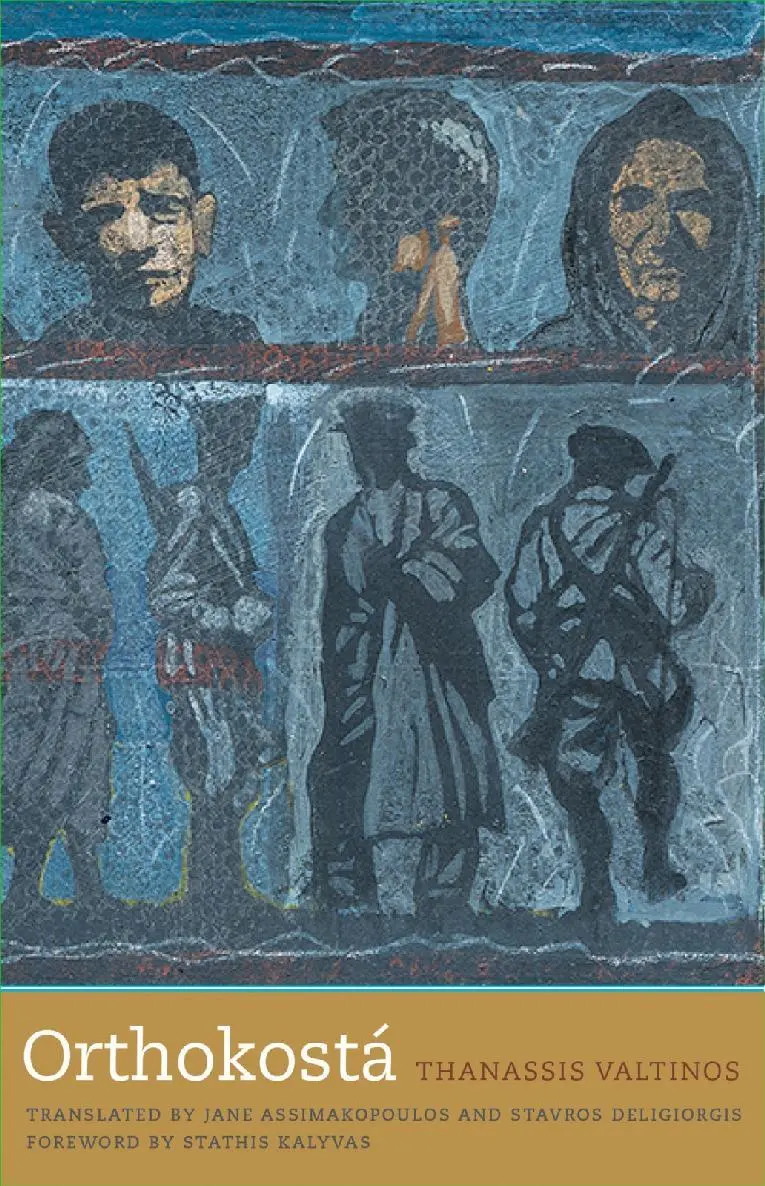
- Название:Orthokostá
- Автор:
- Издательство:Yale University Press
- Жанр:
- Год:2016
- ISBN:нет данных
- Рейтинг книги:5 / 5. Голосов: 1
-
Избранное:Добавить в избранное
- Отзывы:
-
Ваша оценка:
Orthokostá: краткое содержание, описание и аннотация
Предлагаем к чтению аннотацию, описание, краткое содержание или предисловие (зависит от того, что написал сам автор книги «Orthokostá»). Если вы не нашли необходимую информацию о книге — напишите в комментариях, мы постараемся отыскать её.
defied standard interpretations of the Greek Civil War. Through the documentary-style testimonies of multiple narrators, among them the previously unheard voices of right-wing collaborationists, Valtinos provides a powerful, nuanced interpretation of events during the later years of Nazi occupation and the early stages of the nation’s Civil War. His fictionalized chronicle gives participants, victims, and innocent bystanders equal opportunity to bear witness to such events as the burning of Valtinos’s home village, the detention and execution of combatants and civilians in the monastery of Orthokostá, and the revenge killings that ensued.
As a transforming work of literature, this book redefined established methods of fiction; as a work of revisionist history, it changed the way Greece understands its own past. Now, through this masterful translation of
, English-language readers have full access to the tremendous vitality of Valtinos’s work and to the divisive Civil War experiences that continue to echo in Greek politics and events today.
Orthokostá — читать онлайн бесплатно полную книгу (весь текст) целиком
Ниже представлен текст книги, разбитый по страницам. Система сохранения места последней прочитанной страницы, позволяет с удобством читать онлайн бесплатно книгу «Orthokostá», без необходимости каждый раз заново искать на чём Вы остановились. Поставьте закладку, и сможете в любой момент перейти на страницу, на которой закончили чтение.
Интервал:
Закладка:
— What month was it when you arrived in Kastrí?
— April.
— April.
— After the Tsolákoglou capitulation agreement was signed we came here. On April 20, something like that. The twentieth or the twenty-second. I don’t remember. In any case, it was April. I arrived in the village. We came back. I’d served about thirty-nine months since I was drafted. And another six or seven in Albania. I arrived in the village in April. I stayed in the village. I didn’t stay long. I worked here and there. I was working in the Polychronópoulos warehouse. With fertilizers and whatnot. With Sotíris Tsourapélos.
— Where was the warehouse?
— Just above Kasímos’s house. I was working there. One day Níkos Mávros arrives, he takes me downstairs He says, Kapetán Zahariás wants you.
— When was that?
— In ’44. No. It was before the Germans even came to Kastrí. But there were Germans all around.
— You mean in ’43.
— Yes, about then. In ’44 the Germans were there, not in ’43.
— In ’43.
— Yes but in ’44 they came to the village. They set up the blockade.
— Were you here until then?
— I was here.
— When did you join the Battalions?
— I joined in February. No, in March. It was March when the Battalions were formed in Trípolis.
— Yes, I know.
— In March.
— In March of 1944?
— Yes. Níkos Mávros arrives, he takes me with him. Down to Ayía Paraskeví. Kapetán Zahariás was there, with about ten men from Voúrvoura. They were there. He says, I’ll knock your block off. But why, Kapetán? What did I do wrong? Will you become a rebel or not? I tell him, I can’t join. I can’t join the rebels. He says, You’ll join, all right, and you’ll do it gladly too. Or I’ll knock your block off. Well, I tell him. There are eight of us. And two older folks. Ten altogether. I’m working. I’m earning fifty drachmas a day, enough to buy bread. He says, Will you give us bread? I tell him, I have no bread. I have a little wheat at home, I’ll give that to you. And they sent some men and took a truckload of wheat from me. Then Níkos Magoúlis takes me down to Paraskeví’s taverna. It belonged to Níkos Konstantélos back then. Before they killed him. Takes me down to the cellar. To buy me a drink. He says, I’m paying. Okay, Mr. Níkos, I tell him. Don’t call me Mr. Níkos, don’t call me that. Call me Comrade. I tell him, What does that mean? He says, We’re part of the struggle. I ask him, What struggle, Mr. Níkos? — I called him that again. I can’t join the struggle. There are eight children in my family. My father was ill. Back then I was earning sixty drachmas. One thousand eight hundred a month. Driving Galaxýdis’s truck.
— Mihális Galaxýdis’s truck.
— No, Kyriákos’s.
— Mihális’s brother Kyriákos.
— Mihális’s brother.
— They killed him.
— He was killed in Ayiórghis. We were on a raid and he was killed. We brought him back dead to Trípolis. And that’s when Mihális killed Tsígris. Lýras was interrogating him. They heard shots, a German comes running in. What’s going on? Nothing, Some bastard got killed, Lýras said. Lýras was from Karakovoúni, an army captain. And that was that, it was over.
— What was Tsígris?
— He was an officer. An officer in ELAS. We had all agreed in 1943, Tsígris, Vazaíos, and me, and we had gone to Pyramída, just above Ellinikó. When we left Mount Taygetus. I’m talking about 1943 now. When we left there.
— Which of you left?
— Me, Petrákos, Tákis Drínis, and that Mýlis fellow from Karátoula.
— Did you go with Vrettákos?
— We went under the command of Colonel Yiannakópoulos. That rat who sold us out.
— I see.
— He finished us. He’s the one who finished us off.
— When did you go with Yiannakópoulos?
— In 1943.
— What time of year, what month?
— Summertime. Yiannakópoulos was out in the mountains.
— Wait a minute, one thing at a time. You were working here, and Magoúlis took you downstairs.
— Yes.
— Tell me one thing at a time.
— He took me downstairs. We ate.
— And he told you all those things.
— Yes. And I tell him, I can’t. And then I tell him, This meal’s on me, Mr. Níkos. He wouldn’t let me. He paid for everything. I tell him, I won’t go to the mountains, I won’t. He tells me, You won’t go to the mountains, but you’ll help. I say, What help can I be, I’m as good as dead? With a family of ten, I earn sixty drachmas a day. He says, You’ll help us out, and he gave me a note to take to Trípolis. To someone named Nikitópoulos. A cobbler, across from Glinós’s shop. Glinós was a shoemaker. And just across from there Nikitópoulos was working in a basement. I take him the note. The Italians were in Trípolis. So I find him, he cuts open a watermelon, he puts a pistol in it. He says, Take it. I tell him, Where should I take it, I’ll get caught. He says, You’ll take it. And he put it in the watermelon. He had more watermelons. I take a few eggs, and I took them to that bastard Bruno. At the outpost. To that Italian. And I got through.
— The Italians had an outpost?
— Yes, at the train station. And they did searches. I gave the eggs to Bruno, I got through with my car. Pavlákos comes over. Did you bring anything from Trípolis? I say, I brought a watermelon. Oh, I see. I brought the pistol that one time. And after that they were constantly on my back. I say, I’m leaving. Then I went to Kyvéri, on foot. I’d taken some fresh green beans with me, to take to Athens. I got on the train. Some fresh green beans for the black market. I went to Leonídas Vrettákos, the cavalry captain’s brother. I tell him, Here’s what happened. What should we do? So he took us in hand, he gave us a hundred and ten rifles.
— In Athens?
— Yes. Leonídas Vrettákos. Telémahos the cavalry captain’s brother. Rifles to bring to Kastrí.
— Yes.
— We brought them. But Márkos didn’t listen to me. Where did he want to unload them? Down at Vatomourákos’s place, God rest his soul. He says, Let’s take them there. I tell him, What are you saying? What are you talking about, Márkos? That’s how I talked to him. We had loaded some wheat, loose wheat, and we put in the weapons and brought them here. A hundred and ten rifles.
— You brought them to Kastrí?
— And Márkos wanted to unload them at his cousin’s. At Níkos Mávros’s place. I tell him, What are you saying, we can’t do that. I say, I’ll take them. My responsibility. We had him in Ayiliás in a shack. Márkos Ioannítzis. In a shack that belonged to Yiánnis Baskoútos. In Ayiliás. Four or five days later he comes down to Haloúlos’s restaurant. He had invited everyone from EAM there. He pulls out his pistol, he says, Long live the revolution against communism. And bam bam , he fires two shots there in the restaurant. God rest his soul. Kapetán Foúrias, his first cousin Níkos Mávros, gets up and leaves.
— Had you unloaded the weapons?
— At the warehouse. We laid out the rifles. Put loose wheat on top, and in Trípolis the Italian poked around with the iron rod, but what could he find? It would just hit the floor. We took the weapons, we handed them out. Vanghélis Mílis took some, we all took some. Well, all right. Nikólas Petrákis, someone named Sakellaríou, a sergeant major from Vytína. A sergeant major. Yiannakópoulos was done for, he signed the pact with ELAS.
— Did you go to Mount Taygetus?
— We did. We went. And after we went there we split up.
— But you’re not telling me everything. When you left, when and how you left from here. Did you go with Márkos?
Читать дальшеИнтервал:
Закладка:
Похожие книги на «Orthokostá»
Представляем Вашему вниманию похожие книги на «Orthokostá» списком для выбора. Мы отобрали схожую по названию и смыслу литературу в надежде предоставить читателям больше вариантов отыскать новые, интересные, ещё непрочитанные произведения.


Обсуждение, отзывы о книге «Orthokostá» и просто собственные мнения читателей. Оставьте ваши комментарии, напишите, что Вы думаете о произведении, его смысле или главных героях. Укажите что конкретно понравилось, а что нет, и почему Вы так считаете.