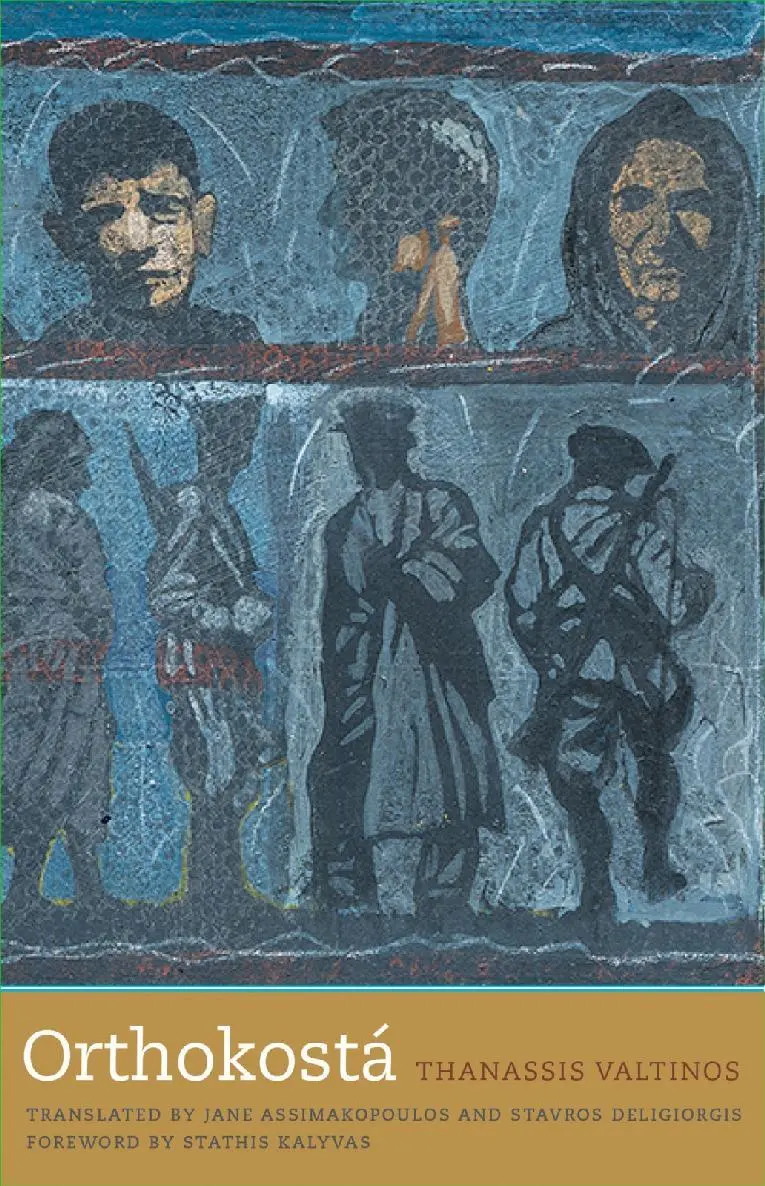
Thanassis Valtinos - Orthokostá
Здесь есть возможность читать онлайн «Thanassis Valtinos - Orthokostá» весь текст электронной книги совершенно бесплатно (целиком полную версию без сокращений). В некоторых случаях можно слушать аудио, скачать через торрент в формате fb2 и присутствует краткое содержание. Год выпуска: 2016, Издательство: Yale University Press, Жанр: Современная проза, на английском языке. Описание произведения, (предисловие) а так же отзывы посетителей доступны на портале библиотеки ЛибКат.
- Название:Orthokostá
- Автор:
- Издательство:Yale University Press
- Жанр:
- Год:2016
- ISBN:нет данных
- Рейтинг книги:5 / 5. Голосов: 1
-
Избранное:Добавить в избранное
- Отзывы:
-
Ваша оценка:
Orthokostá: краткое содержание, описание и аннотация
Предлагаем к чтению аннотацию, описание, краткое содержание или предисловие (зависит от того, что написал сам автор книги «Orthokostá»). Если вы не нашли необходимую информацию о книге — напишите в комментариях, мы постараемся отыскать её.
defied standard interpretations of the Greek Civil War. Through the documentary-style testimonies of multiple narrators, among them the previously unheard voices of right-wing collaborationists, Valtinos provides a powerful, nuanced interpretation of events during the later years of Nazi occupation and the early stages of the nation’s Civil War. His fictionalized chronicle gives participants, victims, and innocent bystanders equal opportunity to bear witness to such events as the burning of Valtinos’s home village, the detention and execution of combatants and civilians in the monastery of Orthokostá, and the revenge killings that ensued.
As a transforming work of literature, this book redefined established methods of fiction; as a work of revisionist history, it changed the way Greece understands its own past. Now, through this masterful translation of
, English-language readers have full access to the tremendous vitality of Valtinos’s work and to the divisive Civil War experiences that continue to echo in Greek politics and events today.
Orthokostá — читать онлайн бесплатно полную книгу (весь текст) целиком
Ниже представлен текст книги, разбитый по страницам. Система сохранения места последней прочитанной страницы, позволяет с удобством читать онлайн бесплатно книгу «Orthokostá», без необходимости каждый раз заново искать на чём Вы остановились. Поставьте закладку, и сможете в любой момент перейти на страницу, на которой закончили чтение.
Интервал:
Закладка:
— Who was there. Do you remember?
— I remember the names. That scoundrel from the islands. A serious criminal. His name was Yiorgópoulos. Not the kapetánios, someone else. Not the kapetánios. And there was that nasty old Tóyias, Vasílis. And that rotten Kíliaris. But he wasn’t there during my ordeal. Tóyias was there. My feet were tied, tied up to the knees, and my hands like this. They burned them with metal nails. They pierced them. The pain was God awful. They sent us away from there. The Germans were coming, and they sent us away. They brought us to Háradros. To the school. They had killed the prefect at Háradros. With a pickax. They broke his shins in front. He died like that. They left him there writhing on the ground. And in one day he died. The village priest went to the rebel chiefs. He said, Please, I beg you. Put a bullet in the poor man. And one of them hits the priest with the back of his hand, knocks his cap off. Shut up, you nasty old priest, or you’ll get the same.
— All this in the school.
— In a ravine farther down. I knew that place. Years later Háyias the lawyer came there with the prefect’s daughter. Antónis. She wanted to exhume her father. She would pay for it. I tell her, If you don’t find someone with broken shins it’s not your father. I don’t know if she found him. I never heard from Antónis again. That’s what happened. They took us to Háradros. They took us to the school. There was a teacher there from Merkovoúni. Dimoyérontas. He’s still alive. Andréas Dimoyérontas. He was a schoolteacher there. After a while they bring down about thirty more prisoners. From our area. That’s when they brought Kapetán Yioúlis, poor man. Old Mímis Mitromáras, from Dolianá. Velissáris tells him, come here, Yioúlis. They would tease him for laughs.
— Yiórghis?
— Yiánnis Velissáris. Why did you kill the rebels in your house? Magoúlis was pacing around in the yard. And Kléarhos Aryiríou. He had a red kerchief, Kléarhos, he had his hat and his shepherd’s crook from Mélana. A staff, not a crook. A shepherd’s staff. And Yiórghis Babakiás was there too. From Dolianá. They were pacing around. Velissáris says, Why did you kill the rebels? Why you jackass, Yioúlis answers. You filthy bastard. Those poor men from Sparta didn’t know what to think. They didn’t know he was half off his rocker. Now you listen here, President, he tells Kléarhos. And he goes over to the wall of the school. Hello. Is this Germany? He starts phoning. Call Hitler for me. The men from Sparta and the other prisoners were scared out of their minds. They’re thinking, Now they’ll kill us all. Listen, Hitler. At the school in Háradros, Kynouría, there are about three hundred of us prisoners. Being held by the greatest bastards on earth, complete jackasses. Please send troops to free us immediately. Was it a stroke of genius, luck, or what, I don’t know. Not half an hour had passed and the Germans arrived. A division had left from Corinth. And they were pressing in on us. Some from Závitsa, others from Dagoúni coming down toward Douminá. They take us away immediately. They take us through the Mántis family storage sheds. They take us to Galtená. Down by Perdikonéri there were a hundred Germans. And because it was dark they didn’t shoot at us. They saw us. They would have killed us all. Kapetán Kléarhos shouts, Quick, the Battalion is coming through. And there were Germans. There were Germans down there.
— And you, how did you walk?
— On my knees. I’d drag myself along. I had a shirt, I folded it and wrapped it in some old rags from the olive press in Háradros. I tied them together. And I’d drag myself along from side to side. On my knees. We came to Galtená. Dimítrios Bíris brings an order from Kapetán Achilléas. From Zisiádis. That no-good Bulgarian. 3
— Zisiádis?
— Yes. He was an engineer at the Agricultural Bank. In Trípolis. The order was to execute the whole detention camp. Both camps. They brought the order at eleven at night. Anyone who can’t keep pace with us, step outside. Then Nikoláou comes over. He says, Iraklís, they’re going to kill us. They had beaten him badly too. On his legs. Mítsos Hasánis comes over. He says, Don’t say you can’t go along. Then I go outside. Kléarhos and I were relatives of sorts, koumbároi. Through Manólis, God rest his soul. Manólis Aryiríou. In 1936, when Kléarhos was out and reporting regularly to the police. Under Metaxás. I had taken care of things for him then. In 1937 I joined the army. And he was still reporting to the police. In Galtená I tell him, Listen, koumbáros.
— Was Kléarhos Manólis’s brother?
— No, his cousin. Kléarhos’s brothers were Kóstas, who they called Kraterós, and Panayótis. Koumbáros, I tell him in Galtená. He tells me, If you can’t walk, have a look at this. He pulls a French double-edged knife on me. He tells me, I’m not wasting any bullets on you. With a silver handle. I have it at home.
— How did you get it?
— He threw it away in Mávri Trýpa. Or he dropped it, I don’t know. I found it. As soon as the order came they sent us to Galtená. They take us to Ayiórghis. In Ayiórghis I was dying of thirst. Stávros Koutsoyiánnis comes over. I say, Old fellow, give me a little water. He gave me a pitcher of wine, and I drank it without realizing it was wine. That’s how parched I was. I didn’t realize what it was. And I went off a way and sat down. And it hit me.
— Was Yiánnis Dránias with you there?
— He was with us. Yiánnis Dránias, Xinós, Hayiázos, and Chrístos Bekáris.
— Which Xinós?
— The one from Eleohóri. He died. And Chrístos Moúntros. He died too.
— Because Dránias doesn’t remember you.
— No, Dránias didn’t come with us. When we went to Eleohóri. When the Germans arrested us. He was in hiding. He stayed behind, and he went into hiding. We gave ourselves up to the Germans. Me and Liás Karzís and another man from Dolianá who works at the hospital now. In the psychiatric ward.
— Were there any women with you, someone named Alíki from Trípolis?
— No, Alíki came later. They had the dye shop, I forget their last name. They had the dye shop down on the way to the barracks, on the right. Next to Kampoúris’s pharmacy. Alíki was going out with my brother Panayótis. She thought he died, and it drove her insane. When they killed the others up there. Panayótis, Themistoklís Anagnostákos, Maraskés, Braílas’s mother. I forget that girl’s last name. The Germans found her, and she was half out of her mind. And she still is, she’s alive and half crazy. She doesn’t understand anything, she doesn’t remember anything.
— Did they take you to Ayiórghis?
— They did. I went to take a leak. They were boiling up beans for the evening. Two rebels get hold of me. Mítsos Nikitákis says to them, Where are you taking him? To take a leak. We’re escorting him. For Chrissakes, you bastards. He tells them, He’s half dead. Can he run away? Go and take a leak, man. I went and took a leak, I came back. They gave out the beans. I threw them out, they were full of flies. So we start out from there. In the afternoon. They take us along a road with rocks all around. They had the village alderman of Mýloi up on a mule. He was wearing a leather jacket with no sleeves. With his legs hanging down, they’d given him quite a beating. But the mule wouldn’t go forward. Fotópoulos’s daughter Thýmia from Roúvali was pulling it along, Yiánnis Kaliakoúdis’s mother. Poor woman had been pressed into service. She says, Kapetán Kléarhos, the mule won’t go forward. Carry out my orders, then send the mule back. Vasílis Skáros from Stólos shoots him with his rifle. My cousin.
— Were you there?
Читать дальшеИнтервал:
Закладка:
Похожие книги на «Orthokostá»
Представляем Вашему вниманию похожие книги на «Orthokostá» списком для выбора. Мы отобрали схожую по названию и смыслу литературу в надежде предоставить читателям больше вариантов отыскать новые, интересные, ещё непрочитанные произведения.


Обсуждение, отзывы о книге «Orthokostá» и просто собственные мнения читателей. Оставьте ваши комментарии, напишите, что Вы думаете о произведении, его смысле или главных героях. Укажите что конкретно понравилось, а что нет, и почему Вы так считаете.