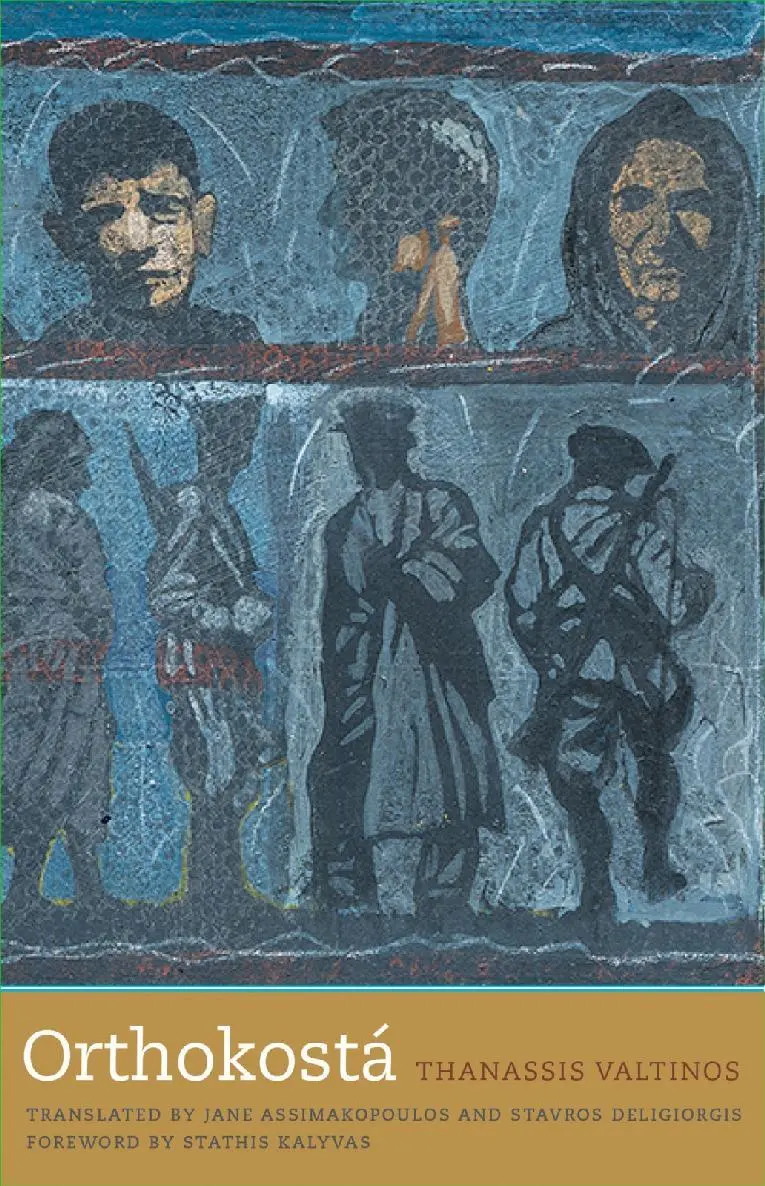
Thanassis Valtinos - Orthokostá
Здесь есть возможность читать онлайн «Thanassis Valtinos - Orthokostá» весь текст электронной книги совершенно бесплатно (целиком полную версию без сокращений). В некоторых случаях можно слушать аудио, скачать через торрент в формате fb2 и присутствует краткое содержание. Год выпуска: 2016, Издательство: Yale University Press, Жанр: Современная проза, на английском языке. Описание произведения, (предисловие) а так же отзывы посетителей доступны на портале библиотеки ЛибКат.
- Название:Orthokostá
- Автор:
- Издательство:Yale University Press
- Жанр:
- Год:2016
- ISBN:нет данных
- Рейтинг книги:5 / 5. Голосов: 1
-
Избранное:Добавить в избранное
- Отзывы:
-
Ваша оценка:
Orthokostá: краткое содержание, описание и аннотация
Предлагаем к чтению аннотацию, описание, краткое содержание или предисловие (зависит от того, что написал сам автор книги «Orthokostá»). Если вы не нашли необходимую информацию о книге — напишите в комментариях, мы постараемся отыскать её.
defied standard interpretations of the Greek Civil War. Through the documentary-style testimonies of multiple narrators, among them the previously unheard voices of right-wing collaborationists, Valtinos provides a powerful, nuanced interpretation of events during the later years of Nazi occupation and the early stages of the nation’s Civil War. His fictionalized chronicle gives participants, victims, and innocent bystanders equal opportunity to bear witness to such events as the burning of Valtinos’s home village, the detention and execution of combatants and civilians in the monastery of Orthokostá, and the revenge killings that ensued.
As a transforming work of literature, this book redefined established methods of fiction; as a work of revisionist history, it changed the way Greece understands its own past. Now, through this masterful translation of
, English-language readers have full access to the tremendous vitality of Valtinos’s work and to the divisive Civil War experiences that continue to echo in Greek politics and events today.
Orthokostá — читать онлайн бесплатно полную книгу (весь текст) целиком
Ниже представлен текст книги, разбитый по страницам. Система сохранения места последней прочитанной страницы, позволяет с удобством читать онлайн бесплатно книгу «Orthokostá», без необходимости каждый раз заново искать на чём Вы остановились. Поставьте закладку, и сможете в любой момент перейти на страницу, на которой закончили чтение.
Интервал:
Закладка:
— I was, right there. He fired his rifle at him, hit him up high. The village alderman fell down dead, down among those rocks. Kostákis Mémos. And he went and pulled off his leather jacket and wore it himself. He took it off that same minute, the man hadn’t even started bleeding. He must still have it, that bastard. I tell him, Listen, Vasílis. Because he realized the Germans were coming. Listen, Vasílis, let’s hide here in Neraïdoráhi. He tells me, Keep going. Keep going, God damn you, or the same will happen to you. And I kept going. We reached Mávri Trýpa. As soon as we got there — Nikoláou, they brought Nikólas over. He was also on a mule. He starts crying. This is the end, Iraklís. Listen, Nikólas, I tell him, they’re going to kill us, what else would they do? It was getting dark out. Then I see a German with an automatic rifle. He was coming from the road, from the brambles, from the river of Eleohóri. In the blink of an eye, before we could say boo, there were three hundred flares in the sky. It was dark now. I shout, We’re prisoners. When I was in school I knew a little French. I remembered the word prisonnier which means “prisoner” in French. I start shouting: Prisonnier of Partisán. Then Kostoúros who runs the Hotel Boúrtzi starts talking, and someone named Grammatikákis from Sparta. In German. The Germans say, Put your hands up. And we surrendered on the spot. They took us to Eleohóri. Dránias didn’t come with us. Yiánnis went and hid. And then they took us to Trípolis. As soon as my feet healed, I went and found Konstantakópoulos. And they gave me that pistol. With one bullet. Konstantakópoulos or Tsékeris, from Kalamáta. The head of X. They gave me that gun, they didn’t have anything else. Then Kapetán Mahaíras comes down from the village of Stríngos. He comes down to Trípolis. He had to make two hundred identity cards for the Germans. Rebel ID cards. The Germans had their headquarters at the Hotel Semirámis.
— Was Mahaíras a rebel?
— A rebel. A kapetánios.
— And he wanted to make fake IDs?
— To get them approved. So they could come down. But I caught on to him.
— Vanghélis Mahaíras the lawyer?
— No, Mahaíras is dead. He died. Kapetán Mahaíras. Vanghélis was from Bertsová. The other man was from Stríngos. A kapetánios. Mahaíras was his code name. Just like our Kapetán Foúrias. I arrest him down at the Palládio. There was once a gas station there, belonged to Zoúzoulas. So I find him there. I recognize him. I arrest him, I was ready to kill him of course.
— And he left.
— He didn’t leave. I had one bullet, I fired it, it didn’t go off. I shout, Shoot him, to Konstantakópoulos. They start chasing him, he goes into Papadákos’s pharmacy. In the back, where the National Bank is now. It was a basement.
— Yes.
— So he hides in there, they went and killed him. And they found the identity cards on him.
— Did you know him?
— I knew him. He was in the detention camp with us. A kapetánios.
— I see.
— And when I saw him in Trípolis I almost fell over. A big hulk of a man. I grab him, I couldn’t hold onto him. He gets away from me. I could hardly stand — could barely stand on my feet. Mímis Athanasiádis had given me a pair of sandals, with holes. With rubber underneath. I couldn’t wear anything else.
— What time of year was it then, April?
— Not April. Almost March. And in March, on March 15, the Battalions were formed. I went and joined up. I found Yiánnis Theodorélos. And Koïtsános. And someone called Batíris, last name Yiannoulópoulos. And we went around together, we had our little group.
— Theodorélos from Trípolis?
— A native of Leonídio. They had killed all his brothers. All of them. Yiánnis Theodorélos. He’s alive today, he married a woman from Dolianá. His house was burned down, he was from Leonídio. Those men were always on the run. We had our little group and we trusted each other. And we still do. I arrest someone called Kapetán Trákas from Tsipianá. At Kambás’s factory. In the plains of Miliá. They’d gone to sleep drunk. Him, someone named Kókkinos, and another man from Tsipianá. The three of them. Some old lady told me about them.
— Were they armed?
— They were armed. When I see him, that Trákas tells me, Do you have my gun? I tell him, I have it, you son of a bitch. Kapetán Yiórghis Trákas. A handsome fellow, he’s back and forth to America now. He lives in Tsipianá and he has land in Spiliá. He’s bought lots of land.
— But you captured them then.
— We captured them. I hit the ground. I couldn’t alert my men.
— Were there other rebels there?
— No. My men were spread out, I couldn’t call them. There was a pear tree and they’d had so much ouzo they were out cold. An old woman tells me, Look down there, boy, there are the rebels. Where? I ask her. Down there, in that ditch. Go and hide. I tell her, What are you talking about? Well, I couldn’t call out. And as they lay there asleep, I go up quietly with my knife and cut the strap of the automatic rifle. He had a German Steyr, Kapetán Trákas. I take it, I take the other man’s gun too. I start kicking them. Kicking them so they’ll wake up. That’s how drunk they were. We brought them to Trípolis tied up. All tied up. And Trákas kept telling me, Please save me and you’ll see how grateful I’ll be. I got him off. And I had him with me after that. And we were friends from then on. The other one, Kókkinos, was a die-hard Communist. But somehow he got off too, he made it up until the Liberation. And he was court-martialed later on. Behrákis was the judge. Same judge who pronounced about Kraterós, Velissáris, and the rest. Behrákis. And Yiórghis Stasinópoulos. Military judges. There was no chance they’d give them anything but the death penalty. No reason not to. And he wouldn’t have gotten off leniently, he had too much against him. But he didn’t say a word. I gambled, Your Honor, and I lost. Now I have to pay. That’s all. And we went on from there. And on the fifteenth, no the twelfth of October, when the Germans left, they sent me to Spétses. Toward the end.
— Of October.
— Yes.
— When did they arrest Panayótis?
— In May or in June. I don’t remember. They arrested him because of me. Because I was active in the Battalions. And on July 29 they killed him. I told you that before.
— Who found him?
— I did. I went up there. Found him dead. We put him up on the mule, in some sacks. And we brought him back.
— Who sent word to you?
— We were there. We’d been on a raid. We’d come out on the top side of Ayiánnis. We were walking up ahead. Six or seven of us. We sat down near a ravine, we had a smoke. I drank some water.
— At night?
— At night. I drank some water, I had some pills the Germans had given us for thirst. We started off. We went up there. A young shepherd tells us, They just killed six men. Right there. We had heard the rifle shots. Hey, I tell him, where was that? In the ravine. In Tóurkos. Across from Ayios Vasíleios.
— Were you in Ayios Vasíleios?
— No, we were going through Ayiánnis.
— And where did you go?
— We got as far as Karyés, just outside.
— Just outside Karyés.
— Karyés. At the monastery. At Ayios Nikólaos. We go there, we find the well. Here’s where they had them, he tells us.
— At the monastery?
— No. Some ways from there. An hour away. Near the mountains of Toúrkos. If we hadn’t stopped for a smoke we would have got there when they were still alive. That’s how unlucky I was. So we went up there. The shepherd tells us, There, in the ravine. We go down to the ravine, on the left side, nothing. We keep going on the other side. And we find them right where the ravine ends and branches out. Dead.
Читать дальшеИнтервал:
Закладка:
Похожие книги на «Orthokostá»
Представляем Вашему вниманию похожие книги на «Orthokostá» списком для выбора. Мы отобрали схожую по названию и смыслу литературу в надежде предоставить читателям больше вариантов отыскать новые, интересные, ещё непрочитанные произведения.


Обсуждение, отзывы о книге «Orthokostá» и просто собственные мнения читателей. Оставьте ваши комментарии, напишите, что Вы думаете о произведении, его смысле или главных героях. Укажите что конкретно понравилось, а что нет, и почему Вы так считаете.