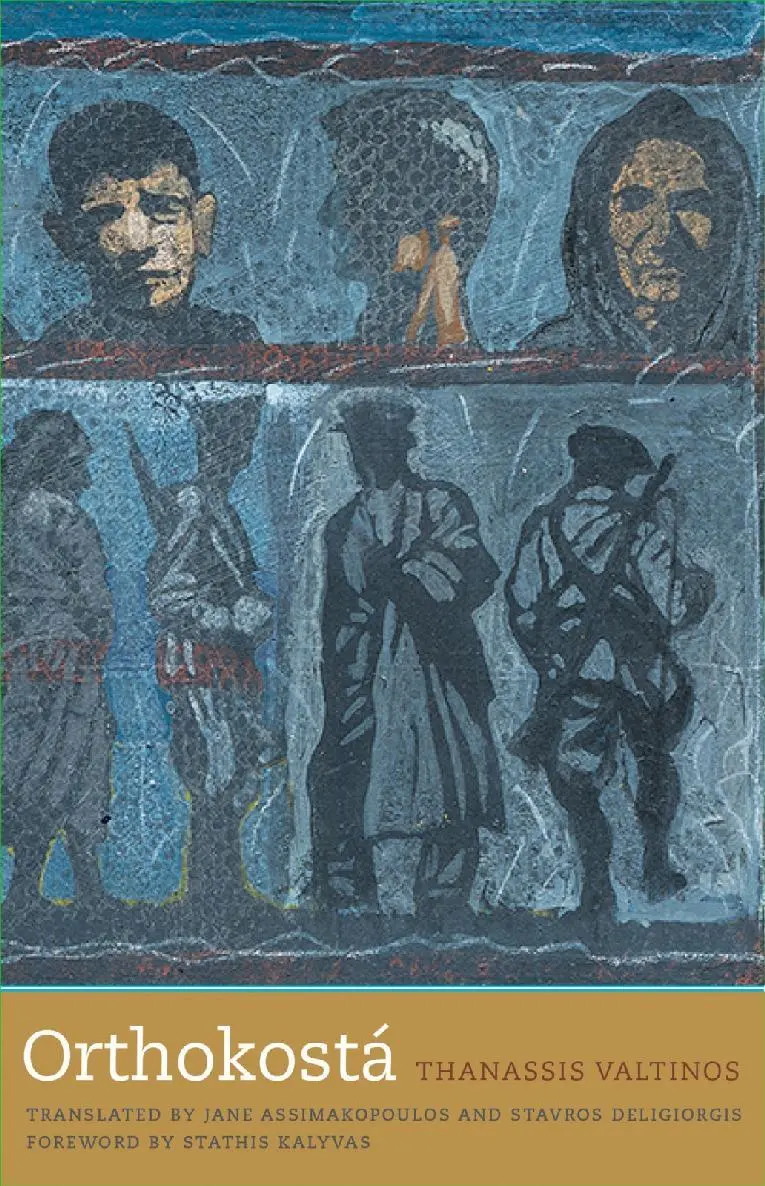
Thanassis Valtinos - Orthokostá
Здесь есть возможность читать онлайн «Thanassis Valtinos - Orthokostá» весь текст электронной книги совершенно бесплатно (целиком полную версию без сокращений). В некоторых случаях можно слушать аудио, скачать через торрент в формате fb2 и присутствует краткое содержание. Год выпуска: 2016, Издательство: Yale University Press, Жанр: Современная проза, на английском языке. Описание произведения, (предисловие) а так же отзывы посетителей доступны на портале библиотеки ЛибКат.
- Название:Orthokostá
- Автор:
- Издательство:Yale University Press
- Жанр:
- Год:2016
- ISBN:нет данных
- Рейтинг книги:5 / 5. Голосов: 1
-
Избранное:Добавить в избранное
- Отзывы:
-
Ваша оценка:
Orthokostá: краткое содержание, описание и аннотация
Предлагаем к чтению аннотацию, описание, краткое содержание или предисловие (зависит от того, что написал сам автор книги «Orthokostá»). Если вы не нашли необходимую информацию о книге — напишите в комментариях, мы постараемся отыскать её.
defied standard interpretations of the Greek Civil War. Through the documentary-style testimonies of multiple narrators, among them the previously unheard voices of right-wing collaborationists, Valtinos provides a powerful, nuanced interpretation of events during the later years of Nazi occupation and the early stages of the nation’s Civil War. His fictionalized chronicle gives participants, victims, and innocent bystanders equal opportunity to bear witness to such events as the burning of Valtinos’s home village, the detention and execution of combatants and civilians in the monastery of Orthokostá, and the revenge killings that ensued.
As a transforming work of literature, this book redefined established methods of fiction; as a work of revisionist history, it changed the way Greece understands its own past. Now, through this masterful translation of
, English-language readers have full access to the tremendous vitality of Valtinos’s work and to the divisive Civil War experiences that continue to echo in Greek politics and events today.
Orthokostá — читать онлайн бесплатно полную книгу (весь текст) целиком
Ниже представлен текст книги, разбитый по страницам. Система сохранения места последней прочитанной страницы, позволяет с удобством читать онлайн бесплатно книгу «Orthokostá», без необходимости каждый раз заново искать на чём Вы остановились. Поставьте закладку, и сможете в любой момент перейти на страницу, на которой закончили чтение.
Интервал:
Закладка:
Our priority was to maintain throughout a balance between the nonstandard or village Greek in most of the narratives of Orthokostá and the equivalent constructions in American English. To this end we have flavored our translation with the occasional recognizably rural but not markedly regional expression meant to transpose some of the more common village speaking patterns of the Greek. At the same time we have been careful not to make the villagers in Orthokostá sound too much like their Midwestern American counterparts, as they must first and foremost come across to the English-speaking reader as Greek villagers living in Greece.
Valtinos has endeavored to approximate through his punctuation (and frequent, deliberate omission of it) the natural spontaneity of oral speech in Modern Greek. His villagers communicate, for the most part, in short, choppy, sometimes ungrammatical sentences, often interrupting themselves midstream and picking up later on. Like most oral speech, theirs is a mixture of the historical present and the past tense, rendered with great brio and virtuosity in the original. We have tried in our translation to reproduce the effects of Valtinos’s prose by adhering as closely as possible to the tense structure and punctuation of the original so as to best reflect its spontaneity within the limits of contemporary English usage.
We have annotated our translation in the minimalist spirit of the novel’s author by providing the basic historical data an educated Greek reader would have brought to the book when it first came out in 1994, some fifty years after the events being described. We have also provided the essential backdrop a nonnative Greek reader of the book today would need to make sense of the narratives. This too has been kept to a minimum: too much information would be tantamount to analyzing the individual dots in a pointillist painting whose size, shape, and color are unimportant in and of themselves. It is rather their concentration and distribution that create the overall effect of an impressionist canvas, which is, properly speaking, the aim of Orthokostá , and indeed of Valtinos’s work in general. To simply index the realist texture of the novel by including excessive biographical or sociopolitical background in the notes would instantly lower the entire work to the status of a poorly researched chronicle. This would be a disservice to the literary dimension of the book and its primary goal of representing the spontaneity and alternating modes of the original accounts: the transcriptions from the Greek killing fields.
NOTES
“Prologue”
1.
Mount Malevós: Another name for Mount Parnon in the southeastern Peloponnese. Much of the action in the book centers on this densely wooded region. During World War II it became a refuge for the Communist Resistance fighters as well as a place where anti-Communist civilians were held hostage.
2.
Ninth-day Feast of the Dormition of the Virgin: Like many Greek monasteries, Orthokostá, though dedicated to the Dormition of the Virgin, which is nationally celebrated on August 15, performs its most solemn festivities, or Apódosis, on August 23, nine days later.
3.
Tsakoniá: Area in the southeastern Peloponnese made up of villages such as Sítaina, Prastós, and Leonídio, in which Tsakónikan, a descendant of Doric Greek, was spoken as late as the 1970s.
Chapter 1
1.
Vigla: A place name referring to a watchtower (from the Latin
vigila
) in the village of Másklina; it was probably built between 1205 and 1432 in the Frankish-occupied Peloponnese.
2.
Lioú: The wife of Liás (in this case Liás Tsioúlos). In the provinces masculine first names are often used in their possessive form to denote a man’s wife or mother.
Chapter 2
1.
Ayiasofiá: Local pronunciation of Ayía Sofía (Saint Sophia), a village in the Arcadia prefecture.
2.
Másklina (also known as Eleohóri): A village near the border between the Arcadia and Argolis prefectures. German troops were stationed there at the time the novel takes place.
3.
Velissaróyiannis: A local variant for the name Yiánnis Velissáris. This type of construction, where the first and last names are compounded in reverse order, is typical of speech in the provinces, particularly the Peloponnese. Similar constructions include, in this chapter, Kalabakóyiannis for Yiánnis Kalabákas; Stavróyiannis for Yiánnis Stávrou (
chap. 6
); Mavroyiórghis for Yiórgos Mávros (
chap. 7
); Mavróyiannis for Yiánnis Mávros (
chap. 36
); and Havdotóyiannis for Yiánnis Havdótos (
chap. 36
).
4.
Ayiopétro: Local way of referring to Ayios Pétros (Saint Peter), a village on Mount Parnon, in the Arcadia prefecture, and the site of detention camps and fierce battles between rebel forces and gendarmes.
5.
The Organization: The Communist Party.
6.
“We’ll cut off your hair”: The Communist guerrillas used to cut off the hair of “enemies” to make it difficult for them to hide among the general population.
7.
Antídoron
: A bite-size piece of bread that has been hallowed during a Greek Orthodox mass and is left over from the sacrament of Holy Communion. The officiating priest hands out these morsels to the parishioners as they exit the church.
8.
Security Battalions: Initially named the Evzones Guard of the Unknown Soldier, the Security Battalions were formed in 1943 by official decree, ostensibly to maintain peace in the Greek countryside. The Battalions were armed by and fought alongside the German Occupation troops, suppressing Communist as well as non-Communist insurgents.
9.
Kapetánios, Kapetán (voc.): The equivalent of a captain in the Communist Resistance army.
Chapter 3
1.
Kapetanaíoi: Plural of
kapetánios
.
2.
Albania: References to “Albania” by speakers in the novel stand for the campaign of the Greek Army between October 1940 and May 1941 in northwestern Greece and southern Albania to stop fascist Italy from invading Greece. Óhi (No!) Day, October 28, is the annual commemoration of the start of that victorious campaign.
Chapter 4
1.
ELAS: Ελληνικός Λαϊκός Απελευθερωτικός Στρατός (Greek Popular Liberation Army), founded on February 16, 1942, as a special branch of the Communist EAM (Εθνικό Απελευθερωτικό Μέτωπο, the National Liberation Front). Founded on September 27, 1941, EAM was the military arm of the Communist Party, created to resist the Occupation during World War II.
2.
Dionýsius Papadóngonas (1888–1944): A politically conservative major general in charge of the Security Battalions in the Peloponnese.
3.
Prophítis Ilías: A hill in northern Greece near the Albanian border named after the prophet Elijah and made famous during the 1940–41 Greco-Italian war. The battle that took place there on November 2, 1940, marked the first victory of the Greek Army against the onslaught of two Italian mountain divisions that had recently invaded Greek territory.
4.
George Tsolákoglou (1886–1948): A general in the Greek Army who signed the armistice agreement in which Greece capitulated to the German and Italian forces in April 1941. Pressed into assuming the premiership of Greece, Tsolákoglou appointed Major General George Bákos (1892–1945) minister of military affairs.
5.
Aris Velouhiótis (1905–1945): Born Thanásis Kláras, he was the leader of the ELAS forces during the Occupation.
6.
KKE: The Greek Communist Party (Κομμουνιστικό Κόμμα Ελλάδας), founded in 1918.
Читать дальшеИнтервал:
Закладка:
Похожие книги на «Orthokostá»
Представляем Вашему вниманию похожие книги на «Orthokostá» списком для выбора. Мы отобрали схожую по названию и смыслу литературу в надежде предоставить читателям больше вариантов отыскать новые, интересные, ещё непрочитанные произведения.

Обсуждение, отзывы о книге «Orthokostá» и просто собственные мнения читателей. Оставьте ваши комментарии, напишите, что Вы думаете о произведении, его смысле или главных героях. Укажите что конкретно понравилось, а что нет, и почему Вы так считаете.