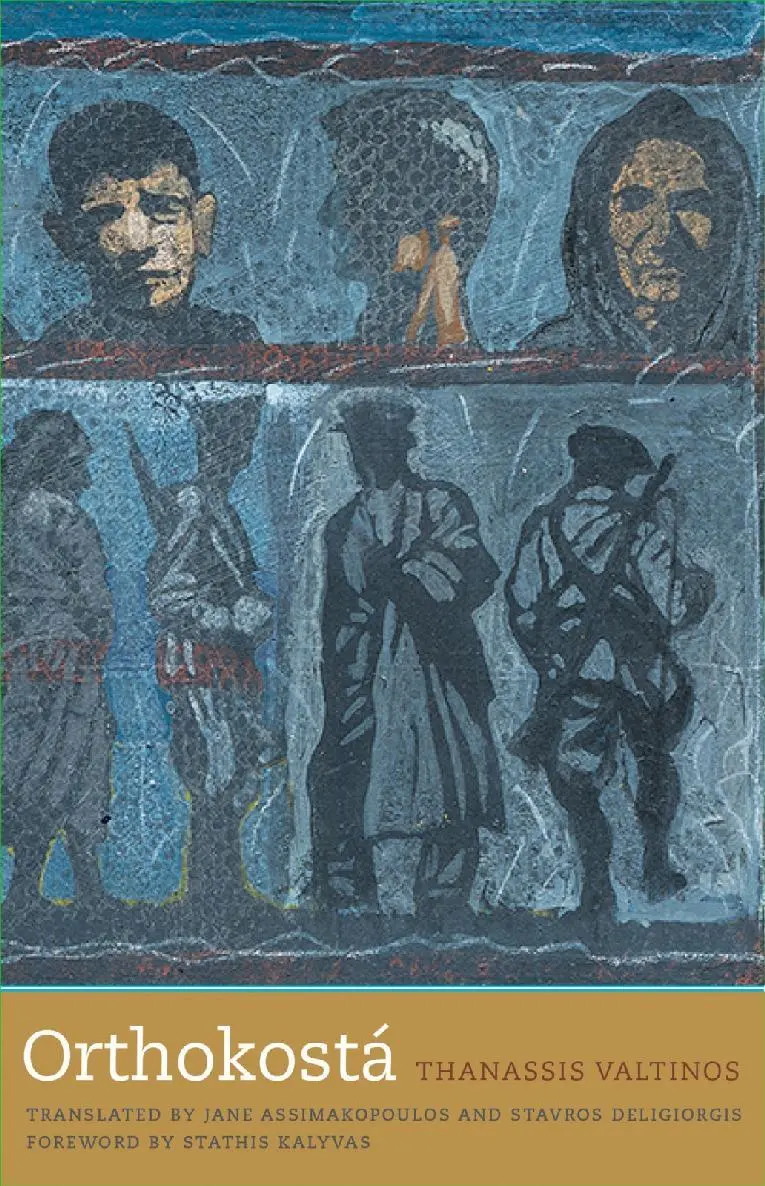
Thanassis Valtinos - Orthokostá
Здесь есть возможность читать онлайн «Thanassis Valtinos - Orthokostá» весь текст электронной книги совершенно бесплатно (целиком полную версию без сокращений). В некоторых случаях можно слушать аудио, скачать через торрент в формате fb2 и присутствует краткое содержание. Год выпуска: 2016, Издательство: Yale University Press, Жанр: Современная проза, на английском языке. Описание произведения, (предисловие) а так же отзывы посетителей доступны на портале библиотеки ЛибКат.
- Название:Orthokostá
- Автор:
- Издательство:Yale University Press
- Жанр:
- Год:2016
- ISBN:нет данных
- Рейтинг книги:5 / 5. Голосов: 1
-
Избранное:Добавить в избранное
- Отзывы:
-
Ваша оценка:
Orthokostá: краткое содержание, описание и аннотация
Предлагаем к чтению аннотацию, описание, краткое содержание или предисловие (зависит от того, что написал сам автор книги «Orthokostá»). Если вы не нашли необходимую информацию о книге — напишите в комментариях, мы постараемся отыскать её.
defied standard interpretations of the Greek Civil War. Through the documentary-style testimonies of multiple narrators, among them the previously unheard voices of right-wing collaborationists, Valtinos provides a powerful, nuanced interpretation of events during the later years of Nazi occupation and the early stages of the nation’s Civil War. His fictionalized chronicle gives participants, victims, and innocent bystanders equal opportunity to bear witness to such events as the burning of Valtinos’s home village, the detention and execution of combatants and civilians in the monastery of Orthokostá, and the revenge killings that ensued.
As a transforming work of literature, this book redefined established methods of fiction; as a work of revisionist history, it changed the way Greece understands its own past. Now, through this masterful translation of
, English-language readers have full access to the tremendous vitality of Valtinos’s work and to the divisive Civil War experiences that continue to echo in Greek politics and events today.
Orthokostá — читать онлайн бесплатно полную книгу (весь текст) целиком
Ниже представлен текст книги, разбитый по страницам. Система сохранения места последней прочитанной страницы, позволяет с удобством читать онлайн бесплатно книгу «Orthokostá», без необходимости каждый раз заново искать на чём Вы остановились. Поставьте закладку, и сможете в любой момент перейти на страницу, на которой закончили чтение.
Интервал:
Закладка:
7.
Várkiza Treaty: On February 12, 1945, representatives of the Nikólaos Plastíras government and EAM-ELAS representatives of the Communist Party of Greece met in the coastal town of Várkiza, south of Athens, and signed a nine-point agreement, chief among which was the disarming of the EAM-ELAS guerrillas and their withdrawal from the cities of Athens and Thessaloníki.
8.
Antónis Katsantónis (1785–1808): A legendary guerrilla leader who fought against Turkish occupation of prerevolutionary Greece.
9.
Grigóris Soúrlas: The organizer of armed anti-Communist farmer bands in central Greece during the Civil War.
10.
Plebiscite: On September 1, 1946, the government of Constantine Tsaldáris conducted a plebiscite to determine whether King George II, who had left Greece during the Occupation, could be reinstated to the throne of Greece; 69 percent of the voters favored the restoration.
11.
Litóchoro and Pontokerasiá: On March 30, 1946, thirty-three leftists attacked a gendarmes station in the town of Litóchoro in the prefecture of Piería. On June 5 another group attacked a Greek Army company in the town of Pontokerasiá in Kilkís. These two incidents are generally considered the beginning of the Greek Civil War.
12.
Haroúlis: Diminutive of Harís.
13.
Napoléon Zérvas (1891–1957): A retired lieutenant colonel and the founder in September 1941 of the right-wing Resistance group EDES (Εθνικός Δημοκρατικός Ελληνικός Σύνδεσμος, Greek National Democratic Union), committed to fighting against German, Italian. and Bulgarian Occupation forces. An anti-Communist, Zérvas openly accused EAM-ELAS of striving to impose a Soviet-style government in Greece following the end of the Occupation.
14.
Athanásios Yiannakópoulos: An infantry colonel who, along with army officers Telémahos Vrettákos, Panayótis Katsaréas, and Stámos Triantafýllis, formed a Resistance group that eventually ceded power to ELAS; an agreement to this effect was signed by Yiannakópoulos.
15.
SMA: Στρατηγείο Μέσης Ανατολής, the Near East Command Headquarters, which was established in Cairo, Egypt, by the British Expeditionary Forces under Colonels Eddie Myers and Christopher Woodhouse. Their liaisons in Greece pressured right-wing Resistance groups into submitting to mostly leftist ELAS leadership.
16.
Metaxourgheío: A poor neighborhood in south-central Athens.
17.
OPLA: Οργάνωση Προστασίας Λαϊκών Αγωνιστών (Organization to Protect People’s Fighters). The OPLA operatives, commissioned in late spring 1943 and active until 1947, were charged with the protection of KKE members and the extermination of suspected anti-Communists and their relatives.
Chapter 5
1.
Voúlis: Short form of Paraskevoúlis, the diminutive of Paraskevás.
Chapter 6
1.
“He saw her as a bride”: Dreaming of a bride is considered a bad omen in Greek folklore.
2.
Panayótis Stoúpas (1894–1944): Army major and commander of anti-Communist Security Battalion units.
3.
Ayiórghis: Local way of referring to the village of Ayios Yiórghios (Saint George) in the Argolis prefecture.
4.
Gaïdoúras: Nickname derived from
gaïdoúra
, a she-donkey, a jenny.
5.
Koumbároi
: Plural of
koumbáros
(m.) or
koumbára
(f.), a person one has close ties with by having been mutual best men or maids of honor at each other’s weddings;
koumbároi
also denotes people who were godparents at each other’s children’s christenings.
Chapter 7
1.
Ioánnis Metaxás (1871–1941): A lieutenant general in the Greek Army who was appointed premier of Greece in 1936, and soon assumed wider dictatorial powers, which brought about strong popular opposition. He is best remembered for the efficient preparation of Greek land defenses and for rejecting Italy’s ultimatum on October 28, 1940.
2.
Konstantinos Maniadákis (1893–1973): Chief of the State Security Police under Ioánnis Metaxás.
3.
Castor oil: Castor oil was used to torture prisoners; it causes diarrhea and rapid dehydration.
4.
Sokrátaina: In local parlance, the wife of Sokrátis. Similar constructions where the suffix “-aina” is added to the root of a masculine name to denote a female relative are typical in the provinces. See also in this chapter Mavroyiórgaina (the wife of Mavroyiórghis) and Mákraina (a female member of the Makrís family), and Kóstaina (the wife of Kóstas) in
chapter 11
.
5.
Yiórghis: A variant of the common first name Yiórgos.
6.
Petroú: The wife of Pétros (Pétros Tatoúlis, father of Mihális).
7.
Saint Paraskeví: A widely venerated second-century martyr and saint of the Greek Orthodox Church. Numerous locations, urban and rural, are named after her. Her feast is celebrated on July 28.
8.
Ayiánnis: Local variant for Ayios Yiánnis (Saint John), a village in the Argolis prefecture. “Apáno” designates a community built on a higher elevation than the village.
9.
The Feast of the Virgin: A religious and national holiday celebrated on August 15 and preceded by a fifteen-day fast.
10.
Mýloi: District on the western outskirts of Athens whose name suggests industrial grain mills.
11.
Léla Karayiánnis (1898–1944): Leader of a resistance movement who as early as 1941 and until her arrest and execution ran a network of anti-Axis saboteurs. She is also commemorated in Israel as one of the Righteous Among the Nations.
12.
Kifisiá: Verdant, posh suburb north of Athens.
13.
Saltadórissa
: From the Italian verb
saltare
, “to leap”: typically an agile teenager who leaped on the backs of occupation supply trucks and emptied them of their contents.
Chapter 8
1.
“Like a tax”: The owners of an olive press usually withheld one-tenth of any amount of oil it pressed as a fee for the pressing. This payment in kind allowed the press owners to accumulate quantities of oil they could use to speculate, buy property, bribe officials, and so on.
Chapter 9
1.
Certificates of “Recognition”: In 1982 the Greek government offered pensions to tens of thousands of persons who claimed they had fought against the German, Italian, and Bulgarian occupation armies during World War II.
2.
The December Uprising: Known in Greek as Τα Δεκεμβριανά, the term refers to the period between December 1944 and January 1945 during which EAM-ELAS Resistance fighters, on one side, and the British-backed Greek Army, metropolitan police, gendarmes, and the royalist “X” faction on the other, engaged in street fighting in Athens and Piraeus, with thousands of combatant and noncombatant casualties.
3.
Mýloi: A seaside town in the Argolis prefecture, not to be confused with the district in Athens.
4.
X: A royalist-backed military organization founded in June 1941 by Colonel George Grívas of the Greek Army. Its name was changed to X, the Greek chi (pronounced “hee”) in March 1943. The new name was emblematized by the crossing of two Greek capital gammas, one standing for King George II of Greece and one for Grívas himself. Those wearing the X insignia on their berets or armbands were called Heétes.
5.
The Feast of Saint Ilías: Celebration for the prophet Elijah (“Ilías” in Greek) held on July 20. Early in the history of Eastern Christianity Elijah, from the book of Kings in the Hebrew Bible, was proclaimed the patron saint of mountaintops and venerated in small churches, often erected on the foundations of former shrines to Zeus.
Читать дальшеИнтервал:
Закладка:
Похожие книги на «Orthokostá»
Представляем Вашему вниманию похожие книги на «Orthokostá» списком для выбора. Мы отобрали схожую по названию и смыслу литературу в надежде предоставить читателям больше вариантов отыскать новые, интересные, ещё непрочитанные произведения.


Обсуждение, отзывы о книге «Orthokostá» и просто собственные мнения читателей. Оставьте ваши комментарии, напишите, что Вы думаете о произведении, его смысле или главных героях. Укажите что конкретно понравилось, а что нет, и почему Вы так считаете.