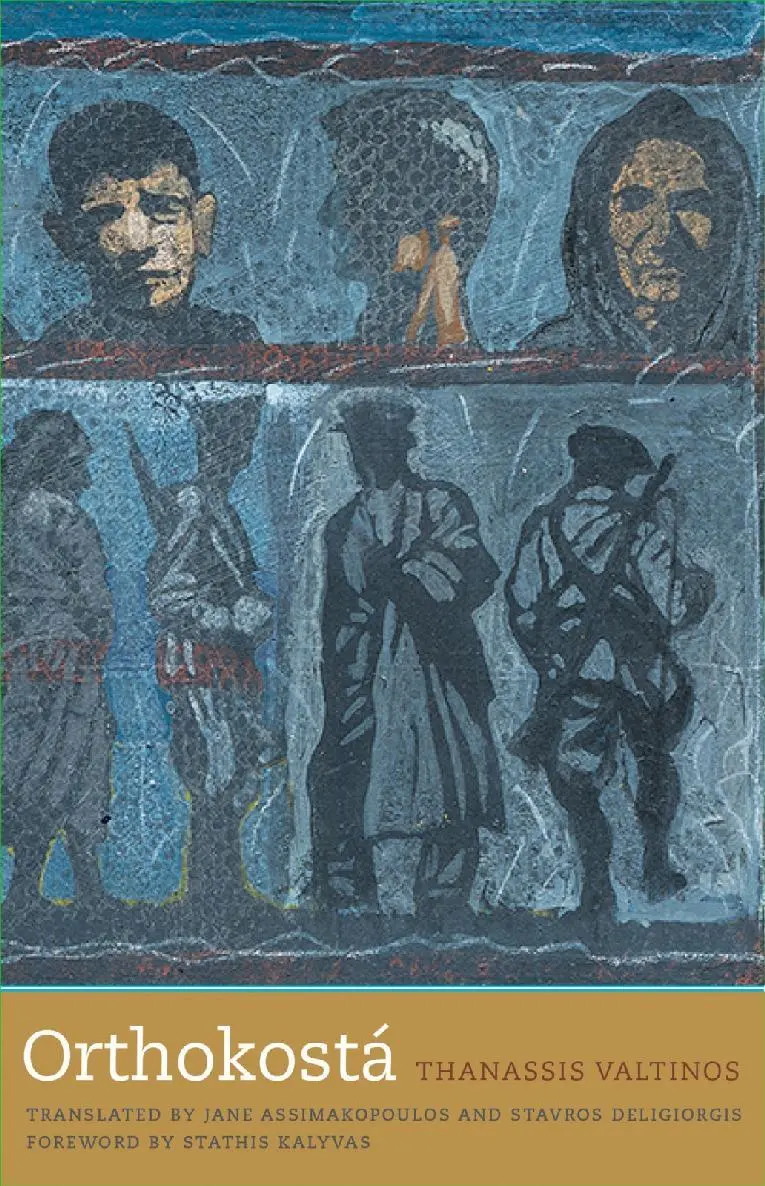
Thanassis Valtinos - Orthokostá
Здесь есть возможность читать онлайн «Thanassis Valtinos - Orthokostá» весь текст электронной книги совершенно бесплатно (целиком полную версию без сокращений). В некоторых случаях можно слушать аудио, скачать через торрент в формате fb2 и присутствует краткое содержание. Год выпуска: 2016, Издательство: Yale University Press, Жанр: Современная проза, на английском языке. Описание произведения, (предисловие) а так же отзывы посетителей доступны на портале библиотеки ЛибКат.
- Название:Orthokostá
- Автор:
- Издательство:Yale University Press
- Жанр:
- Год:2016
- ISBN:нет данных
- Рейтинг книги:5 / 5. Голосов: 1
-
Избранное:Добавить в избранное
- Отзывы:
-
Ваша оценка:
Orthokostá: краткое содержание, описание и аннотация
Предлагаем к чтению аннотацию, описание, краткое содержание или предисловие (зависит от того, что написал сам автор книги «Orthokostá»). Если вы не нашли необходимую информацию о книге — напишите в комментариях, мы постараемся отыскать её.
defied standard interpretations of the Greek Civil War. Through the documentary-style testimonies of multiple narrators, among them the previously unheard voices of right-wing collaborationists, Valtinos provides a powerful, nuanced interpretation of events during the later years of Nazi occupation and the early stages of the nation’s Civil War. His fictionalized chronicle gives participants, victims, and innocent bystanders equal opportunity to bear witness to such events as the burning of Valtinos’s home village, the detention and execution of combatants and civilians in the monastery of Orthokostá, and the revenge killings that ensued.
As a transforming work of literature, this book redefined established methods of fiction; as a work of revisionist history, it changed the way Greece understands its own past. Now, through this masterful translation of
, English-language readers have full access to the tremendous vitality of Valtinos’s work and to the divisive Civil War experiences that continue to echo in Greek politics and events today.
Orthokostá — читать онлайн бесплатно полную книгу (весь текст) целиком
Ниже представлен текст книги, разбитый по страницам. Система сохранения места последней прочитанной страницы, позволяет с удобством читать онлайн бесплатно книгу «Orthokostá», без необходимости каждый раз заново искать на чём Вы остановились. Поставьте закладку, и сможете в любой момент перейти на страницу, на которой закончили чтение.
Интервал:
Закладка:
8.
Katharévousa: The purist, archaizing idiom in which all official documents of the Greek state were written. It was also the formal spoken language of conservative politicians, army officers, and educated clergy, among others.
9.
Stremmata: Plural of
stremma
, an area of measurement equaling one thousand square meters or a quarter of an acre.
10.
“Protopapadákis’s notorious law”: Pétros Protopapadákis (1860–1922) was a minister of finance who devalued the state currency in 1919–22 to meet the expenditures for Greece’s disastrous military campaign in Asia Minor.
11.
Brooklyds: From “Brooklyn,” financially successful emigrants returning from the United States.
12.
Elefthérios Venizélos (1864–1936): An important Greek statesman, supporter of the Entente Cordiale, and opponent of the policies of the Greek palace. A charismatic leader who also encountered fierce personal and political opposition, Venizélos was elected no fewer than seven times to the premiership of Greece in his lifetime. It was during Greece’s military campaign in Asia Minor (1919–22) that the Greek Parliament decided to withdraw its support for the campaign and hold elections in November 1920. Venizélos lost and chose to leave Greece. He was elected prime minister again and served from 1928 to 1932.
13.
Agrarian Reform Law: Premier Ioánnis Metaxás instituted the Agrarian Reform Law in 1936, whereby large landholdings were redistributed to benefit poor rural populations.
14.
Alexandros Svólos (1892–1956): A Greek academic and parliamentarian active — primarily as finance minister — both during the Occupation of Greece and immediately afterward. Svólos is mostly remembered for his 1944 legislation that drastically devalued stock issued by Greek banks from fifty drachmas to one.
Chapter 30
1.
ETA: Επιμελητεία του Αντάρτη (Revolutionaries’ Commissary).
2.
“A date not easily forgotten”: October 28 is Óhi Day. See note 4 of
chapter 13
.
Chapter 36
1.
The Feast of the Elevation of the True Cross: High holy day celebrated on September 14.
Chapter 38
1.
The ancient tragic playwright: The quotation is from Sophocles’
Antigone
.
Chapter 39
1.
Turks: Derogatory term used for Communist guerrillas.
2.
Drobólitsa: Folk pronunciation of Trípolis.
3.
Megaloúpolis: Colloquial variant of Megalópolis.
Chapter 44
1.
Tsirígo: In country parlance, another name for the island of Kýthira.
2.
Farkó: Mispronunciation of “Fargo,” a vehicle originally manufactured by the Fargo Motor Car Company and produced, under different ownership, until 1972.
3.
Bulgarian: Like “Turk,” “Bulgarian” was part of the anti-Communist vocabulary to designate a die-hard Communist.
Chapter 45
1.
Tsivéri: Local variant for the village of Kyvéri.
Chapter 46
1.
Pláka: A picturesque neighborhood on the eastern slopes of the Acropolis in Athens.
2.
Zonar’s: A fashionable café in the center of Athens, established by the Greek-American businessman Károlos Zonarás in 1939.
3.
Syntagma Square: Also known as Constitution Square, it is the central square in Athens, across from the Parliament, and was often the site of demonstrations.
4.
Exárheia: A middle-class neighborhood near the center of Athens.
5.
UNRRA: The United Nations Relief and Rehabilitation Administration, founded in 1943, was especially active in 1945 and 1946. Forty-four countries contributed to funding, supplying, and staffing the agency, of which the United States was the chief donor.
6.
Kefalári: Central square in Kifisiá, a well-to-do northern suburb of Athens.
“Epilogue”
1.
Iconomachy: A period of theological and political strife that divided eastern Christendom, from 726 to 842, into icon worshippers and iconoclasts. It ended with the restoration of the icons in public worship and in church decoration.
ABOUT THE AUTHORS
THANASSIS VALTINOS was born in Kastri, Kynourias, in the Peloponnese. He has written novels, novellas, short stories, and film scripts and translated ancient Greek tragedies for the theater. His work has been translated into many languages and has earned him numerous awards, including Best Film Script for Voyage to Cythera (Cannes Festival 1984), the Greek State Prize for Best Novel (1990), the International Cavafy Prize (2002), the Petros Haris Prize conferred by the Academy of Athens for Lifetime Achievement (2002), the Gold Cross of Honour of the President of the Greek Democracy (2003), and the Greek State Prize for Lifetime Achievement (2012). In 2008 he was elected a member of the Athens Academy and served as its vice president in 2015.
JANE ASSIMAKOPOULOS is an American writer and translator living in Ioannina, Greece. Her translations from the Greek and French include novels by award-winning writers as well as poems and stories in literary journals and anthologies in the United States and in England. She is currently employed by a Greek publisher as translation editor in charge of a series of books by Philip Roth.
STAVROS DELIGIORGIS is a University of Iowa professor emeritus in English and Comparative Literature. He holds degrees from the National University of Athens, Yale University, and the University of California at Berkeley. His publications include books and articles in literary theory as well as poetry and prose translations from the Greek and Romanian.
STATHIS N. KALYVAS is Arnold Wolfers Professor of Political Science at Yale. He is the author of, among other books, Modern Greece: What Everyone Needs to Know, The Logic of Violence in Civil War , and The Rise of Christian Democracy in Europe .
Интервал:
Закладка:
Похожие книги на «Orthokostá»
Представляем Вашему вниманию похожие книги на «Orthokostá» списком для выбора. Мы отобрали схожую по названию и смыслу литературу в надежде предоставить читателям больше вариантов отыскать новые, интересные, ещё непрочитанные произведения.

Обсуждение, отзывы о книге «Orthokostá» и просто собственные мнения читателей. Оставьте ваши комментарии, напишите, что Вы думаете о произведении, его смысле или главных героях. Укажите что конкретно понравилось, а что нет, и почему Вы так считаете.