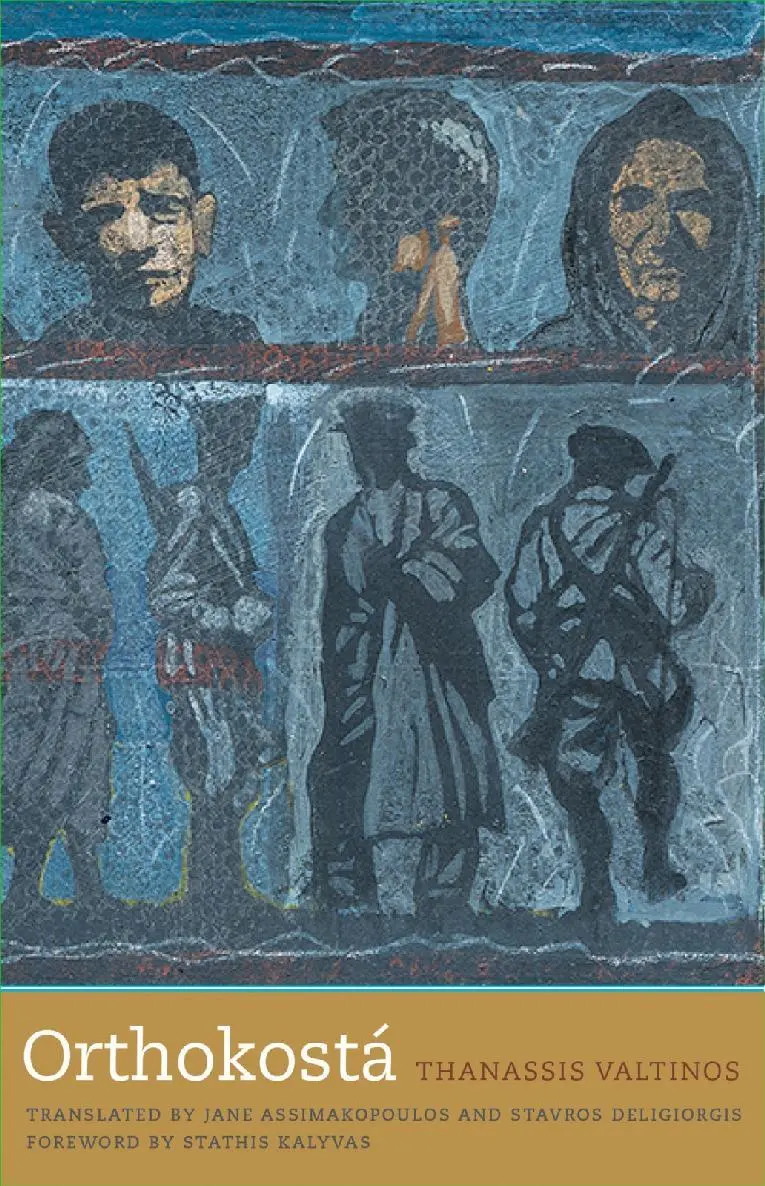
Thanassis Valtinos - Orthokostá
Здесь есть возможность читать онлайн «Thanassis Valtinos - Orthokostá» весь текст электронной книги совершенно бесплатно (целиком полную версию без сокращений). В некоторых случаях можно слушать аудио, скачать через торрент в формате fb2 и присутствует краткое содержание. Год выпуска: 2016, Издательство: Yale University Press, Жанр: Современная проза, на английском языке. Описание произведения, (предисловие) а так же отзывы посетителей доступны на портале библиотеки ЛибКат.
- Название:Orthokostá
- Автор:
- Издательство:Yale University Press
- Жанр:
- Год:2016
- ISBN:нет данных
- Рейтинг книги:5 / 5. Голосов: 1
-
Избранное:Добавить в избранное
- Отзывы:
-
Ваша оценка:
Orthokostá: краткое содержание, описание и аннотация
Предлагаем к чтению аннотацию, описание, краткое содержание или предисловие (зависит от того, что написал сам автор книги «Orthokostá»). Если вы не нашли необходимую информацию о книге — напишите в комментариях, мы постараемся отыскать её.
defied standard interpretations of the Greek Civil War. Through the documentary-style testimonies of multiple narrators, among them the previously unheard voices of right-wing collaborationists, Valtinos provides a powerful, nuanced interpretation of events during the later years of Nazi occupation and the early stages of the nation’s Civil War. His fictionalized chronicle gives participants, victims, and innocent bystanders equal opportunity to bear witness to such events as the burning of Valtinos’s home village, the detention and execution of combatants and civilians in the monastery of Orthokostá, and the revenge killings that ensued.
As a transforming work of literature, this book redefined established methods of fiction; as a work of revisionist history, it changed the way Greece understands its own past. Now, through this masterful translation of
, English-language readers have full access to the tremendous vitality of Valtinos’s work and to the divisive Civil War experiences that continue to echo in Greek politics and events today.
Orthokostá — читать онлайн бесплатно полную книгу (весь текст) целиком
Ниже представлен текст книги, разбитый по страницам. Система сохранения места последней прочитанной страницы, позволяет с удобством читать онлайн бесплатно книгу «Orthokostá», без необходимости каждый раз заново искать на чём Вы остановились. Поставьте закладку, и сможете в любой момент перейти на страницу, на которой закончили чтение.
Интервал:
Закладка:
6.
Lighting the oil candles: A service often performed by women in small neighborhood churches that have no sexton. Since the Greek culture has no tradition of a book of prayers, asking someone to light the oil candles (a floating wick in a glass of oil, typically hung in front of holy icons) amounts to asking for extended prayer.
7.
Siege of Trípolis: When the flourishing multi-ethnic town of Trípolis was under Turkish administration in the nineteenth century, it was besieged by Greek forces under Theódoros Kolokotrónis. The siege lasted from the beginning of June until September 23, 1821, and became the subject of a well-known Greek folksong.
8.
Panayótis Kanellópoulos (1902–1986): A statesman and historian of ideas who was a member of the Greek government-in-exile during the Axis Occupation. He served briefly as minister of defense and minister of reconstruction, and twice as prime minister. He spent seven years under house arrest during the Colonels’ Junta in 1967–74. Kanellópoulos’s landing in the southern Peloponnese in 1944 marked the return of the government-in-exile to power.
9.
Meligalás: A town in the southern Peloponnese where a well-known battle took place on September 13 and 14, 1944, between ELAS forces, which prevailed, and the Security Battalions.
10.
Gargaliánoi: Locality in the southern Peloponnese in which ELAS troops were victorious in the September 21–23, 1944, battle against the Security Battalions under Major Panayótis Stoúpas.
11.
Spýros Tsiklitíras: ELAS division commander in Laconía, in the southern Peloponnese.
12.
PEEA: Πολιτική Επιτροπή Εθνικής Απελευθέρωσης, the Political Committee for National Liberation, active from March to November 1944; a mostly EAM group created to administer the regions of Greece recently vacated by German Occupation troops.
13.
Kolonáki: Upscale residential neighborhood near the center of Athens.
Chapter 11
1.
Gólfo
: A pastoral romance in five acts by Spyrídon Peresiádis (1854–1918) that was a staple of Greek amateur acting companies and a perennial favorite of audiences.
Chapter 13
1.
Valtétsi: A mountain village in the Prefecture of Arcadia, the site of important events during the 1821 Greek Revolution.
2.
Theódoros Tourkovasílis (1891–1976): A nationalist parliamentarian, cofounder of the Populist Party, minister of education, and founder of teachers academies. As head of the Bank of Greece during the Axis Occupation, Tourkovasílis was jailed by the Germans. Thodorís and Thódoros are colloquial variants for the name Theódoros.
3.
EDES: Εθνικός Δημοκρατικός Ελληνικός Σύνδεσμος, Greek National Democratic Union, a rightist coalition founded in September 1941 by Napoléon Zérvas to fight against German, Italian, and Bulgarian occupation forces.
4.
Óhi Day: National holiday celebrated annually to commemorate October 28, 1940, when Prime Minister Ioánnis Metaxás famously responded no (
óhi
) to Italy’s ultimatum to Greece, thus sparking Greece’s entry into World War II.
5.
The Liberation: The withdrawal of German occupation forces from Greece in October 1944.
6.
Ádonis Kýrou (1923–1985): an influential left-wing activist, son of Achilléas Kýrou, owner of the conservative Athens daily
Estia
.
Chapter 14
1.
Mávri Trýpa: A village in Arcadia known since antiquity for its deep geological crevasses. It has since been officially renamed “Trýpi.”
Chapter 16
1.
LOK: Λόχοι Ορεινών Καταδρομών (Alpine Assault Companies) were special army units trained to engage the Communist guerrillas active in the mountainous terrain of Greece during the 1947–49 Civil War.
2.
Tsakónikan: See note 3 to the “Prologue.”
Chapter 19
1.
Loukoú: A monastery near the town of Astros, in the Peloponnese. It is dedicated to Christ of the Transfiguration, its foundation probably dating to the sixth century. Like Orthokostá, Loukoú was used by the guerrillas as a detention camp and as a center of military operations during the Civil War.
2.
Tray: A Greek kafeneío tray, typically of tin or brass, with a handle attached to the rim by three long thin metal strips.
3.
The Torture: This practice, known in Greek as
fálanga
(the rod), became particularly prevalent during the 1960s and 1970s when Greece was ruled by a military junta. Allusions to it would still resonate with readers when the novel first appeared in 1994.
4.
The Karyés Monastery: Located on Mount Parnon, it is dedicated to the Virgin Mary.
5.
Name day: Greeks traditionally celebrate not their birthdays but the feast day of the saint they were named after — in this case Saint John, January 7.
6.
Partisano
: Italian word for “partisan,” widely used in Greece to denote Communist Resistance fighter.
7.
Mávri Trýpa: Literally, “Black Hole.” See note 1 to
chapter 14
.
Chapter 20
1.
Okás: An oká is a measure of weight equaling 1,280 grams or 45 ounces.
2.
Laundering trough: Water mills — to this day, when they are not grinding grains — launder heavy fabrics, blankets, rugs, etc., which the mill will also store for the clients.
3.
Yiannákis: Variant of the common first name Yiánnis. Other variants include Yiannakákis, Yiannoúkos, and Yiannákos.
Chapter 24
1.
The Salutations: The Salutations of the Virgin Mary, sung during the vespers of the first five Lenten Fridays of the Greek Orthodox Church.
2.
Saint Peter’s Day: June 29.
Chapter 26
1.
Saints Constantine and Helen are jointly celebrated on May 21.
2.
Triatatikós
: A made-up word, from the three initial
T’
s in Τηλέφωνο, Ταχυδρομείο, Τηλέγραφος. He was a Telephone, Mail, and Telegraph Service employee.
3.
EPON: Ενιαία Πανελλαδική Οργάνωση Νέων (Unified Panhellenic Youth Organization), an extension of EAM. EPON was founded on February 23, 1943.
4.
Ilisós: A neighborhood in central Athens named after the stream Ilissus (see
chapter 9
) that used to run through it.
5.
ΚΟΒΑ: Κομματική Οργάνωση Βάσης (Local Party Chapter), a neighborhood-based office of the Greek Communist Party.
6.
Palaiá Anáktora: Old Royal Palace, the present-day Parliament building, in the center of Athens.
7.
Goudí: District to the northeast of Athens that served over the years as a base for military and gendarmes.
Chapter 28
1.
Saint Nicholas’s Day: December 6.
2.
Loukoumádes: A traditional Greek sweet. Spoonfuls of white flour dough are deep fried until golden brown and served with honey and a pinch of cinnamon.
3.
“Pinned some basil on them”: Pinning basil on a couple was a sign of public approval of their relationship.
4.
“He had no sisters”: It was customary for a man to find husbands for his sisters before getting married himself.
5.
Fez: A red fez is part of the popular Greek costume worn by National Guards, or Evzones.
6.
Foustanélla: A man’s white pleated skirt. Part of Greek popular costume worn by Evzones.
7.
“State of mourning”: A year-long period during which no weddings could be performed in the village.
Читать дальшеИнтервал:
Закладка:
Похожие книги на «Orthokostá»
Представляем Вашему вниманию похожие книги на «Orthokostá» списком для выбора. Мы отобрали схожую по названию и смыслу литературу в надежде предоставить читателям больше вариантов отыскать новые, интересные, ещё непрочитанные произведения.

Обсуждение, отзывы о книге «Orthokostá» и просто собственные мнения читателей. Оставьте ваши комментарии, напишите, что Вы думаете о произведении, его смысле или главных героях. Укажите что конкретно понравилось, а что нет, и почему Вы так считаете.