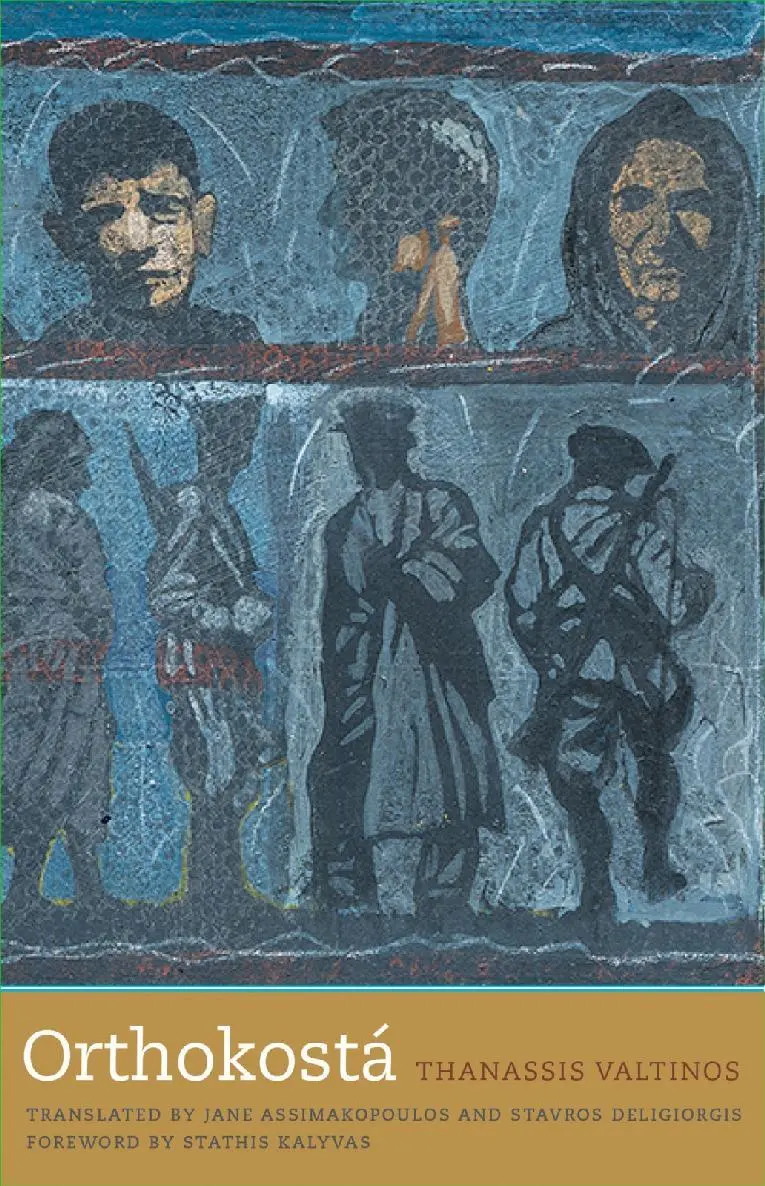
Thanassis Valtinos - Orthokostá
Здесь есть возможность читать онлайн «Thanassis Valtinos - Orthokostá» весь текст электронной книги совершенно бесплатно (целиком полную версию без сокращений). В некоторых случаях можно слушать аудио, скачать через торрент в формате fb2 и присутствует краткое содержание. Год выпуска: 2016, Издательство: Yale University Press, Жанр: Современная проза, на английском языке. Описание произведения, (предисловие) а так же отзывы посетителей доступны на портале библиотеки ЛибКат.
- Название:Orthokostá
- Автор:
- Издательство:Yale University Press
- Жанр:
- Год:2016
- ISBN:нет данных
- Рейтинг книги:5 / 5. Голосов: 1
-
Избранное:Добавить в избранное
- Отзывы:
-
Ваша оценка:
Orthokostá: краткое содержание, описание и аннотация
Предлагаем к чтению аннотацию, описание, краткое содержание или предисловие (зависит от того, что написал сам автор книги «Orthokostá»). Если вы не нашли необходимую информацию о книге — напишите в комментариях, мы постараемся отыскать её.
defied standard interpretations of the Greek Civil War. Through the documentary-style testimonies of multiple narrators, among them the previously unheard voices of right-wing collaborationists, Valtinos provides a powerful, nuanced interpretation of events during the later years of Nazi occupation and the early stages of the nation’s Civil War. His fictionalized chronicle gives participants, victims, and innocent bystanders equal opportunity to bear witness to such events as the burning of Valtinos’s home village, the detention and execution of combatants and civilians in the monastery of Orthokostá, and the revenge killings that ensued.
As a transforming work of literature, this book redefined established methods of fiction; as a work of revisionist history, it changed the way Greece understands its own past. Now, through this masterful translation of
, English-language readers have full access to the tremendous vitality of Valtinos’s work and to the divisive Civil War experiences that continue to echo in Greek politics and events today.
Orthokostá — читать онлайн бесплатно полную книгу (весь текст) целиком
Ниже представлен текст книги, разбитый по страницам. Система сохранения места последней прочитанной страницы, позволяет с удобством читать онлайн бесплатно книгу «Orthokostá», без необходимости каждый раз заново искать на чём Вы остановились. Поставьте закладку, и сможете в любой момент перейти на страницу, на которой закончили чтение.
Интервал:
Закладка:
— In Loukoú?
— No, in Ayiánnis. At Vérvaina grade school. They’d taken them there. I tell him pretend-like, What are you doing here? We’ve got work to do, why are you still here? Oh, what we went through, he’d say later. And he left for Athens.
— That happened in February, right?
— It was winter. Maybe March. February or March. They arrested me in May. We were still making cheese. Here at my mother’s place. With Chrístos Prézas. They came and took me, with my shoes still pressed under my heels. Like slippers. Yes. They were killing me, those raggedy old shoes — when I got to the prison camp my feet were all cut up. In Orthokostá there were lots of people. People I knew. I would cross myself day and night. There were mothers with young children. Day and night, so grateful they didn’t arrest me with my children. The children in the camp would gather on the stairs and play. Old stone steps worn smooth by footsteps. And when they said, Come and eat, what did the little ones get? They gave us peas, just pea soup. Except when someone brought us something from outside. Efthymía was there, my cousin Thanásis’s sister-in-law. Thanásis Samartzís. She was getting married. She married some older man from down there. And I met him back then. In ’39. I was engaged. I got engaged too that day. The same day. They were relatives of my husband, we went to the wedding, and we met them. And he would bring me food. Or send me some.
— Was he from Ayiánnis?
— From Ayios Andréas. Really, he’d send food. To Orthokostá. And not a word to him from anyone.
— How long did you stay there?
— A month. One whole month. And if the Germans hadn’t come they would’ve killed us. They took us out to the mountains.
— Wait a minute. Yeorghía Makrís was there.
— We were together. The two of us. We slept together. All the women did. There was another woman from Ayiasofiá.
— Did they interrogate you?
— No. Nothing. But they did take us out to the mountains. We woke up one morning, they knew the Germans were coming. We saw Tóyias, he had a hand grenade strapped to his waist. A hand grenade. Something’s going on, the others were saying. The men. Poor Panayótis Pezoúlis. They killed him. Iraklís’s uncle. Chrysanthe, he says to me. We were cousins. Second cousins. He had a dream that night. It’s a good dream, I tell him. He was gathering lentils by the handful and throwing them in front of him. It’s a good dream, I tell him, what could I say to him? They tortured those two, him and Iraklís. They didn’t kill them, they didn’t execute them. Just put them through hell. Before the Germans came. And Themistoklís, God rest his soul, could barely move. I went and took him fresh-cut grass. It was May, near summer. Fresh grass to put under him. They’d beat him real bad. To cushion up his body. His back all bruises from top to bottom. That grass gave out warmth, it took away his pain. Chrysanthe, how did you think of that? he said. To ease the pain just a bit, Themistoklís. So you’re not flat against cement. Piled-up grass keeps in the heat. Like we used to say about mowed hay that it “heated up.” And his back soaked up that warmth, caught that heat. He was seething all over from so many beatings. Then they got us up, they took us out to the mountains. They took us out of Orthokostá when they realized that the Germans were coming. We had all slept together that night. They took us up the mountain, there was a ravine, it could hold us. A hundred, hundred fifty people. As soon as it got dark they separated us and they took us to a shepherd. His son took us there. About ten of us, all women. He says, Father, take care of these girls. All right, says the old man. O-o-o-o-kay, goes his son. O-o-o-o-kay, answers the father from under his cape. The son says, Take care of the girls, I’ll take care of them. In the morning at daybreak the father went off a ways. I say to the others, Shall we leave? Shall we just go, I tell them. What are you talking about, they answer me, They’ll kill us. They all said that. They were younger than me. Better if they kill us. Shoot us from behind so we don’t see them. And we left. We go along some more, down a hill. We see the Germans.
— How old were you then?
— Thirty? Maybe not even.
— Do you remember when you were born?
— I was born in 1912. Twelve from forty-four, thirty, thirty-one years old. And I took those girls, I helped them escape. The Germans saw our white kerchiefs, and they didn’t bother us. Back then we all wore head scarves. I told them to. Get a stick and tie your kerchiefs on it, all of you. We tied them on, and we got going. We kept moving toward them. We had to go down a gorge to get across. We meet an Italian man. A deserter. Like someone just stepped out of a washtub, that’s how he looked. Covered in sweat. We ask him, Where you headed? he says, Germans. Germans coming. He spoke a little Greek. He was afraid of the Germans now. And we were on our way to find them. We walked on down, a good lot of kilometers, there was a small stream. We found the Germans there, they were washing their feet. They’d captured two rebels. They asked us, Who are these men? Talking with their hands. What could we say? They had them in the sun, and they were beating them. Beating them with canes long as Easter candles. Those rebels had made my life hell, but I felt sorry for them. We left that place. We never saw those rebels again. We went back to Orthokostá. The Germans were advancing. We got away from those Germans there, they let us go free. We decided to go back to our homes. To go up to Malevós, to come back here. They tell us, Rebels ahead, where are you going? So we split up. I left for Galtená. My sister was there. She’d married someone called Kambylafkás. Panayótis Kambylafkás. We walked all day. All day with a woman from Ayiasofiá. Named Lambrítsa. She’s married now, down in Mýloi. We got ourselves to Galtená. They bedded us down out on the terrace. We fell right asleep. My sister, her mother-in-law, and the girls. She had six girls. At night I hear dogs. I hear the dogs, They’re coming for me, I say. I drag my covers inside. Nonsense, they’re not coming for you, says my sister. The rebels are coming for me, I tell her. I get up next morning, no one came. I get up and put on her mother-in-law’s clothes. Those old-fashioned dresses. I bundle myself up in her scarf. So they won’t recognize me. Where will you go? To Kastrí. I bring myself up here. My mother sees me. You back, my jewel? Come, sit down. I can’t, Mama. They’ll catch me. What are you talking about, child? I take my girl by the hand, a loaf of bread and the boy on my back. And I go to Másklina. Marínos was there. But I had stamina back then, I was strong. A loaf of bread, the boy on my back, and the girl, I’d have her by the hand, then I’d let her move free for a while. I got myself down there, I found Marínos. After eight months apart. We stayed there. Then we left the place, we went to Trípolis. And that’s how we got away. Trípolis was the end.
— How did they kill Themistoklís?
— They took us somewhere else, I told you. No one knows, we never found out. Ruthless men. My mother-in-law went and found him afterward. Two years later. They’d buried him under stones. She found the bones. Was it him, or someone else, well, who knows? So much happened. You get all emotional just talking about it. From Másklina to Trípolis. Terrible years. Especially for me. Bad. Very bad. After the Liberation, I came back here. I wanted to come here. Marínos stayed. I came here. I found nothing. Everything had been leveled. The house burned down. The house here, and the house in Ayiórghis. We had homes in two places. When they set fire to our village Petrákos told us. Chrístos Petrákos. That they burned down the houses one by one. This house here, that house there. And I was left with nothing but the clothes on my back, I swear. We had that shelter, just a hole, we’d hidden our things there. To keep them safe from the Germans. We’d hidden them because of the Germans and the other side took them. They knew the shelter. But now I have shoes. They don’t cut into my feet and make me bleed. Back then I’d stamped them down right here. I was setting the cheese to curdle, they didn’t let me go inside to change. Thank the Lord.
Читать дальшеИнтервал:
Закладка:
Похожие книги на «Orthokostá»
Представляем Вашему вниманию похожие книги на «Orthokostá» списком для выбора. Мы отобрали схожую по названию и смыслу литературу в надежде предоставить читателям больше вариантов отыскать новые, интересные, ещё непрочитанные произведения.


Обсуждение, отзывы о книге «Orthokostá» и просто собственные мнения читателей. Оставьте ваши комментарии, напишите, что Вы думаете о произведении, его смысле или главных героях. Укажите что конкретно понравилось, а что нет, и почему Вы так считаете.