Thanassis Valtinos - Orthokostá
Здесь есть возможность читать онлайн «Thanassis Valtinos - Orthokostá» весь текст электронной книги совершенно бесплатно (целиком полную версию без сокращений). В некоторых случаях можно слушать аудио, скачать через торрент в формате fb2 и присутствует краткое содержание. Год выпуска: 2016, Издательство: Yale University Press, Жанр: Современная проза, на английском языке. Описание произведения, (предисловие) а так же отзывы посетителей доступны на портале библиотеки ЛибКат.
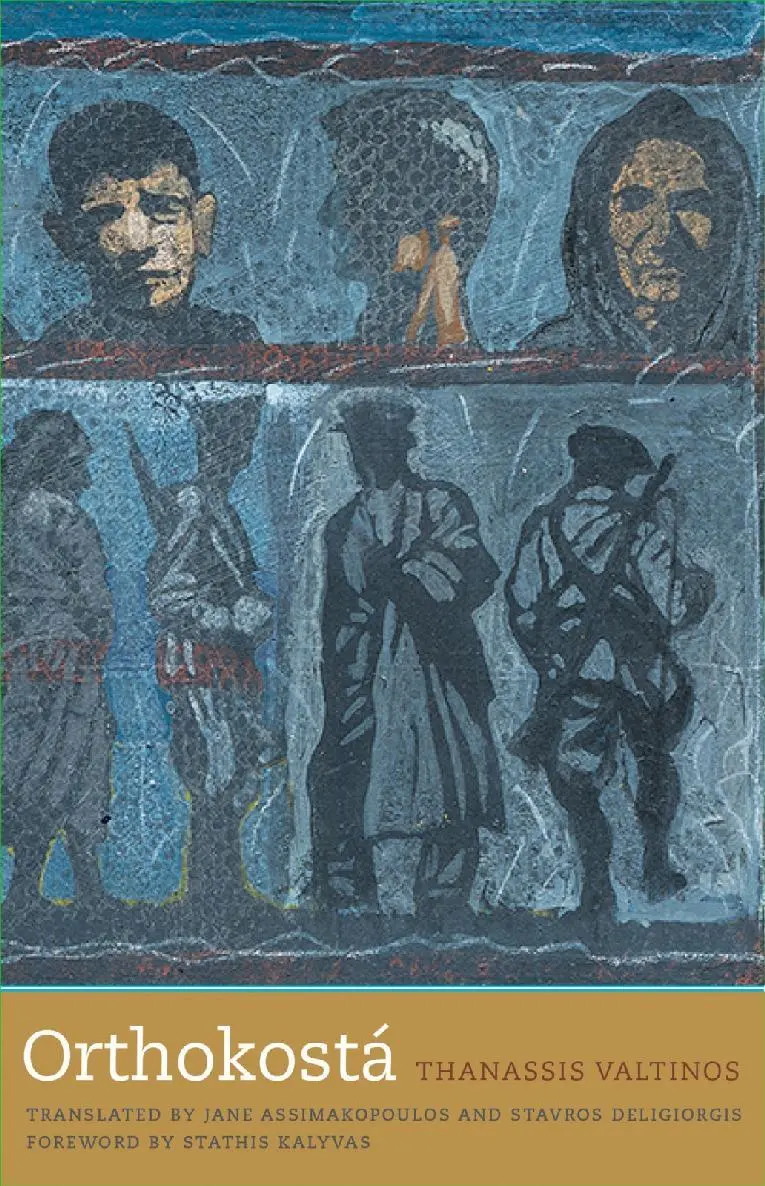
- Название:Orthokostá
- Автор:
- Издательство:Yale University Press
- Жанр:
- Год:2016
- ISBN:нет данных
- Рейтинг книги:5 / 5. Голосов: 1
-
Избранное:Добавить в избранное
- Отзывы:
-
Ваша оценка:
Orthokostá: краткое содержание, описание и аннотация
Предлагаем к чтению аннотацию, описание, краткое содержание или предисловие (зависит от того, что написал сам автор книги «Orthokostá»). Если вы не нашли необходимую информацию о книге — напишите в комментариях, мы постараемся отыскать её.
defied standard interpretations of the Greek Civil War. Through the documentary-style testimonies of multiple narrators, among them the previously unheard voices of right-wing collaborationists, Valtinos provides a powerful, nuanced interpretation of events during the later years of Nazi occupation and the early stages of the nation’s Civil War. His fictionalized chronicle gives participants, victims, and innocent bystanders equal opportunity to bear witness to such events as the burning of Valtinos’s home village, the detention and execution of combatants and civilians in the monastery of Orthokostá, and the revenge killings that ensued.
As a transforming work of literature, this book redefined established methods of fiction; as a work of revisionist history, it changed the way Greece understands its own past. Now, through this masterful translation of
, English-language readers have full access to the tremendous vitality of Valtinos’s work and to the divisive Civil War experiences that continue to echo in Greek politics and events today.
Orthokostá — читать онлайн бесплатно полную книгу (весь текст) целиком
Ниже представлен текст книги, разбитый по страницам. Система сохранения места последней прочитанной страницы, позволяет с удобством читать онлайн бесплатно книгу «Orthokostá», без необходимости каждый раз заново искать на чём Вы остановились. Поставьте закладку, и сможете в любой момент перейти на страницу, на которой закончили чтение.
Интервал:
Закладка:
— Were there any others?
— Mmm, Panayótis Gagás. But it’s the other one I remember. Aryiríou. He spit at us.
— And you stayed here.
— Yes, I did. I stayed here. Then they arrested me, they took me to Ayios Pétros. They turned me in, they said I was looting. That I’d taken a sewing machine that belonged to Yfantís. Nonsense. So they hauled me in for interrogation. Still at Mángas’s house. It was still their headquarters. There was a man called Yiánnis Spyrópoulos from Parthéni. He asked me about the sewing machine. I tell him, I’ve no idea. Since you have no idea you’re going to Ayios Pétros. There was a superior command there. There were still some prisoners there. Three or four rebels come and get us. They take us to Ayios Pétros. Just ten days after we came back. They keep us there for about a month.
— That long?
— Twenty-nine days. They took us outside, we did chores. We had swept the square of Ayios Pétros. Me, Yiánnis Haloúlos, Achilléas Koútselas. He’s dead now. We would go for water. Over at their fountain.
— What did they give you to eat?
— Whatever our relatives brought us.
— Did they come every day?
— Every day. I had my grandmother. She came whenever she could. And she would bring me something — what could she bring me? We had nothing. A potato or two, a cabbage. That’s what she brought. Twenty-nine days. Till the twenty-eighth of October.
— That was in the fall of 1944.
— In the fall, yes. It was — I was released that day. My other grandmother came, Nikotsáras’s mother. They would let her in. She says, so the others can’t hear, Listen child, listen here. Your father says to tell you that some pact was signed that’s good for you men. It was the Várkiza Treaty. That’s when I was released. When the Várkiza Treaty was signed. They called me upstairs. They asked me some stupid questions. About things I didn’t know. There was someone named Petsaloúdas there. From here, from Ayiórghis. He recognized me. He knew I was Nikotsáras’s nephew. Anghelináras, he says to me, okay, go. Yes. He does me that good turn, he says, You can go. And I left. I left as soon as they gave me my permit. My grandmother was still there. I came here. And I stayed here. I left here again in 1948.
— Did you go to Trípolis?
— I went to Athens. Straight to Athens.
— When did they attack Ayios Pétros? When did they attack the gendarmes?
— That was in 1946. Early on. When the second rebel movement was starting up. Don’t ask me for dates. But yes, I went there, and I went there after Trípolis. With everyone from Kastrí.
— When they attacked them, how many gendarmes were there?
— They said ten or twelve.
— Who was police chief then?
— I’m not sure.
— Did they attack during the day or at night?
— At dawn. They killed them at dawn.
— Did they kill them all?
— Not all of them. I remember three bodies. Up on Réppas’s truck. Three bodies on his truck.
— And they’d cut off their privates?
— They’d slashed them there, they didn’t cut anything off. They slashed them up, all around their privates.
— With bayonets.
— With bayonets. Or with knives, I don’t know. Just as they were, in their undershorts.
— In their sleep?
— Yes.
— They caught them asleep?
— They caught them asleep. And if it wasn’t for some man named Katsís, Háris Katsís, from the Battalions, he was right-wing. He gave the signal for the others to leave.
— And they got away.
— They got away and they were saved. Some of them. First of all, their officer. A first sergeant, I think — but people were saying things about him.
— What do you mean?
— That he was the one who’d betrayed them.
— I see.
— The gendarmes. Now how true that is, no one knows.
— And they took the dead men to Trípolis.
— Yes, we took them there. A lot of us from Kastrí went to Ayios Pétros. And we got them and took them to Trípolis. Because we were still holding up. So we all went down to Trípolis.
— And you tore the place up.
— Yes, we went to Trípolis.
— How many of you went down there?
— A lot of us. Three hundred. Or maybe one hundred.
— Do you remember any names?
— Where should I start. With Yiórghis Réppas? With Kóstas Goúlas? With Vasílis Papayiorghíou? With Yiannoúkos Haloúlos? All deceased. Mítsos Kokkiniás, Kóstas Boutsikákis? Whose names should I give you? Which ones? Anghelos Katrinákis. There were so many of us. So many.
— And you went down there with clubs?
— We went down there angry. And we got to where we knew the Communists were. We nabbed someone named Babakiás at Panayotópoulos’s bakeshop. Up in the attic. Next to Xagás’s tailor’s shop.
— Down near Ayía Varvára.
— No, at Evanghelismós. It’s a museum now.
— Yes it is.
— Panayotópoulos’s bakeshop was just behind it. And Kóstas Goúlas had hidden up in his attic.
— Uh-huh.
— Do you remember Old Man Kóstas with the mustache?
— Uh-huh.
— Well, he went up there and grabbed Babakiás by the hair.
— Where was he from, Babakiás?
— From Dolianá. He was a captain. A real captain. Not like Kapetán Thódoros or Kapetán Nikotsáras.
— Babakiás.
— That’s right. He grabbed him and dragged him down the stairs. There they started in on him with an automobile crank. There were these imported motorcars back then, they had cranks two meters long. Sarrís and Dimítris Prásinos went to work on him. They put him through the mill. He couldn’t move for weeks. Mmm, after that I don’t know what happened to him. We were young then. We wanted revenge. After that I left. I came here to the village. I worked until 1948. In ’48 I left, on the twenty-eighth of October. A date not easily forgotten, we might say. 2
— In the meantime the rebels were wreaking havoc everywhere.
— Wreaking havoc all over. Not so much in the day. They were afraid of Kastrí. But back then we would hide. We didn’t sleep at our houses.
— Where did you hole up at night?
— Outside. I hadn’t slept in my house in years. Not days, years.
— Yes.
— Like animals. We slept in any old hole. We’d fixed up underground hiding places. We had found caves — and we moved around. Right here, behind Houyiázos’s place there was one. We once had you stay there too.
— Yiórgos did. I was away.
— Yiórgos. One of you did. I remember. Usually four of us slept there. Liás Andrianákos, and Sofianós’s cousin, they’re in Australia now; Vasílis Patsiás and me. And whenever Liás didn’t come, Vanghélis Koútselas did. He’s deceased now. There was a hollow rock. We’d squeeze under it like snakes. That kind of thing. There’s no end to the stories. In 1948 I left. I went to Athens. The two girls stayed behind. Maria, born in 1942. In 1948 she was six. And Chrysoúla, a little older. Fourteen, fifteen. Yeorghía was in Athens, the older girl. Yiánnis was in Athens, Kóstas was in Athens. Our uncle tells us. He had flour mills. He owned the Amyla flour mill. He tells us, his nephews and nieces. We were all working there. He tells us, You left something behind for the rebels too. Their portion of the spoils. He meant Chrysoúla. There was no transportation back then. There were no telephones and things. I found someone, and I sent a letter to the old man. I think it was Yiannoúkos Haloúlos I found. Someone, at any rate. At that time there were trucks that went back and forth between Athens and Kastrí. The Galaxýdis trucks. So I wrote that letter to the old man and told him to send Chrysoúla to us. By airplane. There was a Dakota at the time that flew between Trípolis and Athens. You must remember that.
Читать дальшеИнтервал:
Закладка:
Похожие книги на «Orthokostá»
Представляем Вашему вниманию похожие книги на «Orthokostá» списком для выбора. Мы отобрали схожую по названию и смыслу литературу в надежде предоставить читателям больше вариантов отыскать новые, интересные, ещё непрочитанные произведения.

Обсуждение, отзывы о книге «Orthokostá» и просто собственные мнения читателей. Оставьте ваши комментарии, напишите, что Вы думаете о произведении, его смысле или главных героях. Укажите что конкретно понравилось, а что нет, и почему Вы так считаете.