Thanassis Valtinos - Orthokostá
Здесь есть возможность читать онлайн «Thanassis Valtinos - Orthokostá» весь текст электронной книги совершенно бесплатно (целиком полную версию без сокращений). В некоторых случаях можно слушать аудио, скачать через торрент в формате fb2 и присутствует краткое содержание. Год выпуска: 2016, Издательство: Yale University Press, Жанр: Современная проза, на английском языке. Описание произведения, (предисловие) а так же отзывы посетителей доступны на портале библиотеки ЛибКат.
- Название:Orthokostá
- Автор:
- Издательство:Yale University Press
- Жанр:
- Год:2016
- ISBN:нет данных
- Рейтинг книги:5 / 5. Голосов: 1
-
Избранное:Добавить в избранное
- Отзывы:
-
Ваша оценка:
Orthokostá: краткое содержание, описание и аннотация
Предлагаем к чтению аннотацию, описание, краткое содержание или предисловие (зависит от того, что написал сам автор книги «Orthokostá»). Если вы не нашли необходимую информацию о книге — напишите в комментариях, мы постараемся отыскать её.
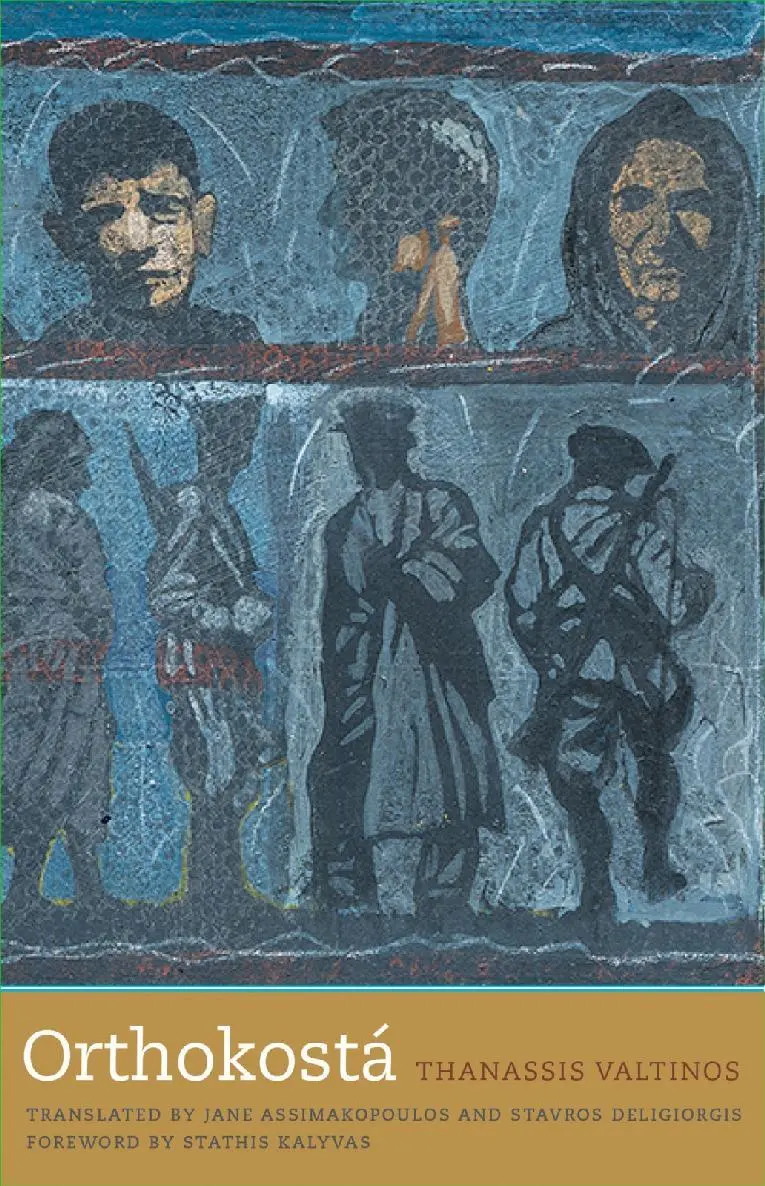
defied standard interpretations of the Greek Civil War. Through the documentary-style testimonies of multiple narrators, among them the previously unheard voices of right-wing collaborationists, Valtinos provides a powerful, nuanced interpretation of events during the later years of Nazi occupation and the early stages of the nation’s Civil War. His fictionalized chronicle gives participants, victims, and innocent bystanders equal opportunity to bear witness to such events as the burning of Valtinos’s home village, the detention and execution of combatants and civilians in the monastery of Orthokostá, and the revenge killings that ensued.
As a transforming work of literature, this book redefined established methods of fiction; as a work of revisionist history, it changed the way Greece understands its own past. Now, through this masterful translation of
, English-language readers have full access to the tremendous vitality of Valtinos’s work and to the divisive Civil War experiences that continue to echo in Greek politics and events today.
Orthokostá — читать онлайн бесплатно полную книгу (весь текст) целиком
Ниже представлен текст книги, разбитый по страницам. Система сохранения места последней прочитанной страницы, позволяет с удобством читать онлайн бесплатно книгу «Orthokostá», без необходимости каждый раз заново искать на чём Вы остановились. Поставьте закладку, и сможете в любой момент перейти на страницу, на которой закончили чтение.
Интервал:
Закладка:
— Was he by himself?
— There were others, but not many.
— Had he already gone over to ELAS?
— Yes, I think so. At any rate, he came here as part of ELAS. He told us we had to support ELAS and join the rebel movement and all that. He had us men all fired up. And there were a lot of us, not like today. He had us all fired up. So at a certain point he says, Whoever wants to go to the mountains, go stand at the Unknown Soldier’s Monument. On your left. Whoever doesn’t want to go, stay where you are. And we all went over to the Unknown Soldier. Then he tells us, Go to your homes and talk it over with your parents. To see if they agree. In that way he gave us a chance to think about it. To think it over. No one followed him at that time.
— What happened with Mihális?
— With Mihális. Some men had gone on a raid at the time. To attack the villages down below. Koubíla, Galtená, and the rest.
— And Kyriákos was killed.
— I don’t know how it happened. At any rate, he was killed. Mihális had just found out.
— It was his own fault he was killed.
— Yes. He was banging the butt of his gun against a door. As soon as Mihális found out he went up to the 2nd Bureau. Before they even brought his brother to Trípolis. He knew that Tsígris was being interrogated there. And he took out his gun and shot him in cold blood. He settled the score.
— Tsígris, where did they arrest him?
— Tsígris. At some blockade, I think. But I’m not very certain.
— After that the Germans left. Then came the Liberation.
— Yes.
— And you men stuck around. You stayed in Trípolis.
— Yes.
— For how many days?
— Not too many.
— Did you go to Spétses after that?
— No. I didn’t go. Papadóngonas told us, Any of you who are with us, who don’t have a questionable record, you can stay. We’ve signed an agreement, they won’t bother you. And I believed what he said, so I stayed.
— Then you were there when Kanellópoulos arrived with Aris.
— Kanellópoulos and Aris. Yes, I was there. They spoke from a hotel, in the main square.
— From the Maínalon.
— The Maínalon, yes. And me in particular, for a while, until we surrendered our arms and all that, Dr. Panagákos covered for me. Not only for me, for other men from Kastrí too. He took us to the house of a relative of his. He had left us there. He brought us food until the ELAS men finally arrived. Then a rebel came there, to the house where we were staying. He says, You have to come and surrender your weapons. So the doctor, who’s now deceased, loaded up our weapons. Along with Kóstas Yiorghoulís, also deceased. Kóstas was a sergeant.
— How many of you were there?
— About twelve of us. They got our weapons, they took them to the barracks. They surrendered them. But then they asked for us. So the doctor comes back with another rebel. He says, Line up, you’re going to give yourselves up. And we went and gave ourselves up. They put us in a room. Someone from Megalópolis arrived, a kapetánios. He talked to us. He told us that they could kill us and all that. But ELAS was sparing us, and we should join in the struggle. And so on. So they let us go free.
— And you went back to Kastrí?
— From the barracks I went down to the square. To the square just when Kanellópoulos was speaking. Well, just then Thodorís Kalamís arrives. I was sitting on the steps of the courthouse. Thodorís Kalamís, from Voúrvoura, comes over and gets hold of me. Are you Anghelináras? I am. Follow me. I followed him. I knew that Kalamís fellow. He used to sing and play the lute at the fairs. He was in Barbátsainas’s band of musicians. Before the war, all this. And those same men killed Barbátsainas. So I followed him. And he was leading me down toward Halalás’s place. Almost the last house after the grove. But as soon as I saw that I stopped. I ask him, What do you want? Where are you taking me? He says, You’re going to tell me where the Galaxýdis brothers have my flock. Let’s go back, I tell him. Because if that’s what this is about I don’t know anything. He scared me for a minute. He grabbed me by the ear. I tell him, Get your hands off me, or you’ll have others to answer to. In the meantime, I had Nikotsáras backing me. I’d seen him in the barracks. I knew he was in Trípolis.
— Which Nikotsáras?
— My mother’s brother. He was with the rebels. I tell him, You’ll have others to answer to. Like Nikotsáras. Dimítrios Selákos was his name. The minute he heard Nikotsáras’s name, he says, How do you know him? Go and ask him, I tell him. That’s exactly what I said. Now I was getting my courage back. Go and ask him and stop bothering me.
— Had the Galaxýdis brothers taken his sheep?
— Of course they had. Who took them from him? Was it the Galaxýdis brothers? Back during all that unrest, in the middle of all that unrest? Anyone who had the chance would swipe whatever he could. Everyone swiped things from everyone else. I went back. We went back together. And what a coincidence, right there on the steps of the courthouse again, there was Nikotsáras. With Thanásis Fotiás. And as soon as he saw me, he started in. Swearing at me of course. What are you doing with those bums, and on and on he went. I tell him, Now you can explain things to Kapetán Thodorís. And he turns to him and tells him, What do you think you’re doing with my nephew? And after that they left me alone. I wanted to come to Kastrí but I was afraid. Nikotsáras gets me, he takes me upstairs. To what used to be the 2nd Civilian Intelligence Bureau. That’s where Aris was stationed now.
— In what building?
— In the courthouse. Inside. He takes me upstairs to the 2nd Bureau. He hands me a permit. They fixed that permit for me, stamped it, and I could circulate freely with it. With that permit I saved Panayótis Kouroúnis from a beating.
— Where did they capture him?
— In Hoúria. We were coming down, Vrastós, my uncle, Nikotsáras’s brother, me, and Kouroúnis. Not the younger one. Not Tákis. Panayótis. And they mistook him for the other one. As soon as we got to Hoúria. In Hoúria there was a guardhouse. As for me, they saw my permit, there was someone, was it Lyritzís? I don’t remember now. Anyhow, he was from Messinía. A major. Or something. At any rate. They let me go. They took Kouroúnis upstairs to the old police headquarters. They started in on him. They had taken Vrastós there too. So I walk into the office, I walk in. I tell them, Who are you beating, Selákos? Nikotsáras’s brother. They knew Nikotsáras. They say, How come one’s on our side and the other’s on theirs? And they let Vrastós go downstairs. Then we hear Panayótis. They were beating him. They had just started. Nephew, Vrastós shouts. Go up and explain to them. I go upstairs, I tell them, You’re barking up the wrong tree. The Kouroúnis you’re looking for is someone else. He’s young, he’s my age. See, it’s like this. This one here is a family man, he has children. And with that they finally let him go. And that was the end of it. We went on our way. Continued on foot. I was barefoot. I’d forgotten that. On my way from Trípolis, just before Ayios Sóstis. At the roadside shrine they had a guardhouse. They stopped us, they took my boots away. They asked for my permit. They saw my army boots. They were in good shape, almost new, they tell me, Take them off. And they left me barefoot. After that we came here. They greeted us with insults. The worst ones from Eléni, Karadímas’s wife. And listen to this. Five years later they brought her to me. Five or six years. Tried to arrange a marriage between us. I said no. More swearing. You bums, you this, you that. We didn’t answer her. My folks were in Másklina, they hadn’t come back. We went down there with Vrastós, found our house burned down. We went to the marketplace. Another kind of welcome there. From up on Mángas’s balcony. ETA 1had taken it over, they hadn’t burned that place down. Chrysoúlis Aryiríou. Nicknamed Kaílas. You dogs, you traitors, what did you think? We’ll teach you a lesson, we’ll show you.
Читать дальшеИнтервал:
Закладка:
Похожие книги на «Orthokostá»
Представляем Вашему вниманию похожие книги на «Orthokostá» списком для выбора. Мы отобрали схожую по названию и смыслу литературу в надежде предоставить читателям больше вариантов отыскать новые, интересные, ещё непрочитанные произведения.


Обсуждение, отзывы о книге «Orthokostá» и просто собственные мнения читателей. Оставьте ваши комментарии, напишите, что Вы думаете о произведении, его смысле или главных героях. Укажите что конкретно понравилось, а что нет, и почему Вы так считаете.