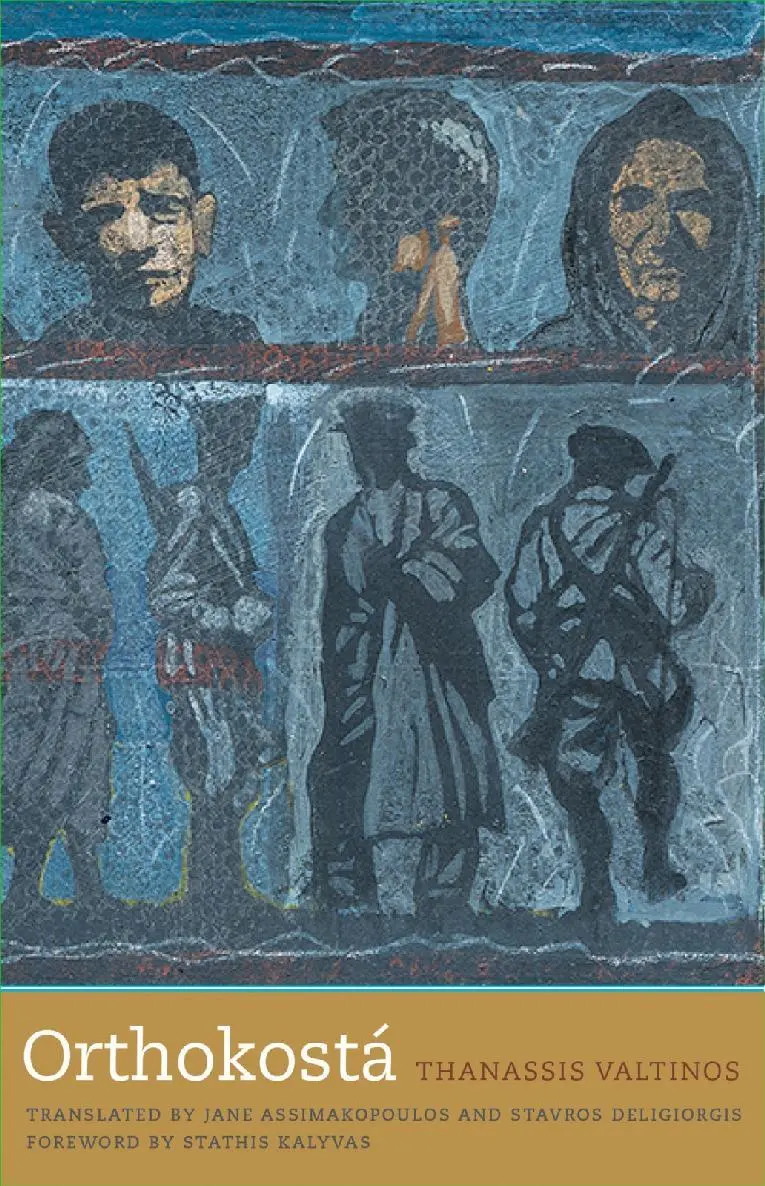
Thanassis Valtinos - Orthokostá
Здесь есть возможность читать онлайн «Thanassis Valtinos - Orthokostá» весь текст электронной книги совершенно бесплатно (целиком полную версию без сокращений). В некоторых случаях можно слушать аудио, скачать через торрент в формате fb2 и присутствует краткое содержание. Год выпуска: 2016, Издательство: Yale University Press, Жанр: Современная проза, на английском языке. Описание произведения, (предисловие) а так же отзывы посетителей доступны на портале библиотеки ЛибКат.
- Название:Orthokostá
- Автор:
- Издательство:Yale University Press
- Жанр:
- Год:2016
- ISBN:нет данных
- Рейтинг книги:5 / 5. Голосов: 1
-
Избранное:Добавить в избранное
- Отзывы:
-
Ваша оценка:
Orthokostá: краткое содержание, описание и аннотация
Предлагаем к чтению аннотацию, описание, краткое содержание или предисловие (зависит от того, что написал сам автор книги «Orthokostá»). Если вы не нашли необходимую информацию о книге — напишите в комментариях, мы постараемся отыскать её.
defied standard interpretations of the Greek Civil War. Through the documentary-style testimonies of multiple narrators, among them the previously unheard voices of right-wing collaborationists, Valtinos provides a powerful, nuanced interpretation of events during the later years of Nazi occupation and the early stages of the nation’s Civil War. His fictionalized chronicle gives participants, victims, and innocent bystanders equal opportunity to bear witness to such events as the burning of Valtinos’s home village, the detention and execution of combatants and civilians in the monastery of Orthokostá, and the revenge killings that ensued.
As a transforming work of literature, this book redefined established methods of fiction; as a work of revisionist history, it changed the way Greece understands its own past. Now, through this masterful translation of
, English-language readers have full access to the tremendous vitality of Valtinos’s work and to the divisive Civil War experiences that continue to echo in Greek politics and events today.
Orthokostá — читать онлайн бесплатно полную книгу (весь текст) целиком
Ниже представлен текст книги, разбитый по страницам. Система сохранения места последней прочитанной страницы, позволяет с удобством читать онлайн бесплатно книгу «Orthokostá», без необходимости каждый раз заново искать на чём Вы остановились. Поставьте закладку, и сможете в любой момент перейти на страницу, на которой закончили чтение.
Интервал:
Закладка:
— Yes.
— Mítsos Hasánis.
— Yes.
— And they caught that Orfanós fellow. Yiánnis. You must remember him too.
— Yes.
— And they had them spying on me. Pretending the others were hounding them too. And on and on it went. Get it? When the Germans arrested us, down in Ayiasofiá, they went along with the rebels. So don’t waste any words on them, to hell with them. They’ve done so many things to me here. They killed one of my brothers, he was a secretary in the County Legal Department. They sent someone named Kaloyerákis, and he stabbed him right in the middle of the street.
— When was that?
— Back in 1943. Or ’44. And that’s not all. They poisoned my mules, they did all kinds of things to me. They took me to the detention camp, they made a cripple out of me. And I never did anything to anyone, never. I say, the Lord be praised, a clear conscience is everything. If your conscience reproves you, forget it. So, my friend, that’s it. And may God forgive them. It wasn’t their fault. It was others higher up who were to blame. And I didn’t tell you the most important thing. One of Kléarhos’s sisters, who was married to my wife’s cousin, she had left town. Yes, and they had appointed me the village alderman, since they couldn’t find anyone better than me here in the village. They appointed me village alderman, and a paper came directing me to transfer the property of any Communists, etc., to the town. Well, Kléarhos’s sister also came here. And I let her, she sold her fields, in Zygós. Someone from down below bought them, from the lower villages. But she did do one good thing for us; she let us keep the water. The big fountain up there, if you know it. She willed it to the town. That one thing. At any rate, I never bothered them, never harmed any of them. That’s about it. As much as I can remember.
Chapter 33
The Battalions were advancing toward Astros. Some kind of reconnaissance, something like that. Lýras tells me, You’re going with them. The only time I saw action outside the Bureau. He tells me, You’ll go with the Battalion. My mission was to bring in Paraskevás Denézos. Paraskevás was a lawyer, a member of ELAS, they’d put him in charge of ETA. The Rebel Commissary. I think he was Trámbalis’s brother-in-law. Trámbalis, manufactured ice and spaghetti. In Trípolis. At any rate, they were related somehow. Distant relatives through marriage. And we had to get him out of there, away from the Organization. Lýras tells me, You’ll go down there, you’ll get Denézos. He’s been notified. He’ll go with you. And I had to transport him safely to Trípolis. It was a way out, that, a setup so there wouldn’t be any retaliation. So he could appear not to be going with them voluntarily. We went to Kastrí. We passed through Kastrí. The Battalions, hordes of them, were grabbing whatever they could. Kastrí was already burned down, of course. We went to Ayios Pétros. Same thing there. We went down to Ayiánnis, and from there to Mesóyeio, Astros. And all of them barging into homes and looting. As though they were in enemy territory. In a foreign country. I never imagined it could be like that. We went back, we spent the night at Koulourás’s inn. For our own safety. The next day we went back up to Ayiánnis. Paraskevás was there with his sister. They came over to me. I took them along. Voúla Papayiánnis, Kóstas Vasilópoulos’s wife, decided to come with us. Kóstas and I were colleagues, he was also a schoolteacher. But he was involved with EAM. Voúla came with us to try to somehow make up for her husband’s forced participation in EAM. Of her own accord. We met at her brother’s house. Astéris Papayiánnis. Ada was there too. It was summer when that raid was carried out. They’d come up from Mesóyeio. They were spending the summer there. Voúla came with us. They knew us, we were neighbors. She was a colleague’s wife. I had her sit in the front seat of the car. Mihális Galaxýdis was driving the car. And he wouldn’t stop hounding her. We went to Trípolis. Lýras took Denézos, he took him to Trámbalis. Voúla was staying somewhere else in the beginning. Another man from Astros had come with us, name of Kontákos. A few days later they sent for Voúla, then she went and stayed at Trámbalis’s house. Mihális Galaxýdis would keep arresting her, hauling her in to the police station. He’d arrest her and lock her up, put her in jail. Because supposedly her husband was with EAM. They sent word to me. I went over and found him, and I had words with him. I told him, What’s going on here? I brought this woman to Astros, she came here with me. Under my protection. And she came here to safeguard her husband, to justify his forced participation in EAM. I would arrange to get her out of the police station, Lýras would give an order, they’d let her go. Then Mihális would arrest her again. He was threatening to turn her over to the Germans. Voúla was staying at Trámbalis’s place, I was at the Hotel Grítsi. One afternoon she called me over to the fence. There was an open space between us. She says, What shall I do, how long will this go on? She was upset. And rightly so. I tell her, You’re not in danger. As long as Lýras is there I’ll take care of things any time you’re there. But I couldn’t figure out why he was so steamed up, so obsessed with her. And then she told me why herself. A lover’s frustration. He wanted her. Even before she was married. And she wouldn’t look twice at him. That kind of insane passion was fairly widespread. I just want to point out what sort of thing one was up against then. But we shouldn’t speak about that. Voúla was both a fellow villager and the wife of a colleague. May God rest her soul.
Chapter 34
I remember everything. They got me from here. They took me to Ayios Pétros. Along with Chrístos Kokkiniás. From Ayios Pétros they took us to Kastánitsa. They had Marínos’s brothers there. They killed Themistoklís. Mihális died last year.
— And Marínos?
— Marínos was in Athens. That’s why they caught us. I had Dína and the boy, they were little.
— Yiórgos?
— Not Yiórgos. I had him later. Yiórgos and Themistoklís.
— Which children did you have then?
— Dína and Dimítris. Dína’s almost fifty. She’s married to a miller, in Aséa. Dimítris is in Trípolis. Working for the telephone company.
— Themistoklís is in Trípolis too.
— Yes, but Themistoklís came later, I had him later.
— Dimítris and Dína, how old were they then?
— Let me think. They must have been four or five.
— And they stayed here when they arrested you?
— My mother took them. My mother married a Perentés. You remember Mítsos Perentés?
— No.
— You’re not very old, you. How old were you back then?
— In the Occupation I was seven.
— You’re not old.
— Says who I’m not? I’m fifty-two.
— Then you’re older. My children were three or four years old. The girl was born first. Worried herself sick. Bleeding from her ears, you know. And Dimítris started saying, Light all gone, Grandma. Looked at that oil lamp and kept saying, Our light all gone, Grandma. He was so young, I mean he could barely speak. Maybe he was two. And the girl was three. About that age.
— Who took you from here?
— Lenghéris.
— Pótis?
— One of the two. Maybe it was Harís.
— And they took you to Mángas’s house.
— Yes. And to Ayios Pétros — Kastánitsa. We were covered in lice, tons of them. Such filth. In Orthokostá we found that poor Braílas woman. They had arrested her earlier. Along with Marínos. I was the one got Marínos out. All innocent-like. I went and saw him.
Читать дальшеИнтервал:
Закладка:
Похожие книги на «Orthokostá»
Представляем Вашему вниманию похожие книги на «Orthokostá» списком для выбора. Мы отобрали схожую по названию и смыслу литературу в надежде предоставить читателям больше вариантов отыскать новые, интересные, ещё непрочитанные произведения.


Обсуждение, отзывы о книге «Orthokostá» и просто собственные мнения читателей. Оставьте ваши комментарии, напишите, что Вы думаете о произведении, его смысле или главных героях. Укажите что конкретно понравилось, а что нет, и почему Вы так считаете.