Jonis Agee - The Bones of Paradise
Здесь есть возможность читать онлайн «Jonis Agee - The Bones of Paradise» весь текст электронной книги совершенно бесплатно (целиком полную версию без сокращений). В некоторых случаях можно слушать аудио, скачать через торрент в формате fb2 и присутствует краткое содержание. Год выпуска: 2016, Издательство: William Morrow, Жанр: Современная проза, на английском языке. Описание произведения, (предисловие) а так же отзывы посетителей доступны на портале библиотеки ЛибКат.
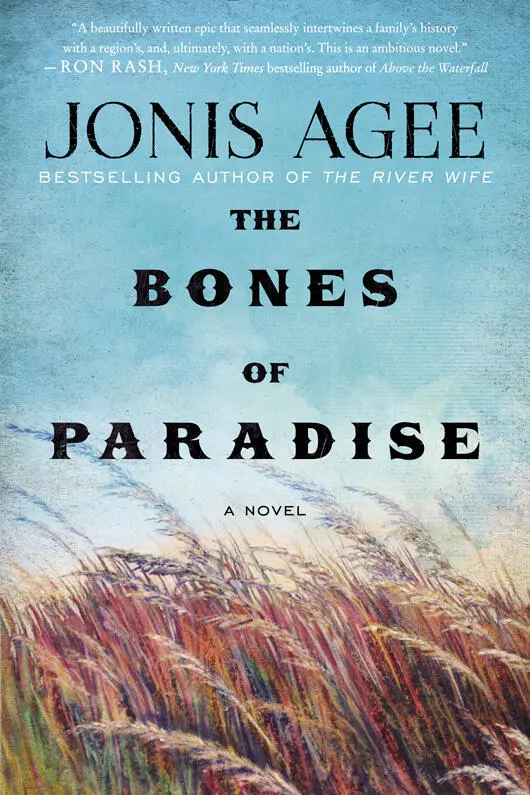
- Название:The Bones of Paradise
- Автор:
- Издательство:William Morrow
- Жанр:
- Год:2016
- ISBN:нет данных
- Рейтинг книги:3 / 5. Голосов: 1
-
Избранное:Добавить в избранное
- Отзывы:
-
Ваша оценка:
The Bones of Paradise: краткое содержание, описание и аннотация
Предлагаем к чтению аннотацию, описание, краткое содержание или предисловие (зависит от того, что написал сам автор книги «The Bones of Paradise»). Если вы не нашли необходимую информацию о книге — напишите в комментариях, мы постараемся отыскать её.
returns with a multi-generational family saga, set in the unforgiving Nebraska Sandhills in the years following the massacre at Wounded Knee—an ambitious tale of history, vengeance, race, guilt, betrayal, family, and belonging, filled with a vivid cast of characters shaped by violence, love, and a desperate loyalty to the land. Ten years after the 7th Calvary massacred more than 200 Lakota men, women, and children at Wounded Knee, J. B. Bennett, a white rancher, and Star, a young Native American woman, are murdered in a remote meadow on J. B.’s land. The deaths bring together the scattered members of the Bennett family: his cunning and hard father, Drum; his estranged wife, Dulcinea; and his young sons, Cullen and Hayward. As the mystery of these twin deaths unfolds, the history of the dysfunctional Bennett’s and their damning secrets are revealed exposing the conflicted heart of a nation caught between past and future.
At the center of
are two remarkable women. Dulcinea, returned after bitter years of self-exile, yearns for redemption and the courage to mend her broken family and reclaim the land that is rightfully hers. Rose, scarred by the terrible slaughters that have decimated and dislocated her people, struggles to accept the death of her sister, Star, and refuses to rest until she is avenged.
A kaleidoscopic portrait of misfits, schemers, chancers, and dreamers, Jonis Agee’s bold new novel is a panorama of America at the dawn of a new century. A beautiful evocation of this magnificent, blood-soaked land—its sweeping prairies, seas of golden grass and sandy hills, all at the mercy of two unpredictable and terrifying forces, weather and lawlessness—and the durable men and women who dared to tame it. Intimate and epic,
is a remarkable achievement: a mystery, a tragedy, a romance, and an unflagging exploration of the beauty and brutality, tenderness and cruelty that defined the settling of the American west.
The Bones of Paradise — читать онлайн бесплатно полную книгу (весь текст) целиком
Ниже представлен текст книги, разбитый по страницам. Система сохранения места последней прочитанной страницы, позволяет с удобством читать онлайн бесплатно книгу «The Bones of Paradise», без необходимости каждый раз заново искать на чём Вы остановились. Поставьте закладку, и сможете в любой момент перейти на страницу, на которой закончили чтение.
Интервал:
Закладка:
Seated in J.B.’s office, Dulcinea, Chance, and the sheriff examined each other for a moment. Chance was the first to break the silence, reaching inside his coat and withdrawing a thick sheaf of folded papers. “I think we’re well within our legal rights on this, Mrs. Bennett. I went to the length of consulting by telegraph with a colleague in Omaha. We all agree that the letter and subsequent will should take precedent. Since Mr. Rivers could see nothing flawed in my argument, he’s allowing the documents to be filed.” He opened the folded papers and smoothed them with the edge of his hand. “Provided you attend a hearing when the county court is next in session, it should turn out fine.” He leaned back and looked at the plaster ceiling. “That should be in late fall, I believe. Too much ranch work until after first snow.” He glanced at her. “Is that agreeable?”
She gazed at him, noting the too-straight nose, as if it had been drawn on his face by a skilled artist re-creating the ideal proportions of an ancient Greek statue. His longish face had a more Byzantine aspect, or Spanish Inquisition. El Greco’s long-fingered, hollow-cheeked noblemen with pointed beards that seemed too carefully groomed. Still, there was something about the lawyer that pleased the eye if one ignored the almost constant amusement in his.
She shook her head and picked up a large, crudely made knife J.B. had used as a letter opener. It surprised her by fitting neatly in her hand, and the rawhide-wrapped grip immediately warmed her fingers. She tapped the flat of the nicked blade against the stack of unopened envelopes and assorted sheets of paper before her, watched the balance shift, the pieces separate and slide off, revealing a small beaded figure that resembled a turtle. She picked it up and turned it over. It was unlike J.B. to own such artifacts. Hayward’s perhaps?
“Your husband seemed to have an interest in Sioux culture. I happen to have a number of artifacts in my possession. If you like, I can show—” He reached into his coat pocket, and she held up a hand to stop him.
Again, she heard the sound of men’s loud voices and ignored them. She pushed the papers back over the beaded piece.
“Mr. Chance, my case?”
“Yes, well, I suppose we could petition the court for an early judgment. Contact the judge, send him the papers, explain the exigency, and so on. No guarantee he’ll want to take it on, but it’s worth a try. I’ll explain that you have traveled a great distance and that deferring the ruling means detaining you and creating great discomfort in your current, ah, situation, when you are accustomed to a life more accommodating to your, ah, feminine nature.” He cleared his throat as she glanced at the dust and horsehair on the front of her blouse and began to brush it off.
She smiled and looked directly in his eyes, the color of her old dark blue velvet opera cloak. “I suppose it wouldn’t do to appear before him in my current state?”
The lawyer dipped his head in a slight bow. “Although it has its charms, perhaps you are right. Helpless is a better tone to set with Judge Foote.” He paused and appraised her for a moment, which made her uncomfortable. “I myself prefer a woman who is unafraid to take command of her surroundings.” He leaned back and clasped his hands behind his head. The sheriff cleared his throat.
“Have some things to tell you,” he began. Her heart leapt at the possibility that he’d solved the murder. She was quickly disappointed, then angered by what he said.
“Well, I asked around town, nobody knew nothing. Then I thought about the Indians since one of theirs, you know—” The man dropped his chin and looked at his hands. “At first, none of them knew a thing. Then I got this boy in jail for fightin’ and he spins a tale about—” He glanced over his shoulder, then back at her.
“What?” she asked.
“About those boys of yours coming up on the rez and causing trouble. Might be that girl was part of it, too.” He took a shallow breath and let it out with a shake of his head. His face was damp again, and he pulled the big blue handkerchief from his jacket, patted his cheeks and forehead.
“You’re not serious,” she said with a quick glance at the lawyer, who seemed amused.
The sheriff studied her a moment while outside they heard the boys whooping as they clattered into the ranch yard at a gallop.
“They’re children,” she said. “Do I have to hire Pinkertons to come out here and find my husband’s murderer?” She laid her hands on the desk and leaned forward.
The sheriff looked at his hands, plucked his hat off his knee, and stood. “Don’t know what to tell you, Mrs. Bennett. My money’s on the boys. You hire anyone else, they’ll come to the same conclusion. My advice: hire you a good lawyer. Good day.” He nodded to her and Chance, put on his hat, and left. She spun her chair and watched him struggle to mount his sorry horse and put it into the slow trot that would eat the miles to town.
“Mrs. Bennett?” She turned at the sound of the lawyer’s voice.
“Could I help out?” For once all the features on his face matched in seriousness.
She shook her head. “I can’t believe this.”
“He’s a dentist, not a trained investigator. Undertaker too. Not much experience aside from pulling teeth and putting people in holes. I wouldn’t trust him to find a stray cat.” The lawyer eyed her, started to say something else, and then stopped.
She picked up a brittle yellowed newspaper from a stack on the desk and saw J.B.’s notes on the Wounded Knee massacre. Rose had told her about losing her mother there, and that her sister, Star, was close to unmasking her killer. She had repeatedly warned Dulcinea not to mention the story to anyone, but she thought she should tell the lawyer the one fact that might help his investigation. As she opened her mouth to speak, her nerves sang to stop.
“I recently hired a Sioux woman whose sister was the girl killed with my husband. Star was her name, I believe. Perhaps you could discover how—” She paused, her throat closed. She coughed to clear it and found she had to hold her fingers against her neck to continue. “What their relationship was.” She felt her face flush, and couldn’t look at him.
Chance stood. “Of course.” He put on his hat and paused at the door. “You can count on me to be discreet.” He studied the doorframe for a moment. “What’s the Indian’s name?”
After he left, she resolved to tell Rose what she’d done. In some way, it was essential that Dulcinea know if her husband was having an affair with the young girl. She was haunted by the terrible notion that he’d deserved to be killed by the girl’s family if he had corrupted her. She shook her head. No, she couldn’t believe it, no matter what Drum said. And the idea that her boys could kill—that was ridiculous. But even as she thought the words, she felt uneasy. Could Cullen? Hayward was too young, but his brother? What would she do if it was true? She’d have to protect him from Rose as well as the authorities. She’d have to leave the hills with both boys and sell the ranch, hide as far away as possible. Europe or South America.
Her shaking hands rattled the newspaper she held and her gaze fell on J.B.’s underlined sentences that described how the bodies were stripped and thrown into a mass grave. On the second page, J.B. had underlined the names of whites who’d been there—and written Harney Rivers and Percival Chance in the margin. It sent a shiver across her shoulders, and she swiveled her chair around to look out the window. Chance was talking to the hands on the porch of the bunkhouse. She gathered the papers, tucked them in the bottom of the lowest desk drawer, and locked it.
Читать дальшеИнтервал:
Закладка:
Похожие книги на «The Bones of Paradise»
Представляем Вашему вниманию похожие книги на «The Bones of Paradise» списком для выбора. Мы отобрали схожую по названию и смыслу литературу в надежде предоставить читателям больше вариантов отыскать новые, интересные, ещё непрочитанные произведения.








Обсуждение, отзывы о книге «The Bones of Paradise» и просто собственные мнения читателей. Оставьте ваши комментарии, напишите, что Вы думаете о произведении, его смысле или главных героях. Укажите что конкретно понравилось, а что нет, и почему Вы так считаете.