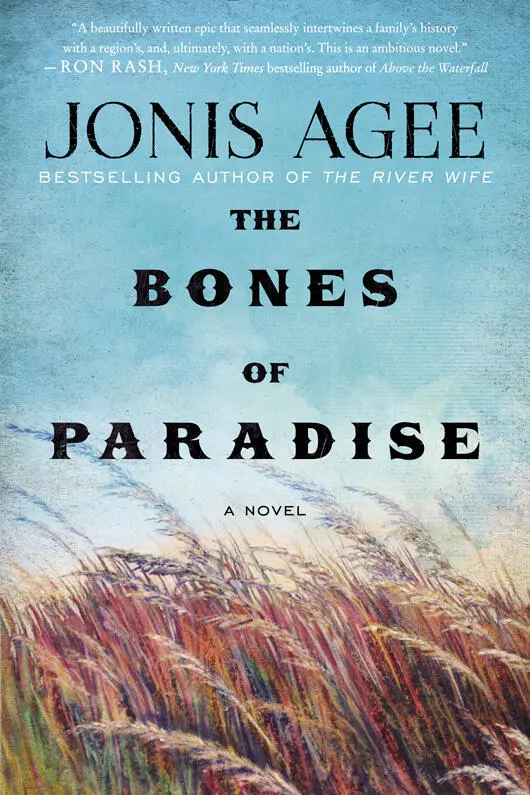
Jonis Agee - The Bones of Paradise
Здесь есть возможность читать онлайн «Jonis Agee - The Bones of Paradise» весь текст электронной книги совершенно бесплатно (целиком полную версию без сокращений). В некоторых случаях можно слушать аудио, скачать через торрент в формате fb2 и присутствует краткое содержание. Год выпуска: 2016, Издательство: William Morrow, Жанр: Современная проза, на английском языке. Описание произведения, (предисловие) а так же отзывы посетителей доступны на портале библиотеки ЛибКат.
- Название:The Bones of Paradise
- Автор:
- Издательство:William Morrow
- Жанр:
- Год:2016
- ISBN:нет данных
- Рейтинг книги:3 / 5. Голосов: 1
-
Избранное:Добавить в избранное
- Отзывы:
-
Ваша оценка:
The Bones of Paradise: краткое содержание, описание и аннотация
Предлагаем к чтению аннотацию, описание, краткое содержание или предисловие (зависит от того, что написал сам автор книги «The Bones of Paradise»). Если вы не нашли необходимую информацию о книге — напишите в комментариях, мы постараемся отыскать её.
returns with a multi-generational family saga, set in the unforgiving Nebraska Sandhills in the years following the massacre at Wounded Knee—an ambitious tale of history, vengeance, race, guilt, betrayal, family, and belonging, filled with a vivid cast of characters shaped by violence, love, and a desperate loyalty to the land. Ten years after the 7th Calvary massacred more than 200 Lakota men, women, and children at Wounded Knee, J. B. Bennett, a white rancher, and Star, a young Native American woman, are murdered in a remote meadow on J. B.’s land. The deaths bring together the scattered members of the Bennett family: his cunning and hard father, Drum; his estranged wife, Dulcinea; and his young sons, Cullen and Hayward. As the mystery of these twin deaths unfolds, the history of the dysfunctional Bennett’s and their damning secrets are revealed exposing the conflicted heart of a nation caught between past and future.
At the center of
are two remarkable women. Dulcinea, returned after bitter years of self-exile, yearns for redemption and the courage to mend her broken family and reclaim the land that is rightfully hers. Rose, scarred by the terrible slaughters that have decimated and dislocated her people, struggles to accept the death of her sister, Star, and refuses to rest until she is avenged.
A kaleidoscopic portrait of misfits, schemers, chancers, and dreamers, Jonis Agee’s bold new novel is a panorama of America at the dawn of a new century. A beautiful evocation of this magnificent, blood-soaked land—its sweeping prairies, seas of golden grass and sandy hills, all at the mercy of two unpredictable and terrifying forces, weather and lawlessness—and the durable men and women who dared to tame it. Intimate and epic,
is a remarkable achievement: a mystery, a tragedy, a romance, and an unflagging exploration of the beauty and brutality, tenderness and cruelty that defined the settling of the American west.
The Bones of Paradise — читать онлайн бесплатно полную книгу (весь текст) целиком
Ниже представлен текст книги, разбитый по страницам. Система сохранения места последней прочитанной страницы, позволяет с удобством читать онлайн бесплатно книгу «The Bones of Paradise», без необходимости каждый раз заново искать на чём Вы остановились. Поставьте закладку, и сможете в любой момент перейти на страницу, на которой закончили чтение.
Интервал:
Закладка:
Inside the cool shadows of the barn she stopped to let her eyes adjust, and then headed to the back, where they’d stalled the new horses. Relief washed over her as the gray stallion poked his head over the stall door and nickered. The black mare paced uneasily, her coat damp, while the bay munched hay with a contented eye. They needed to stretch their legs. She searched for the halters and found them in the dust on the ground.
Sloppy. J.B. wouldn’t put up with hands treating equipment this way, and neither would she. Time to stand up to these men. She raised her head and straightened her shoulders. They’d hate taking orders from her, but they’d learn.
She led the mares out one at a time, starting with the bay, who helped settle the nervous black. The horses needed names. Maybe she should let the boys decide. She recalled Cullen laughing at her and knew it was likely a waste of time. She turned them loose in the big square pen beside the barn, and each let itself down with a groan, rolled over and over, then stood, shook off the dust like a dog, spun and galloped and bucked around the pen until it tired. It had been a long train ride from Kentucky for the two pregnant mares, but they seemed in good shape.
She went back in the barn for the stallion. As she caressed his long neck, she wondered what J.B. would have thought of her gift, bought with her own money. She had planned it so carefully. He would bring both boys to her, the three of them reunited, a family. Of course, they’d have to work out the problems, but it would be a fresh start. She’d used an old acquaintance of her father’s, who owned racehorses, to procure these three from a reputable breeder. The gray was just below the rank of top sires. He’d broken down his first race with a badly bowed tendon, so he was cheap. The two mares were of the same quality: good, not excellent. Perfect for her plan. She imagined J.B. walking through the stable door, whistling, hands thrust in the pockets of his jeans, smiling to see her. She started to think of good things to tell him, but the illusion faded and foamy salt filled her mouth like blowback from a running horse. He had written her about the spotted mare, a brief note she’d pondered, wondering if he had killed her himself or had one of the men do it, or maybe done as he’d suggested so many years before and turned her loose to die of cold, starvation, or mountain lions. It was another stone she stacked on the wall between them. Go get your son, she’d ordered him in March. Now he was dead. Drum had to be the killer. She felt a chill on her face, stopped and heard the men yelling and whistling at the cattle in the branding pen outside. Cullen was home now, yet the thought gave her little comfort. Something was wrong with the boy.
“Damn you, J.B.,” she cursed under her breath as the stallion swung around and headed toward the water bucket, shoving it with his nose so it splashed. It shouldn’t be so full, Dulcinea thought, why wasn’t he drinking?
He pushed the bucket again, and more water slopped over the sides. “Stop it,” Dulcinea said and pressed her hand to his chest, backing him away.
The mouse was a small brown field variety, with a long tail that lay on top of the water like a thick piece of string unfurled, weaving back and forth as if steering the exhausted body between scrabbling attempts to climb the slick sides of the bucket. It didn’t seem to notice the woman watching. It was far beyond that scale of worry and menace.
Dulcinea cupped her hand underneath to lift it, and it managed to swim over her fingers. She tried again, this time with both hands, raising it up, water streaming, the soft mewling exhausted and angry. She thought to close her hands, but didn’t want it to bite or scratch. The mouse had suffered enough. She released it by a small hole in the corner of the stall. Outside she heard a commotion of voices rise then quickly fall. Maybe it was the boys. She should let them grieve, although a part of her wished they were more like their father and didn’t put themselves on display so much. Without her family’s social courtesies, and lacking the code of western men, they were more like dogs let off the chain. Although she would not admit it to a soul, they frightened her. If only she and Rose could find the killer. Then she would leave these hills and take the boys with her; they would improve with education, she was sure of it.
When she led the stallion out to his pen, she saw Larabee, Irish Jim, and Willie Munday resting in the shade beside the barn, their clothes and faces streaked with dirt-soaked sweat, three shovels propped next to them. They’d been working on the road between the ranches since Drum demanded they improve it. She wanted to tell them not to spend much muscle because she intended to put a stop to his plans this week. As she turned the horse loose, someone called her name from the hayloft window. Rose stood in the opening, pointing toward the house, where Percival Chance stepped down from a tall, narrow bay mare with a crooked white stripe down her nose that veered to the right at her nostrils. Beside him, Alvin Eckhart, the sheriff, struggled to dismount from a nondescript shaggy brown horse that could only be another refugee from Dun Riggins’s livery stable. Overweight and unused to riding, the sheriff looked pale and sweaty as he stumbled to maintain his feet and stand beside the horse to loosen the girth.
She ignored the newcomers and turned to the resting cowboys. “Why aren’t you men working? There’s a lot of daylight left.” She found herself imitating J.B.’s manner of address with the men.
They stopped talking and averted their eyes as they brushed the dirt from their trousers and shirts.
“We’re waiting on Higgs.” Larabee indicated the foreman’s house with a tilt of his head.
“Go knock on the door and find out what he wants you to do, for heaven’s sake.” She was tired of these men and their mincing rules.
The other two looked at the ground while Larabee shrugged and shook his head. “Rule one: don’t bother Higgs in his house.”
She snorted. “Rule two: don’t expect to get paid for standing around half a day. So here’s work: Willie, you clean the henhouse, pull out the old bedding, line the laying boxes with fresh grass, and wash the waterers and feeders. Irish Jim: You clean the horse stalls and lay down fresh bedding. Then scrub out the water buckets and refill them. Larabee: you shovel the manure out of the corrals and clean the water tanks. When you’re done, you can start taking down the cobwebs in the stable, and I want the tack hung up properly in the tack room. No more throwing equipment on the ground. If you still have time on your hands, check with me. I don’t mind being bothered if it means you earn your keep.”
She blushed at their surprised expressions, yet knew from teaching school and every other job she’d held over the last ten years that she had to stay firm or they’d spot her softness, and that never did anybody any good.
Chance wore a small grin, and his eyes appraised her anew. She took in the pink glow on his cheeks from the ride in the full hot sun that produced a sprinkle of freckles over his nose and on the backs of his hands. She was surprised he didn’t wear gloves like most of the town men, but when she put out her hand the way a man would, she recognized the reassurance the callused palm gave his grip. He was a handsome man, yet her body felt uneasy around him and she couldn’t say why.
“That’ll teach them to sit idle when the boss is around,” he said with a laugh.
“Ma’am.” The sheriff managed to tip his hat and wipe his face with a big blue square handkerchief at the same time.
“We’ll go inside,” she said and looked back at the barn where Rose stood in the shadows. It would help if she’d come and hear what was said. She tipped her head, gave a small wave of her hand, and hoped Rose understood.
Читать дальшеИнтервал:
Закладка:
Похожие книги на «The Bones of Paradise»
Представляем Вашему вниманию похожие книги на «The Bones of Paradise» списком для выбора. Мы отобрали схожую по названию и смыслу литературу в надежде предоставить читателям больше вариантов отыскать новые, интересные, ещё непрочитанные произведения.






Обсуждение, отзывы о книге «The Bones of Paradise» и просто собственные мнения читателей. Оставьте ваши комментарии, напишите, что Вы думаете о произведении, его смысле или главных героях. Укажите что конкретно понравилось, а что нет, и почему Вы так считаете.