Jonis Agee - The Bones of Paradise
Здесь есть возможность читать онлайн «Jonis Agee - The Bones of Paradise» весь текст электронной книги совершенно бесплатно (целиком полную версию без сокращений). В некоторых случаях можно слушать аудио, скачать через торрент в формате fb2 и присутствует краткое содержание. Год выпуска: 2016, Издательство: William Morrow, Жанр: Современная проза, на английском языке. Описание произведения, (предисловие) а так же отзывы посетителей доступны на портале библиотеки ЛибКат.
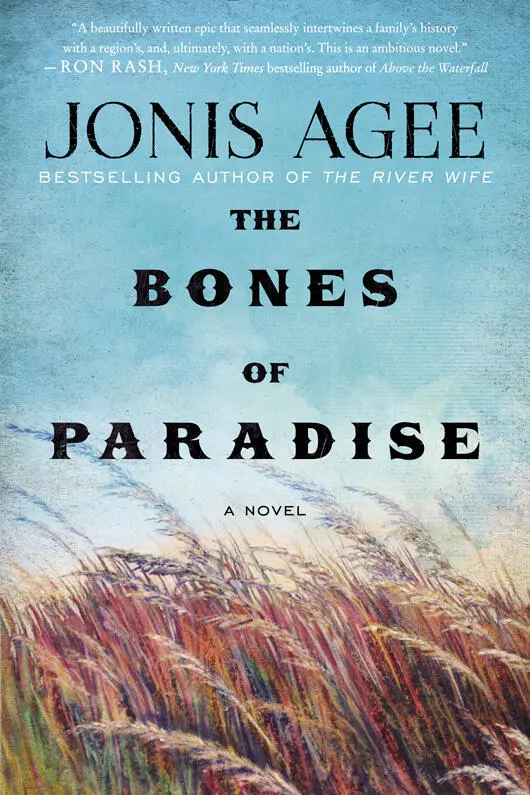
- Название:The Bones of Paradise
- Автор:
- Издательство:William Morrow
- Жанр:
- Год:2016
- ISBN:нет данных
- Рейтинг книги:3 / 5. Голосов: 1
-
Избранное:Добавить в избранное
- Отзывы:
-
Ваша оценка:
The Bones of Paradise: краткое содержание, описание и аннотация
Предлагаем к чтению аннотацию, описание, краткое содержание или предисловие (зависит от того, что написал сам автор книги «The Bones of Paradise»). Если вы не нашли необходимую информацию о книге — напишите в комментариях, мы постараемся отыскать её.
returns with a multi-generational family saga, set in the unforgiving Nebraska Sandhills in the years following the massacre at Wounded Knee—an ambitious tale of history, vengeance, race, guilt, betrayal, family, and belonging, filled with a vivid cast of characters shaped by violence, love, and a desperate loyalty to the land. Ten years after the 7th Calvary massacred more than 200 Lakota men, women, and children at Wounded Knee, J. B. Bennett, a white rancher, and Star, a young Native American woman, are murdered in a remote meadow on J. B.’s land. The deaths bring together the scattered members of the Bennett family: his cunning and hard father, Drum; his estranged wife, Dulcinea; and his young sons, Cullen and Hayward. As the mystery of these twin deaths unfolds, the history of the dysfunctional Bennett’s and their damning secrets are revealed exposing the conflicted heart of a nation caught between past and future.
At the center of
are two remarkable women. Dulcinea, returned after bitter years of self-exile, yearns for redemption and the courage to mend her broken family and reclaim the land that is rightfully hers. Rose, scarred by the terrible slaughters that have decimated and dislocated her people, struggles to accept the death of her sister, Star, and refuses to rest until she is avenged.
A kaleidoscopic portrait of misfits, schemers, chancers, and dreamers, Jonis Agee’s bold new novel is a panorama of America at the dawn of a new century. A beautiful evocation of this magnificent, blood-soaked land—its sweeping prairies, seas of golden grass and sandy hills, all at the mercy of two unpredictable and terrifying forces, weather and lawlessness—and the durable men and women who dared to tame it. Intimate and epic,
is a remarkable achievement: a mystery, a tragedy, a romance, and an unflagging exploration of the beauty and brutality, tenderness and cruelty that defined the settling of the American west.
The Bones of Paradise — читать онлайн бесплатно полную книгу (весь текст) целиком
Ниже представлен текст книги, разбитый по страницам. Система сохранения места последней прочитанной страницы, позволяет с удобством читать онлайн бесплатно книгу «The Bones of Paradise», без необходимости каждый раз заново искать на чём Вы остановились. Поставьте закладку, и сможете в любой момент перейти на страницу, на которой закончили чтение.
Интервал:
Закладка:
“That horse isn’t real cowy,” Graver said by way of making conversation. Jerome smiled.
“I should hope not,” Dulcinea said. “We’re going to breed a new kind of horse out here, one that will, well, one that will be a pleasure to ride and possess greater beauty and intelligence. And it can be taught about cows.” She dropped her chin and frowned. “Where are those boys?”
“You could give them a holler,” Graver said and leaned against the post that held up the porch overhang. He studied the stallion, a tall gray with four white socks, and wondered about its bloodlines.
“We’ll go and set up some bottles and try them out.” Cullen exited first, cradling his new rifle across his chest like an orphan calf, followed by Hayward, adjusting how the new holster rode his hips.
“These sit a little heavy. Maybe I should just wear one. Leave the other one on my saddle. It’s hard to walk. Maybe I should—”
“You bought guns,” Dulcinea said, her expression flat.
“Aren’t they something?” Cullen held up his rifle so it pointed at the stallion’s chest. Graver straightened. Even Hayward looked startled and reached a hand toward his brother, then let it drop.
“Hayward’s too young for those pistols,” she said.
“I am not! Watch—” He drew the guns so quickly she gasped. “I got a cross draw, too.” He flipped the guns into their holsters and just as quickly pulled them out cross armed, wearing a big proud grin.
“But how accurate are you?” Graver said. “Doesn’t matter how fast you are if you can’t shoot straight.”
“I hit everything I’m aiming at.” The boy pouted.
“And I get anything he misses,” Cullen said.
“We’ll have this discussion at the ranch,” Dulcinea said.
Cullen stared at the horse, fascinated, as he slowly shook his head.
She fixed the boys with a hard stare. “I need you to help get the wagons home. You can come back tomorrow or the next day if Higgs doesn’t have work for you.”
“Can I ride him?” Cullen asked.
“In a few days. The mares are a gift for you boys. The stud was for your father, so—” Dulcinea hesitated.
Cullen’s eyes darkened and he looked away.
“I need your help in exchange, though.” She glanced at Graver.
“Can I ride him now, on the way home?” Cullen asked.
“Nooo, you have to earn his trust first. Now what I do need help with . . .”
“Get off the horse,” Cullen said, and his carelessly held rifle swung upward and pointed at his mother. Without thinking, Graver shoved past Hayward and slammed into Cullen hard enough to knock him backward. He grabbed the rifle and flung it away as the boy fell against the Emporium wall, rattling the plate-glass window. Then he pulled him up by the back of his shirt collar, shook him like a puppy, and slapped him hard across the face.
“A man doesn’t point a gun at a lady,” he said with another hard slap, leaving a bright red imprint on the boy’s cheek. “And don’t point a gun at anything you aren’t going to kill.”
With tears in his eyes Cullen yanked free and whispered, “Then you’re dead!”
Graver raised his hand to slap him again, and Dulcinea cried, “Stop! Cullen, Hayward, get on your horses now.”
Hayward looked at his brother, who shook his head as if to clear it and was about to retrieve the rifle when Graver stepped in his way. “At the ranch.”
Cullen slowly released his breath and straightened to stand eye to eye with the older man. “I been beat so hard I couldn’t walk, you think a couple little slaps mean anything? These hills are big, lonesome country—you better ride loose from now on. And you interfere with me and my mother again, I’ll kill you on the spot.” Graver could see tears in the boy’s eyes.
“Anything I can do for you folks?” The sheriff leaned against the wall of the Emporium, watching them.
Mrs. Bennett hesitated, then stepped down from the gray and handed the reins to Graver. “I need to speak with you,” she said, and the sheriff nodded toward his office a few doors away.
“Go on ahead, I’ll catch up,” she called back to Rose and Jerome Some Horses. “Boys, you go on, too.”
CHAPTER SEVENTEEN
Although she didn’t ask Graver to wait, he did, as he attempted to puzzle out where he’d seen that lawyer before. Then he remembered the December day ten years ago when he’d gone up to Wounded Knee, hitching a ride with a wagonload of whiskey for the extra troops, who arrived so quickly they outran their supplies, especially nonessentials like liquor. The merchants in Rushville had telegraphed an urgent order to Babylon and John Parker had decided to take matters into his own hands. His plan was to drive all the way to Wounded Knee and sell directly to the troops. It was a spur-of-the-moment decision on Graver’s part. One moment he was listening to the talk in the livery stable, where he’d come to have a broken wagon wheel repaired by the blacksmith, the next he was helping Parker heft the barrels and bottles of whiskey on the wagon and climbing up beside him.
The ride there was bitter cold, and the wind bit into his face and through his coat. He and his bride had just moved into the hills, and it felt like a fine adventure to finally see an Indian encampment and the soldiers he’d heard so much about. His wife was safe; he’d kissed her good-bye and left her in a room at the hotel with a book and plenty of blankets against the cold. He’d also left her with the last of their cash in case she needed anything. Even then, he shook his head at his ignorance. She was seventeen. Of course her eye would be taken by the bright playthings the stores displayed.
They arrived just after dark, pulling behind the last row of tents so as not to attract the attention of the officers. The sentries let them through as soon as Parker revealed the wagon’s contents, and word quickly spread through the enlisted ranks. For a few hours, they did a land-office business, and by nine o’clock they were rolling out blankets in the bed of the empty wagon. Parker had saved one bottle for himself, and Graver took a couple of quick swallows to warm his empty stomach. By the time he drifted off to sleep, the drunken noise of the camp had grown so loud it formed a disturbing barricade that brought bad dreams and little rest.
He awoke at dawn to find his blankets and hair coated with heavy frost. Parker shook himself off and climbed down to piss. Graver followed, shaking in the damp cold that had settled in his clothes. Parker tilted his head toward the cooking fires and the two men were able to find coffee and plates of bacon and beans without much trouble, even though the soldiers, holding their swollen, battered faces in their hands as they fought hangovers, were less than eager to see them again. Graver could feel the ill will and short tempers ooze around the camp like a yellow pestilent cloud. Then the Indian drums began to pound and the heads of the men near them jerked up, eyes wild.
“Are they comin’?” one soldier whispered as he reached for the rifle on the ground beside him.
Another soldier stood and brought his telescope to his eyes. “Just dancing.” He sat down hard, as if his legs gave out.
“They’re comin’,” said the first soldier, who stood and cocked his rifle, his face covered in greasy sweat, a sour stink rolling off him in waves.
Parker stabbed his fork into another piece of bacon and jammed it in his mouth, then stood, placing his metal plate in a pile with the others. “Let’s take a look before we go.” He nodded toward the small valley where the tipis had been hastily rigged. The camp was alive with playing children, romping dogs, and figures collecting at the dance site, the drummers gathering on the circle.
Читать дальшеИнтервал:
Закладка:
Похожие книги на «The Bones of Paradise»
Представляем Вашему вниманию похожие книги на «The Bones of Paradise» списком для выбора. Мы отобрали схожую по названию и смыслу литературу в надежде предоставить читателям больше вариантов отыскать новые, интересные, ещё непрочитанные произведения.





Обсуждение, отзывы о книге «The Bones of Paradise» и просто собственные мнения читателей. Оставьте ваши комментарии, напишите, что Вы думаете о произведении, его смысле или главных героях. Укажите что конкретно понравилось, а что нет, и почему Вы так считаете.