Jonis Agee - The Bones of Paradise
Здесь есть возможность читать онлайн «Jonis Agee - The Bones of Paradise» весь текст электронной книги совершенно бесплатно (целиком полную версию без сокращений). В некоторых случаях можно слушать аудио, скачать через торрент в формате fb2 и присутствует краткое содержание. Год выпуска: 2016, Издательство: William Morrow, Жанр: Современная проза, на английском языке. Описание произведения, (предисловие) а так же отзывы посетителей доступны на портале библиотеки ЛибКат.
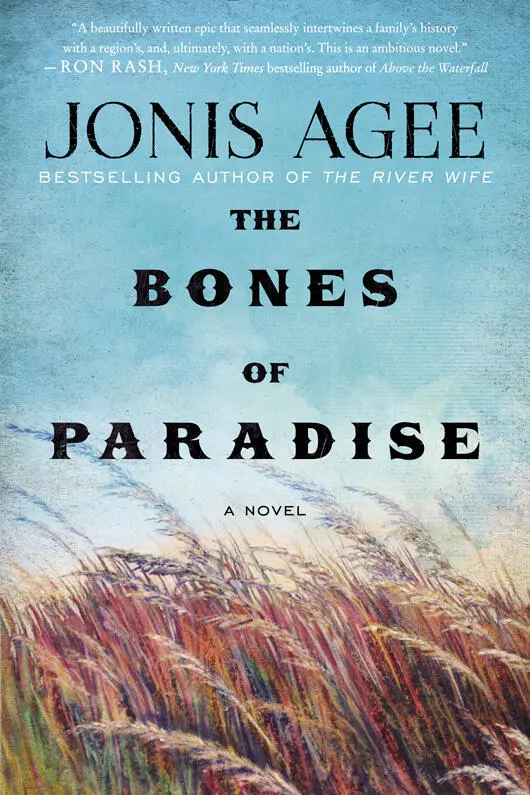
- Название:The Bones of Paradise
- Автор:
- Издательство:William Morrow
- Жанр:
- Год:2016
- ISBN:нет данных
- Рейтинг книги:3 / 5. Голосов: 1
-
Избранное:Добавить в избранное
- Отзывы:
-
Ваша оценка:
The Bones of Paradise: краткое содержание, описание и аннотация
Предлагаем к чтению аннотацию, описание, краткое содержание или предисловие (зависит от того, что написал сам автор книги «The Bones of Paradise»). Если вы не нашли необходимую информацию о книге — напишите в комментариях, мы постараемся отыскать её.
returns with a multi-generational family saga, set in the unforgiving Nebraska Sandhills in the years following the massacre at Wounded Knee—an ambitious tale of history, vengeance, race, guilt, betrayal, family, and belonging, filled with a vivid cast of characters shaped by violence, love, and a desperate loyalty to the land. Ten years after the 7th Calvary massacred more than 200 Lakota men, women, and children at Wounded Knee, J. B. Bennett, a white rancher, and Star, a young Native American woman, are murdered in a remote meadow on J. B.’s land. The deaths bring together the scattered members of the Bennett family: his cunning and hard father, Drum; his estranged wife, Dulcinea; and his young sons, Cullen and Hayward. As the mystery of these twin deaths unfolds, the history of the dysfunctional Bennett’s and their damning secrets are revealed exposing the conflicted heart of a nation caught between past and future.
At the center of
are two remarkable women. Dulcinea, returned after bitter years of self-exile, yearns for redemption and the courage to mend her broken family and reclaim the land that is rightfully hers. Rose, scarred by the terrible slaughters that have decimated and dislocated her people, struggles to accept the death of her sister, Star, and refuses to rest until she is avenged.
A kaleidoscopic portrait of misfits, schemers, chancers, and dreamers, Jonis Agee’s bold new novel is a panorama of America at the dawn of a new century. A beautiful evocation of this magnificent, blood-soaked land—its sweeping prairies, seas of golden grass and sandy hills, all at the mercy of two unpredictable and terrifying forces, weather and lawlessness—and the durable men and women who dared to tame it. Intimate and epic,
is a remarkable achievement: a mystery, a tragedy, a romance, and an unflagging exploration of the beauty and brutality, tenderness and cruelty that defined the settling of the American west.
The Bones of Paradise — читать онлайн бесплатно полную книгу (весь текст) целиком
Ниже представлен текст книги, разбитый по страницам. Система сохранения места последней прочитанной страницы, позволяет с удобством читать онлайн бесплатно книгу «The Bones of Paradise», без необходимости каждый раз заново искать на чём Вы остановились. Поставьте закладку, и сможете в любой момент перейти на страницу, на которой закончили чтение.
Интервал:
Закладка:
Behind them a bugle sounded and the hungover men clumsily prepared arms. The Indians seemed to ignore the soldiers, although Graver noticed some officers in conversation with a couple of their elders, while their few young men acted guard, pacing nervously behind them.
This went on for a while until the young men went back to their tipis, retrieved their old guns and pistols, and dropped them at the feet of the colonel in charge. The steady drumbeat and pulsing rhythm found its way into Graver’s body—thud, thud, thud, the sound pumped in his blood, up his legs, into his chest, down his arms, and inside his head, knocked against his skull and the backs of his eyes until he felt both restless and lulled. The din of the soldiers behind them grew louder, and the young braves standing guard paced, keeping one eye on the soldiers. Graver saw the big Hotchkiss cannons wheeled into place on the rise above the camp. Surely they didn’t mean to . . .
A dancer threw back his head, chanting in Lakota, and tossed a handful of dirt to the sky. Then a rifle fired. There was a moment of stunned silence, and then all at once every gun roared in reply. Parker pulled him flat and they watched as the cavalry fought the Indians. The big guns mowed down dancers, tipis, children, dogs, old people, and women alike. At some point Graver clamped his hands over his ears and squeezed his eyes shut. Behind him, he could hear soldiers hit by gunfire cry out.
When the Hotchkiss guns finally went silent, Graver rose to his hands and knees, looked out across what was left of the camp, now strewn with bodies and burning tipis, and threw up. Parker stood, his expression dazed. He shook his head, made a sound of disgust in his throat, spit, and turned away. “I’ve had enough. You coming?”
Graver paused, uncertain, and then followed. They didn’t speak all the way to Rushville, where they were forced to spend the night because Parker had driven the horses too hard the night before.
They bedded in the livery, since it was already snowing. The New Year coming, and his wife alone. At the time, Graver had no idea that night was only the start of the disappointment that awaited her in married life. Warm at last, nestled in the straw of the loft, he couldn’t stop replaying the morning’s bloody images, and finally he rose and walked down the street to the hotel. Although it was coming on midnight, the town was awake with dangerous energy like they rode an electrical current that would never release them. He could hear men swearing and fighting up and down the street. Whatever they had done up there, he was sure they would never be free of it.
At the hotel saloon he stood at the bar and ordered a beer. The stranger next to him turned and raised his glass in a toast. Graver stared at the man, tall, blond, and handsome with unearned amusement in his eyes, like he had won some game without having to play too hard. His lips were pursed as if he held in outright laughter and Graver’s first instinct was to punch him in the face. The man dropped something on the bar and Graver stared at a pair of child’s moccasins, beaded, the bottoms barely worn. He raised his eyes to the stranger, who shrugged and drank from his glass of whiskey.
“You there today? Thought I saw you there. Yes, you were the one brought the whiskey to the troops.” The man nodded and a conspirator’s smile, small and confident, appeared on his face.
Graver thought to deny that it was his liquor, then said nothing and looked at his beer. He didn’t want to be here. Didn’t want the man to say another word.
“We were lucky to be there. Spectacular show. Never saw anything like it. Especially afterwards . . . some wonderful pieces to be had . . . I found these on a young girl.” He spread his palm over the moccasins.
Graver lifted his fist, then dropped it, turned, and walked out. The man’s smug laughter followed him all the way into sleep when it finally arrived around dawn. The memory still chilled him, made him feel as if he had somehow used a gun on those people, too.
The lawyer, Percival Chance, was the man in the bar, Graver was certain. He would never forget the amused expression on the man’s face as he gestured toward his trophy.
CHAPTER EIGHTEEN
As soon as she reached the end of the block, Rose turned the uncooperative horses and circled behind the Emporium. Tying them to the rail, she eased around to the back door, the one Indians were forced to use. White people paid little attention to the comings and goings back here. She pulled the door open slowly so it didn’t squeak and let it settle behind her without latching.
The storeroom was in twilight compared to the next room, and she took her time, gazing around at the bags of flour, sugar, and coffee alongside barrels that held whiskey and pickles. She had never understood pickles, and she hated whiskey. She was of half a mind to stick her skinning knife in the barrels to release their contents, but had more important things to do. She edged to the door and peered into the main room, where Smith hustled up and down aisles waiting on white customers, too cheap to hire help. She could do it, she knew every item in the store, where it was, and what it cost. She’d spent that much time studying what she couldn’t afford. If he caught her now, he might ban them forever. As it was, they were only allowed in on Mondays and Thursdays, never the weekends when most ranch families came to town. And they had to be gone from town by five P.M.
She thought of pulling her shirt over her head and half covering her face, knowing that it wouldn’t make her invisible to others, that it would only make her feel better. In fact, it might make her more distinct. She took a deep breath and edged into the main room, eyeing Smith as she ducked behind the counter.
A yellow-haired white woman in a plain white cotton dress filled the aisle ahead, speaking over her shoulder to the storekeeper as she shook out a remnant of gingham cloth. “I want something original, handmade. I’m surprised you have nothing made by Indians here. Surely you can put them to work beading and sewing. Why in Denver, I visited the most wonderful store full of Indian crafts.”
The yellow-haired woman wanted to buy a headdress, a pair of moccasins, a quilled or beaded medicine bag. She only wanted handmade. Rose imagined more women like her collecting tribal goods for their houses, putting her people on display as curiosities. These people stuffed the animals they killed, and would stuff Indians too if they could. Although whites thought her slow-witted, Rose was known as a wise woman on the reservation, one who could read English on her own. She’d read all the contracts her people had made with the U.S. government. She spoke with the tribal elders about the laws that changed constantly, and the ways the government cheated them out of their allotted land and food. But none of that mattered after Star was found murdered. Now she had one job: to find the man who had killed two women in her family. From what Star had said that last day at the trading post in Mission, Rose believed she had found him. Then she was killed on Bennett land. Rose knew the answers were out there, and hoped, for Dulcinea’s sake, that it wasn’t J. B. Bennett or her boys. She planned to take her revenge. No counting coups this time.
Rose searched the shelves under the counter. She had to hurry before Smith came back for the shawl and belt to show the white woman. She hoped he hadn’t the time to put it away in his storeroom. She’d made the belt for Star, but her sister was killed before she had the chance to give it to her, and Rose had vowed she’d wear it forever when she learned of her death. There it was, the white stars glowing under her shawl. He could keep that, it meant nothing. She pulled out the belt and wrapped it around her waist, pulling her shirttail over it before standing and quickly leaving the way she’d come, shoulders stiff against the fear of his voice demanding that she stop.
Читать дальшеИнтервал:
Закладка:
Похожие книги на «The Bones of Paradise»
Представляем Вашему вниманию похожие книги на «The Bones of Paradise» списком для выбора. Мы отобрали схожую по названию и смыслу литературу в надежде предоставить читателям больше вариантов отыскать новые, интересные, ещё непрочитанные произведения.








Обсуждение, отзывы о книге «The Bones of Paradise» и просто собственные мнения читателей. Оставьте ваши комментарии, напишите, что Вы думаете о произведении, его смысле или главных героях. Укажите что конкретно понравилось, а что нет, и почему Вы так считаете.