Jonis Agee - The Bones of Paradise
Здесь есть возможность читать онлайн «Jonis Agee - The Bones of Paradise» весь текст электронной книги совершенно бесплатно (целиком полную версию без сокращений). В некоторых случаях можно слушать аудио, скачать через торрент в формате fb2 и присутствует краткое содержание. Год выпуска: 2016, Издательство: William Morrow, Жанр: Современная проза, на английском языке. Описание произведения, (предисловие) а так же отзывы посетителей доступны на портале библиотеки ЛибКат.
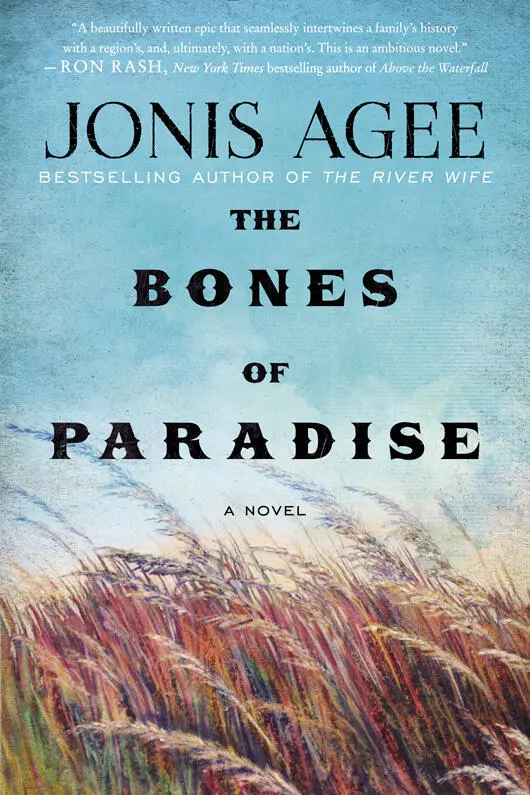
- Название:The Bones of Paradise
- Автор:
- Издательство:William Morrow
- Жанр:
- Год:2016
- ISBN:нет данных
- Рейтинг книги:3 / 5. Голосов: 1
-
Избранное:Добавить в избранное
- Отзывы:
-
Ваша оценка:
The Bones of Paradise: краткое содержание, описание и аннотация
Предлагаем к чтению аннотацию, описание, краткое содержание или предисловие (зависит от того, что написал сам автор книги «The Bones of Paradise»). Если вы не нашли необходимую информацию о книге — напишите в комментариях, мы постараемся отыскать её.
returns with a multi-generational family saga, set in the unforgiving Nebraska Sandhills in the years following the massacre at Wounded Knee—an ambitious tale of history, vengeance, race, guilt, betrayal, family, and belonging, filled with a vivid cast of characters shaped by violence, love, and a desperate loyalty to the land. Ten years after the 7th Calvary massacred more than 200 Lakota men, women, and children at Wounded Knee, J. B. Bennett, a white rancher, and Star, a young Native American woman, are murdered in a remote meadow on J. B.’s land. The deaths bring together the scattered members of the Bennett family: his cunning and hard father, Drum; his estranged wife, Dulcinea; and his young sons, Cullen and Hayward. As the mystery of these twin deaths unfolds, the history of the dysfunctional Bennett’s and their damning secrets are revealed exposing the conflicted heart of a nation caught between past and future.
At the center of
are two remarkable women. Dulcinea, returned after bitter years of self-exile, yearns for redemption and the courage to mend her broken family and reclaim the land that is rightfully hers. Rose, scarred by the terrible slaughters that have decimated and dislocated her people, struggles to accept the death of her sister, Star, and refuses to rest until she is avenged.
A kaleidoscopic portrait of misfits, schemers, chancers, and dreamers, Jonis Agee’s bold new novel is a panorama of America at the dawn of a new century. A beautiful evocation of this magnificent, blood-soaked land—its sweeping prairies, seas of golden grass and sandy hills, all at the mercy of two unpredictable and terrifying forces, weather and lawlessness—and the durable men and women who dared to tame it. Intimate and epic,
is a remarkable achievement: a mystery, a tragedy, a romance, and an unflagging exploration of the beauty and brutality, tenderness and cruelty that defined the settling of the American west.
The Bones of Paradise — читать онлайн бесплатно полную книгу (весь текст) целиком
Ниже представлен текст книги, разбитый по страницам. Система сохранения места последней прочитанной страницы, позволяет с удобством читать онлайн бесплатно книгу «The Bones of Paradise», без необходимости каждый раз заново искать на чём Вы остановились. Поставьте закладку, и сможете в любой момент перейти на страницу, на которой закончили чтение.
Интервал:
Закладка:
Some Horses waited at the edge of town, and the boys were nowhere in sight. Rose’s heart thumped at the sight of her family. Lily was the leader in the games and tricks the children played on their elders, and Some Horses was popular for his funny stories and quick schemes. He made money off any whites who happened to cross his path. Their history was a tale of survival, whether it was recorded as the winter count on the tipis or in the stories and songs they passed along their generations. Even now, the Lakota held hidden gatherings to practice the peyote religion that had made its way from the Southwest, while the Christian converts decorated their churches in traditional Lakota colors. Some of the priests understood, learned their language and studied their beliefs so the two could merge without harm. She’d even heard of one priest who secretly entered traditional life, living in his residence only when his own elders visited. Otherwise, he was a married man who supported a family, attended sweats in the lodge behind the church, and observed the traditional calendar alongside the Christian one. It wasn’t especially confusing to her people. She wasn’t so sure about the whites, who seemed able to grasp only a single thought or belief at a time. She pitied them in that.
As she drew up beside the runabout, the paint tried to buck in its traces, and she checked him with the rein, so instead he reached over and bit the fat mare’s neck. She squealed but slumped her head in defeat. Rose picked up the whip and gave him a stinging cut across his wide buttocks and cursed him in Lakota. He stood trembling, and then hesitantly twisted his head around to peer back at her. She commanded him to move in Lakota. He put his shoulders into the harness and trudged forward. She wondered where the pony came from on the reservation.
With time to think on the ride back to the ranch, Rose said a quick prayer to Star, and waited, but received no reply. It was discouraging. Either the ghost was with her or not. She had entered into a fearful bargain with her dead sister, violated all of their teachings about death. If her people knew that she’d invited the ghost back to live with her, they would shun her, or worse, insist she spend time alone, without family, and undergo a cleanse in the hope that her sister could be persuaded to the red road and home.
“I know what I’m doing,” she whispered and lifted the reins to urge the horses faster than their plodding walk so the runabout wouldn’t get too far ahead. Ten years ago, she’d learned that no one cared about her people’s dead. Seventeen soldiers received the Medal of Honor for their killings at Wounded Knee and at White Clay Creek the following day. She spit to the side of the wagon. She alone was responsible for finding her sister’s killer. Dulcinea would ask the sheriff for help, and involve the white courts, but Rose knew it was worthless.
She thought about the Pine Ridge Indian School, where she’d been forced to board, where the doors were locked night and day, the grounds surrounded by barbed wire, and the children imprisoned for their own good, or so they were told. They were punished for speaking Lakota and could not practice their religion, but their families found ways to continue their traditions. Once her mother sent a doeskin bag filled with healing plants, their uses outlined with beads and signs that a white would interpret as mere decoration. Rose still had the bag, the last gift she’d received from her mother. It was for her also that she must undertake this vengeance. A flood of warm anger spread across her chest and she lifted her head to scan the hills.
This was not her first act of vengeance. Rose was known as a fierce warrior among those who attended the school. While the whites mistook her as untrainable, she worked against them and held secret classes where the children spoke their language, performed the pipe ritual, observed the moons, and practiced dancing. They were almost never discovered, and when they were she always took the blame, which would usually be light since she was considered too dumb to learn. She found her weapon, though. In February of 1894, she set fire to the school and burned it to the ground. The snow around it melted and the earth welcomed the new freedom from the weight of the building that had held so much wrong for so long. She sang prayers for her mother’s spirit that night as the sky burst yellow and red, strong colors, from the burning building. It wasn’t enough.
Her need for vengeance was a rank seed she watered daily, until even her husband grew afraid. After Star’s funeral, she spent two days sweating and praying, her husband and child left alone. Then she consulted the oldest woman on the reservation, the one person who held enough wisdom to help. The visit did not go well, and she left feeling more alone than ever before. It was her task only, she decided, although the woman told her that the world would die in a flood many lifetimes beyond, and that all creation would be called to justice, so there was no point to vengeance. She said too much wrong had tilted the people into chaos that would not be righted in her lifetime or her child’s or her child’s child’s. Her task was to survive, merely to survive. Rose jumped up from her chair and rushed out the door.
She had thought hard as she and Dulcinea rode back to the Bennetts’ ranch, and sent a message to Some Horses to meet her in town. She assured him she would not take any action that would endanger their family, their child, and that she merely wanted to bring the killer to the attention of white authorities. They both knew she lied, but in a marriage, one agrees to certain stories in order to survive. She would be careful, she promised herself. Her husband and child were part of her spirit and she theirs. She would die before seeing them harmed.
The runabout slowed and pulled to the side as Dulcinea and Graver galloped up and hauled their horses to a prancing stop. The two boys came whooping out of the little draw ahead and Rose saw Dulcinea watching her sons, a fearful expression on her face. Had they done the killings? Rose had asked around the reservation about Star and heard strange tales from her aunt’s husband, of some Lakota boys and white boys at the last rodeo. She wondered if these were the boys. She would find out.
As she drew up to the runabout, Some Horses glanced down at Lily squirming on the seat, then out into the flat expanse. The girl needed to pee. “Traveler’s stop. You go on ahead,” Rose said as she pulled up beside them.
Rose climbed down, handed the lines to Graver, and took her daughter out a ways, finally stopping in a patch of soapweed tall enough to screen the squatting child. Lily was about to stand when they heard the warning rattle behind her and both froze. Rose waited, tried not to hold her breath, and was on the verge of greeting the snake in Lakota when it uncoiled so she could see its huge head and thick body as it stretched to its full six feet. It gazed at her, tongue fingering the air, then oozed away, leaving a signature trail etched in the sandy dirt.
“Thank you, sister,” Rose whispered. Lily stared at her before she dropped her eyes and whimpered.
PART THREE. FALLING TOWARD the WOUND
CHAPTER NINETEEN
Dulcinea slept long and hard after the trip to town. She woke to find breakfast over and the ranch yard alive with men, horses, and bawling cattle. She paused on the front porch and looked for her boys. Were they already working? Somehow she doubted it, and the thought troubled. Then she recalled Cullen’s reaction to the stallion and trotted down the walk to the gate. Two men on horseback were coming down the road toward the ranch. Where was Graver? Or Rose and Some Horses?
Читать дальшеИнтервал:
Закладка:
Похожие книги на «The Bones of Paradise»
Представляем Вашему вниманию похожие книги на «The Bones of Paradise» списком для выбора. Мы отобрали схожую по названию и смыслу литературу в надежде предоставить читателям больше вариантов отыскать новые, интересные, ещё непрочитанные произведения.







Обсуждение, отзывы о книге «The Bones of Paradise» и просто собственные мнения читателей. Оставьте ваши комментарии, напишите, что Вы думаете о произведении, его смысле или главных героях. Укажите что конкретно понравилось, а что нет, и почему Вы так считаете.