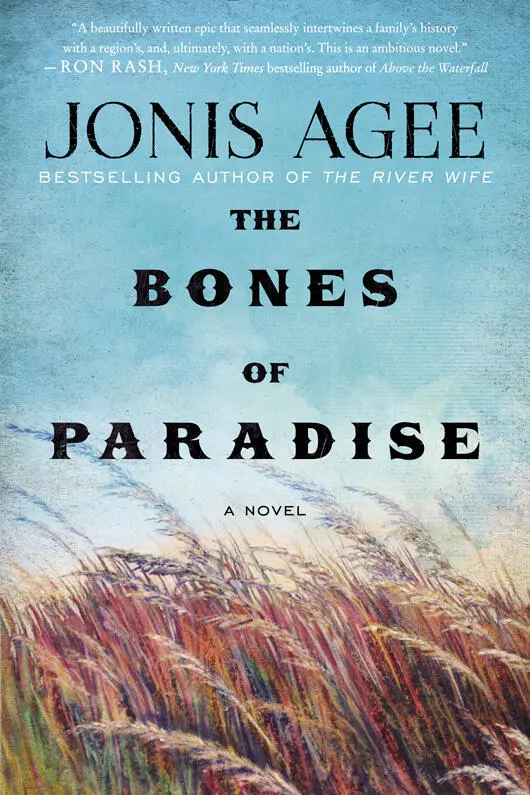
Jonis Agee - The Bones of Paradise
Здесь есть возможность читать онлайн «Jonis Agee - The Bones of Paradise» весь текст электронной книги совершенно бесплатно (целиком полную версию без сокращений). В некоторых случаях можно слушать аудио, скачать через торрент в формате fb2 и присутствует краткое содержание. Год выпуска: 2016, Издательство: William Morrow, Жанр: Современная проза, на английском языке. Описание произведения, (предисловие) а так же отзывы посетителей доступны на портале библиотеки ЛибКат.
- Название:The Bones of Paradise
- Автор:
- Издательство:William Morrow
- Жанр:
- Год:2016
- ISBN:нет данных
- Рейтинг книги:3 / 5. Голосов: 1
-
Избранное:Добавить в избранное
- Отзывы:
-
Ваша оценка:
The Bones of Paradise: краткое содержание, описание и аннотация
Предлагаем к чтению аннотацию, описание, краткое содержание или предисловие (зависит от того, что написал сам автор книги «The Bones of Paradise»). Если вы не нашли необходимую информацию о книге — напишите в комментариях, мы постараемся отыскать её.
returns with a multi-generational family saga, set in the unforgiving Nebraska Sandhills in the years following the massacre at Wounded Knee—an ambitious tale of history, vengeance, race, guilt, betrayal, family, and belonging, filled with a vivid cast of characters shaped by violence, love, and a desperate loyalty to the land. Ten years after the 7th Calvary massacred more than 200 Lakota men, women, and children at Wounded Knee, J. B. Bennett, a white rancher, and Star, a young Native American woman, are murdered in a remote meadow on J. B.’s land. The deaths bring together the scattered members of the Bennett family: his cunning and hard father, Drum; his estranged wife, Dulcinea; and his young sons, Cullen and Hayward. As the mystery of these twin deaths unfolds, the history of the dysfunctional Bennett’s and their damning secrets are revealed exposing the conflicted heart of a nation caught between past and future.
At the center of
are two remarkable women. Dulcinea, returned after bitter years of self-exile, yearns for redemption and the courage to mend her broken family and reclaim the land that is rightfully hers. Rose, scarred by the terrible slaughters that have decimated and dislocated her people, struggles to accept the death of her sister, Star, and refuses to rest until she is avenged.
A kaleidoscopic portrait of misfits, schemers, chancers, and dreamers, Jonis Agee’s bold new novel is a panorama of America at the dawn of a new century. A beautiful evocation of this magnificent, blood-soaked land—its sweeping prairies, seas of golden grass and sandy hills, all at the mercy of two unpredictable and terrifying forces, weather and lawlessness—and the durable men and women who dared to tame it. Intimate and epic,
is a remarkable achievement: a mystery, a tragedy, a romance, and an unflagging exploration of the beauty and brutality, tenderness and cruelty that defined the settling of the American west.
The Bones of Paradise — читать онлайн бесплатно полную книгу (весь текст) целиком
Ниже представлен текст книги, разбитый по страницам. Система сохранения места последней прочитанной страницы, позволяет с удобством читать онлайн бесплатно книгу «The Bones of Paradise», без необходимости каждый раз заново искать на чём Вы остановились. Поставьте закладку, и сможете в любой момент перейти на страницу, на которой закончили чтение.
Интервал:
Закладка:
The boys were sullen at supper, eating quickly and sloppily with their faces a few inches from their plates, refusing to answer the lawyer’s polite inquiries. Although she hadn’t wanted to, she’d invited him to stay the night since his interviews with the men had taken the rest of the day. Rose was silent when Dulcinea told her about the lawyer’s offer without mentioning the sheriff’s initial conclusion. Maybe Rose already knew, maybe all the Indians believed it was her boys. The thought made her frantic.
Chance raised his voice to be heard above Drum’s constant thumping overhead. “Do you find many Indian artifacts in your blowouts?” The boys glanced at each other.
“Hayward, I saw a collection of arrowheads in your room. Why don’t you tell Mr. Chance about them?”
Her son’s face reddened with the effort to remain silent as he pushed at the half-eaten slab of chicken with his fork. A sly smile widened Cullen’s mouth. Was it possible to dislike her own flesh and blood so much she wished them ill? She wanted to tell Cullen that she didn’t even recognize him. She wanted to announce that he had to leave her table and never return. She hated herself for it and turned her attention to him with a smile.
“Cullen, perhaps with your greater experience, you wish to speak to Mr. Chance’s question.” She touched her lips with her napkin and lifted her chin. He glared at her with such pure hatred it made her skin clammy. How did her lovely towheaded boy become this Cullen? She looked deeper into his eyes, searching for that boy, but they remained bottomless, empty, as if she could see through the dark tunnel to his skull.
Then he pushed back his chair, stood, lifted his hand and dropped the linen napkin on the gravy laden plate, shoved the chair against the table, rattling the glasses, and strode toward the stairs, mounting them with the litheness of a cat leaping from limb to limb. The pounding on the ceiling stopped, and those left at the table absorbed the silence in its wake.
Higgs and Vera studied their plates. Hayward looked confused as to whether he should follow his brother or finish the food he eyed hungrily. With a sigh he cut a large chunk of chicken breast and stuffed it in his mouth, chewing rapidly. When he tried to swallow and commenced to choke, it was Chance who thumped him on the back and handed him a glass of water. Hayward almost thanked him when he could breathe again, caught himself, and settled for a quick nod. Chance looked at Dulcinea with a twinkle in his eyes. She glanced at Vera in time to catch her watching them with an odd, distracted expression.
Cullen still hadn’t reappeared when they’d finished the meal, so Dulcinea invited Hayward and Percival upstairs to the small porch J.B. had built off their bedroom when they found they couldn’t sleep inside in the summertime.
She opened the French doors, stepped out, and pulled the cover from the telescope stationed at the railing. Since the porch was at the back of the house, the light from the men’s bunkhouse and Frank and Vera’s did not interfere with its view of the night sky. Chance gave an appreciative chuckle. Hayward stepped closer and stroked the long brass barrel with the wonder of a child. Apparently he had not known about his father’s obsession.
“What is it?” he asked.
“A telescope.” She explained its use. “Want to see?”
Chance stepped back as she positioned the eyepiece, moving the barrel to focus first on the moon. When its cratered surface appeared, she waved Hayward to her side and showed him how to place his eye. He gasped when he realized what he saw, quickly looking up at the distant moon, almost full, and then placed his eye back at the scope. “The shadows are canyons!”
“And it’s not made of cheese or little green men or fanciful creatures,” Chance said. “Or lovers’ sighs or wishes either.” He smiled at Dulcinea.
“Here, there’s something else you can see.” Hayward stepped back and she peered into the scope, moving it slightly to focus on the Archer with Orion’s Belt. In his eagerness, Hayward stepped on her foot, and looked aghast, quickly uttering an apology. She placed a reassuring hand on his back and he didn’t shrug it off. When he bent to scan the stars she pointed out to him, she rested her hand on the back of his neck, thrilled at the soft down of his hair. He was busy observing the Milky Way, so she dipped her head and caught his scent as she had when he was a babe in her lap. It was different now, a young man’s sweat, complex with tobacco, horse, and whiskey. She was caught in a terrible tide of regret. How could she have left him? Drum’s threat loomed again, and she remembered the sickening bargain she was forced to make. She wasn’t prepared for what followed, when no amount of arguing with J.B. mattered. He wouldn’t allow her to take Hayward and he wouldn’t rescue Cullen from his father. Her breath came short and shallow as she felt the lost years with her sons, and she looked up in an effort to keep from crying.
The sky over the hills was so close tonight, as if a person could reach up and pluck the stars one by one and tuck them in her pocket for safekeeping. Somewhere close by, a coyote called, running up and down the scale like a musician opening an instrument, then another joined and another, and before long, the sky filled with a joyous, triumphant ululating that ran from horizon to horizon as the coyotes gave chase. It ended abruptly with the almost human scream of a rabbit, then silence as the animal was quickly torn to pieces. The ritual was nothing new, but it seemed to shake the group as they released their collectively held breaths and glanced at each other uncertainly. Hayward stepped back from the telescope. The spell was broken, and he mumbled, “Good night, Mother,” as he slid around her and left.
Chance stepped to her side. “May I see?”
He moved the telescope from place to place, then straightened. “Very good instrument. But I notice it’s positioned for the northern sky.”
As she shrugged, she became aware of something she had not thought of before. J.B. had positioned the telescope for the northern sky, the sky over her head on Rosebud. The peddler had recently delivered a new eyepiece, too, stronger, more carefully ground, from Germany. Perhaps it was merely coincidence that he last scanned the sky over her. Next, he might have turned to the west or east, or taken the telescope out of the house for a clear view of the southern sky from the roof of the barn. She stopped the sentiment. J.B. didn’t just give his oldest son to his father, he abandoned her, too, even if she was the one who had left.
“My husband had a curious nature.” She lifted the canvas cover from the floor and spread it over the telescope. “Let me show you to your room.”
It was a relief to be rid of him. She wondered if she was a cold woman. When she first returned home to Chicago, she spent sleepless nights on the widow’s walk of her parents’ house, peering west, as if her husband were a sailor adrift in an ocean of grass, and making his way to her, he could arrive at any time, and she had to be the one to catch first sight of him. She was still young then. She hadn’t realized how long it would take. She thought again of the piece of paper Drum had shown her. It took three days for her to fully understand what it meant, what J.B. had done, and what could never be undone. She thought again of Rose’s sister. Had J.B. taken solace there despite the girl’s young age? Had he been unfaithful? She pushed the thought aside and dragged their wedding quilt out to the balcony, content to spend the night as he must have, lying alone with the stars overhead, and the rush of the wind rustling the grass, and the steady throb of the peepers beating along with her heart.
Читать дальшеИнтервал:
Закладка:
Похожие книги на «The Bones of Paradise»
Представляем Вашему вниманию похожие книги на «The Bones of Paradise» списком для выбора. Мы отобрали схожую по названию и смыслу литературу в надежде предоставить читателям больше вариантов отыскать новые, интересные, ещё непрочитанные произведения.





Обсуждение, отзывы о книге «The Bones of Paradise» и просто собственные мнения читателей. Оставьте ваши комментарии, напишите, что Вы думаете о произведении, его смысле или главных героях. Укажите что конкретно понравилось, а что нет, и почему Вы так считаете.