Jonis Agee - The Bones of Paradise
Здесь есть возможность читать онлайн «Jonis Agee - The Bones of Paradise» весь текст электронной книги совершенно бесплатно (целиком полную версию без сокращений). В некоторых случаях можно слушать аудио, скачать через торрент в формате fb2 и присутствует краткое содержание. Год выпуска: 2016, Издательство: William Morrow, Жанр: Современная проза, на английском языке. Описание произведения, (предисловие) а так же отзывы посетителей доступны на портале библиотеки ЛибКат.
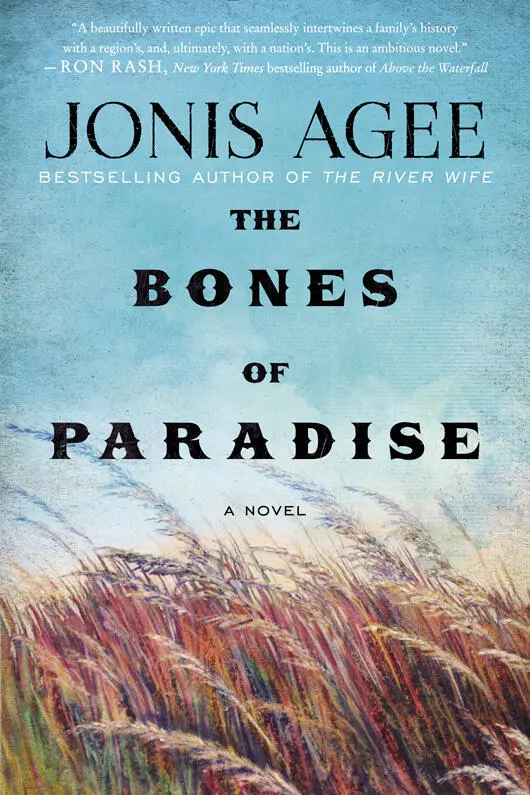
- Название:The Bones of Paradise
- Автор:
- Издательство:William Morrow
- Жанр:
- Год:2016
- ISBN:нет данных
- Рейтинг книги:3 / 5. Голосов: 1
-
Избранное:Добавить в избранное
- Отзывы:
-
Ваша оценка:
The Bones of Paradise: краткое содержание, описание и аннотация
Предлагаем к чтению аннотацию, описание, краткое содержание или предисловие (зависит от того, что написал сам автор книги «The Bones of Paradise»). Если вы не нашли необходимую информацию о книге — напишите в комментариях, мы постараемся отыскать её.
returns with a multi-generational family saga, set in the unforgiving Nebraska Sandhills in the years following the massacre at Wounded Knee—an ambitious tale of history, vengeance, race, guilt, betrayal, family, and belonging, filled with a vivid cast of characters shaped by violence, love, and a desperate loyalty to the land. Ten years after the 7th Calvary massacred more than 200 Lakota men, women, and children at Wounded Knee, J. B. Bennett, a white rancher, and Star, a young Native American woman, are murdered in a remote meadow on J. B.’s land. The deaths bring together the scattered members of the Bennett family: his cunning and hard father, Drum; his estranged wife, Dulcinea; and his young sons, Cullen and Hayward. As the mystery of these twin deaths unfolds, the history of the dysfunctional Bennett’s and their damning secrets are revealed exposing the conflicted heart of a nation caught between past and future.
At the center of
are two remarkable women. Dulcinea, returned after bitter years of self-exile, yearns for redemption and the courage to mend her broken family and reclaim the land that is rightfully hers. Rose, scarred by the terrible slaughters that have decimated and dislocated her people, struggles to accept the death of her sister, Star, and refuses to rest until she is avenged.
A kaleidoscopic portrait of misfits, schemers, chancers, and dreamers, Jonis Agee’s bold new novel is a panorama of America at the dawn of a new century. A beautiful evocation of this magnificent, blood-soaked land—its sweeping prairies, seas of golden grass and sandy hills, all at the mercy of two unpredictable and terrifying forces, weather and lawlessness—and the durable men and women who dared to tame it. Intimate and epic,
is a remarkable achievement: a mystery, a tragedy, a romance, and an unflagging exploration of the beauty and brutality, tenderness and cruelty that defined the settling of the American west.
The Bones of Paradise — читать онлайн бесплатно полную книгу (весь текст) целиком
Ниже представлен текст книги, разбитый по страницам. Система сохранения места последней прочитанной страницы, позволяет с удобством читать онлайн бесплатно книгу «The Bones of Paradise», без необходимости каждый раз заново искать на чём Вы остановились. Поставьте закладку, и сможете в любой момент перейти на страницу, на которой закончили чтение.
Интервал:
Закладка:
Since that time, Drum couldn’t stand the smell of kerosene. He kept coal oil lamps, candles, and cow chips for fuel at his ranch. He’d avoided civilization after that, choosing game trails and outposts. As he walked, he planned. First he changed his name to Drum Bennett, after the man who had ruined their lives. No one would expect him to take the dead man’s identity, so that’s what he did. Even J.B. didn’t know his true origins. That was fine.
The day he came for his grandson, the past was wound around his insides like a tapeworm, eating itself full while the man starved, belly distended. Drum had rebuilt the family fortune, seized the land from Indians and other settlers, fought fiercer than any animal could to hold on to it. When his place was secured and his son’s also, he started thinking toward the future. He couldn’t be sure J.B. was strong enough to make the boy into a man who could hold the land against the Bennett Shears of the world. Sending J.B. to his wife’s folks in Missouri to be raised hadn’t worked out so well. His son was too soft, too generous when he should hold the line against others. That woman he married was evidence of what happened when the right stamp wasn’t put on a boy. No, Drum knew how it had to be. That day he got up, told Stubs to fix a pallet bed for the boy in his own room, saddled two horses, and set off for J.B.’s. He hadn’t reckoned on the disturbance she’d make. Drum’s own wife had been a sullen, quiet woman who obeyed him without speaking, had done so until the day she disappeared, just like that, off the face of the earth. He found no tracks, no evidence that she had walked, ridden a horse, or driven a wagon. Within days, it was as if she’d never been there, and he felt enormous relief. Since she was a poor cook anyway, he was happy to eat the victuals prepared by Swensen the Swede, who had lost a foot in a blizzard and needed other work after a winter of lying around eating. Over the years, Swensen had perfected the plain food Drum preferred, neglecting salt and pepper even. It was food meant to toughen the boy, he’d explained to Swensen. The ancient Greeks and Romans knew better than to baby a male child. Make them sleep on the ground, without clothing, teach them to take the blows without speaking.
The coffee began to boil and Drum hobbled to the bread safe to cut a couple of slices. The saucer of butter had been left on the table without a cover and bore the impression of a tiny mouse paw and the twin gnawed furrows of teeth. Waste. It made him so mad, he smeared over the soft surface, obscuring the disturbances, and positioned the plate so no one would suspect. He’d eat his bread with mulberry jam. Another of J.B.’s fancies. If he’d paid more attention to the future, and less to every little comfort, he might be alive today. Drum cursed under his breath and knocked his fist against the table. Goddamn it.
He poured a cup of coffee and hobbled outside to the porch to sit and wait for Vera, Higgs, and the men. Something about this morning reminded him of the day he’d come for Cullen. Except then, he rode with his back to the sunrise, and the gray-blue around him gradually turned rose, then yellow, and finally full color at almost the same moment the full bright heat began to warm the back of his shirt. Today, the sun took its time, stabbing the bunkhouse windows with light that seemed to sink, then bounce back, sharp and brittle, like a signal sent one place to another to another. He’d read Homer’s Iliad and Odyssey the first winter he’d spent in the hills living in a tipi on the Niobrara River. He’d found a spit of land with an artesian well that never froze and the river itself only took a skim of ice in places, and he’d found an old tipi he patched and used. It was cold as the dickens, but the wild plum, willow, and burr oak kept off the worst of the wind. Sheltered in the lee below the hills to the south, he learned to drive the tipi poles deep into the ground, to keep a fire going, and to not touch the sides of his tipi with his body. He would have starved except for the river, which drew deer, antelope, and turkeys during the long cold months, even when the snow was deep. He came close to eating coyote, too, but didn’t. Once he found a stray cow and, nearly starving, was torn between killing it and trapping it to begin his own herd in the spring. His stomach hurt so bad he chewed willow bark and boiled grass to drink the broth that played havoc on his bowels, but he kept the cow alive, and come spring he would turn it loose and track it to other cattle it would find. On one particularly cold, still night when the tree limbs crackled as the sap froze and he could make out the pad of coyote paws circling the camp, he coaxed the cow into the tipi with him. When he woke in the morning, the animal was lying by his side, providing the warmth he had dreamed about.
It was right at the end of that bad cold spell when he and the cow almost died that he found the Indian woman mired and exhausted in a chest-deep drift she’d plunged into coming off the hill on a little buckskin mare. Try as they might, it was clear they couldn’t free themselves and were doomed when darkness fell. Drum watched their feeble struggles for a few minutes, and then waded through the deep snow toward them. His own horse had taken off the night of the first snowfall, and he wore snowshoes he’d fashioned from strips of willow branches and bark. The churned-up snow made it hard to keep from sinking, but he managed to get close enough to grab the war bridle and pull the horse’s head. Although she stretched her neck, the game little mare didn’t have the strength to raise her forelegs high enough to strike out into the snow in front of her, so Drum went around to the side and lifted the nearest leg by hand, placing it ahead of the horse, then repeated the action on the other side, then went to the haunches and pushed and swatted until the horse was driven to a desperate lunge. In this way, he half dragged, half pushed the horse out of the drift. The woman, sunk into the snow beside the mare, he dragged to safety.
He nursed her until the thaw finally arrived in the middle of a late March night and they woke to a warm wind and snowmelt creeping into the tipi. She stood, shook out her waist-length hair, tied it with a strip of buckskin, and began to roll their bed before it got soaked. He realized then that she had been waiting for this moment to leave, and he hastily signed for her to stay as his wife. He assumed that no white woman could survive the hills with him. She was plain, with broad flat features and expressionless eyes so dark he always seemed to be looking at his own reflection when she stared at him. There was a small thick scar on her chin that she often covered with one hand when she knew he watched. She had not said a word in the weeks she’d been with him although he had tried English, then a smattering of Ute, Sioux, Omaha, and Ponca. He didn’t know any other languages. Still she soundlessly joined with him in the deep cold nights of that winter. It kept them alive, and she showed him other ways of boiling bark and grass, of spearing fish that waited sleepily at the bottom of the small pool under the young cottonwoods, of smoking the deer meat in strips, sucking the marrow from the bones and grinding them for soup. The cow somehow found enough forage to stay alive, fatten even, he realized that morning of the March thaw. Her sides bulged and her coat had a glossy sheen. The Indian looked at the cow and burst out laughing, the first he’d heard from her. When he raised his brows and shook his head, she tugged the ragged sleeve of his coat and gestured to the cow’s stomach, then her own, using her hands to draw a round pregnant shape. He looked at the woman’s stomach pushing hard against the deer hide dress, then the cow’s heavy stomach hanging just above the newly revealed earth.
Читать дальшеИнтервал:
Закладка:
Похожие книги на «The Bones of Paradise»
Представляем Вашему вниманию похожие книги на «The Bones of Paradise» списком для выбора. Мы отобрали схожую по названию и смыслу литературу в надежде предоставить читателям больше вариантов отыскать новые, интересные, ещё непрочитанные произведения.






Обсуждение, отзывы о книге «The Bones of Paradise» и просто собственные мнения читателей. Оставьте ваши комментарии, напишите, что Вы думаете о произведении, его смысле или главных героях. Укажите что конкретно понравилось, а что нет, и почему Вы так считаете.