Jonis Agee - The Bones of Paradise
Здесь есть возможность читать онлайн «Jonis Agee - The Bones of Paradise» весь текст электронной книги совершенно бесплатно (целиком полную версию без сокращений). В некоторых случаях можно слушать аудио, скачать через торрент в формате fb2 и присутствует краткое содержание. Год выпуска: 2016, Издательство: William Morrow, Жанр: Современная проза, на английском языке. Описание произведения, (предисловие) а так же отзывы посетителей доступны на портале библиотеки ЛибКат.
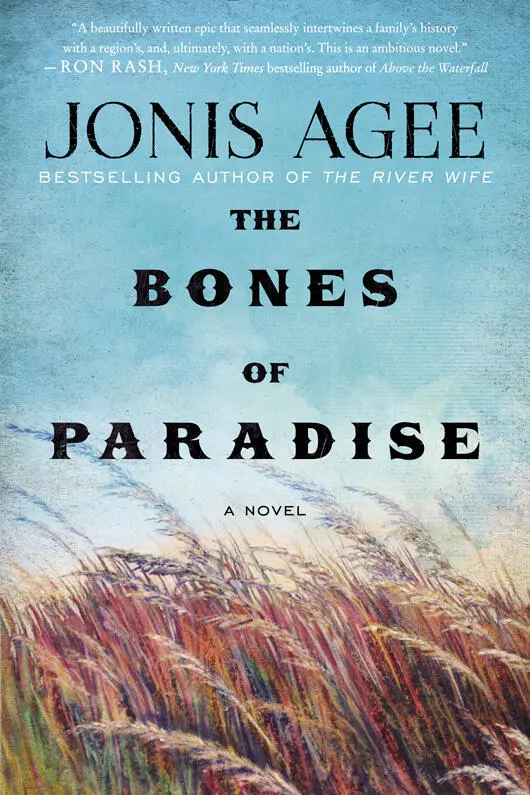
- Название:The Bones of Paradise
- Автор:
- Издательство:William Morrow
- Жанр:
- Год:2016
- ISBN:нет данных
- Рейтинг книги:3 / 5. Голосов: 1
-
Избранное:Добавить в избранное
- Отзывы:
-
Ваша оценка:
The Bones of Paradise: краткое содержание, описание и аннотация
Предлагаем к чтению аннотацию, описание, краткое содержание или предисловие (зависит от того, что написал сам автор книги «The Bones of Paradise»). Если вы не нашли необходимую информацию о книге — напишите в комментариях, мы постараемся отыскать её.
returns with a multi-generational family saga, set in the unforgiving Nebraska Sandhills in the years following the massacre at Wounded Knee—an ambitious tale of history, vengeance, race, guilt, betrayal, family, and belonging, filled with a vivid cast of characters shaped by violence, love, and a desperate loyalty to the land. Ten years after the 7th Calvary massacred more than 200 Lakota men, women, and children at Wounded Knee, J. B. Bennett, a white rancher, and Star, a young Native American woman, are murdered in a remote meadow on J. B.’s land. The deaths bring together the scattered members of the Bennett family: his cunning and hard father, Drum; his estranged wife, Dulcinea; and his young sons, Cullen and Hayward. As the mystery of these twin deaths unfolds, the history of the dysfunctional Bennett’s and their damning secrets are revealed exposing the conflicted heart of a nation caught between past and future.
At the center of
are two remarkable women. Dulcinea, returned after bitter years of self-exile, yearns for redemption and the courage to mend her broken family and reclaim the land that is rightfully hers. Rose, scarred by the terrible slaughters that have decimated and dislocated her people, struggles to accept the death of her sister, Star, and refuses to rest until she is avenged.
A kaleidoscopic portrait of misfits, schemers, chancers, and dreamers, Jonis Agee’s bold new novel is a panorama of America at the dawn of a new century. A beautiful evocation of this magnificent, blood-soaked land—its sweeping prairies, seas of golden grass and sandy hills, all at the mercy of two unpredictable and terrifying forces, weather and lawlessness—and the durable men and women who dared to tame it. Intimate and epic,
is a remarkable achievement: a mystery, a tragedy, a romance, and an unflagging exploration of the beauty and brutality, tenderness and cruelty that defined the settling of the American west.
The Bones of Paradise — читать онлайн бесплатно полную книгу (весь текст) целиком
Ниже представлен текст книги, разбитый по страницам. Система сохранения места последней прочитанной страницы, позволяет с удобством читать онлайн бесплатно книгу «The Bones of Paradise», без необходимости каждый раз заново искать на чём Вы остановились. Поставьте закладку, и сможете в любой момент перейти на страницу, на которой закончили чтение.
Интервал:
Закладка:
CHAPTER TWENTY
At first light Drum Bennett slowly gathered himself for the task ahead, easing one leg, then the other out of bed and planting his feet on the floor. Cullen had helped him with his trousers the night before, and the arm was healed enough that he could discard the sling and slide into a shirt. Buttoning it took time until his shoulder, stiff from inactivity, gave with a few noticeable crunches and he worked the hand that had stayed immobile for so long. In the old days, when he was younger, he’d worked cattle with a broken arm. Now he was weak as an orphan calf. He wanted to bellow his rage at the injustice, but knew better than to wake the household. Dulcinea with her fancy-man lawyer spending the night. Oh, he’d heard them talking. He knew what they were up to. Rivers sent him a message. He’d fix her. That was number one. Number two was joining the ranches. Number three, and he knew this was a distant possibility, was finding his son’s killer. With all the time laid up, he’d had some unwelcome thoughts on the subject. Now he needed to prove himself wrong, or he’d never feel safe again.
Drum waited for the lightness in his body to recede before he could muster the strength to pull on his boots. Last night, Cullen brought him rawhide strings to tie around the upper portion that they’d had to slit open to release his swollen foot four weeks ago, and he’d be damned if he was going to throw away perfectly good boots. He would fix them himself if he didn’t have this work ahead of him. As it was, he’d give them to Stubs to mend. Man was too old and worthless on a horse anymore, had to earn his keep mending equipment. Drum bent over to wrap the boot with rawhide, and grimaced at the way his belly had grown fat and wobbly, making it difficult to breathe at this angle. Hell, come to that he was next in line after Stubs for a bullet to the brain. Look at the shape he was in. Fat as a tick and snake-poison mean.
He straightened and pushed his feet firmly into the boots, despite the protest they made. What did a man come to, a bag of bones and a waddle of fat, all disarranged and helpless. He glanced at the picture of J.B. on the dresser and the thick envelope that lay beside it.
“Damn it, son, you never did amount to a pile of crap, did you?” He took a deep breath, released it slowly, and straightened his spine as he did so, then using the cane Cullen had fashioned, pushed upward, forcing the wobbly ankle to hold his weight despite the pain that shot up his leg into his back. Although the arm was still weak, he made it do its job, and pressed down on the cane to support the bad leg. It felt like the healing arm threatened to snap again, but he ordered it to get to work. With just a few more steps to the door, the words to an old-timey song started in his head. Old Joe Clark was a mean old man . . . He couldn’t remember more than the refrain, which he repeated with every step. Old Joe Clark was a mean old man . . .
By the time he made it down the stairs, he was panting and his shirt soaked with sweat. “J.B.,” he mumbled. He had to stop talking to his son, to remember he was dead. He blamed too much time sitting around without work to wear a body out. He knew his son was gone. Some son of a bitch shot him. Just like Drum’s grandfather, in Missouri, a lifetime ago. Shot him dead, right in front of Drum, when he was only a boy of thirteen. His father was killed by Indians out West, he was told, and his mother died in childbirth, left him to be raised by her father. After the old man’s death, Drum struggled to keep the homestead going. He was too young, and no one would help a boy his age alone. They wanted him to stay with the neighbors down the road, a large family of girls who could use another strong back to do for them. Store wouldn’t extend him credit till he could bring in the crop. He had all he could do keeping meat on the table and milking the cows. In all the years they lived together, his grandfather, another mean old man, had two things to tell his grandson: “This land is everything. Don’t ever sell, lose, or walk away from our land. And, boy, never trust nobody, not even me.” Then he’d slapped him so hard the boy wore the finger welts on his face for a week. From then on, Drum flinched every time his grandfather or anyone raised a hand. After a while, it wore on the old man until he made him stand like a stone and take his punishment. Drum hadn’t meant to lose the land. He had struggled long and hard to keep it, but there was no chance. He was fourteen when he walked away, carrying the shame on his back like a rock-filled pack.
Drum stood, hands on the back of the chair at the kitchen table, bracing until the tremble left his legs and his breath returned to normal. He was the first in three generations to reach sixty and he had no idea what to expect. Usually he didn’t think about his age, and just pushed himself harder when the joints ached and the lungs felt small. The breakfast dishes were laid out, the coffeepot ready for the fire in the stove to be lit. No reason he couldn’t do that himself. Vera would be over soon. Damn, he hoped Higgs would take his offer to get rid of Dulcinea in exchange for the foreman’s house. Get things back to normal here. He lit the fire and found himself staring into the flames, something he avoided as a rule. No point in going back there. What’s done is done.
But this morning the past wouldn’t go lie down in the corner like an old dog. The scene appeared again and again, in waves of ever greater detail. The faces at the window with the flames in the background like a painting of the last judgment, then the terrible collapse of the roof before he had time to—He always told himself he was going back inside, he was, he would fight his way through the fire and save them. He hadn’t known they were there when he went back with the kerosene and rags. Drum groaned, and then glanced around to see if anyone had heard him. The coffeepot burped and murmured as the water heated. The fire crackled and the stovepipe ticked as the rising smoke heated the tin.
By the time he was fourteen he was skin and bones, too tired to cook, let alone eat. He could barely shoulder the pack onto his mule, and the walk to town took twice as long. He hobbled then, too, he thought ruefully. He’d lost a toe to the plow. And that was another thing he counted against the man. In town, he sat to rest behind the livery stable under a big sugar maple, and fell asleep in the dense summer heat. By the time he woke, it was coming dark and he had to hurry. Bennett Shear was just going to supper at Shadow’s Tavern to celebrate his new acquisition, which solidified him as owner of the entire valley. He’d already moved a tenant farmer onto Drum’s farm. When Shear heard his name called, he glanced at the boy without understanding that he should be afraid, then turned back to speak with a man leaving the tavern.
The bullet caught him midsentence right through the heart, spun him slowly down the boardwalk steps into the muddy street where he lay on his side like a man gone to sleep. There was such harmlessness in the final picture that people stopped and stared for a moment, unable to determine if Shear was dead or alive. Drum had been too exhausted to move at first, then some instinct told him to walk slowly away, holding the pistol at his side, finger on the other trigger he intended to cock and pull if anyone moved to stop him. But by some magic, people were too curious about the dead man to notice a boy. When he gathered the mule’s rope, his first thought was to head west through the woods where trackers would have a harder time. Instead he went north, back the way he’d come, picturing the kerosene barrel in the corner of the shed and the rags that were his grandfather’s clothes in the other. He didn’t know about the tenant family. The five little ones on the pallet bed he’d left in the sleeping loft. He didn’t have time to warn them that it was too hot in the summer and too cold in the winter, that they would spend their nights hugging each other to keep warm.
Читать дальшеИнтервал:
Закладка:
Похожие книги на «The Bones of Paradise»
Представляем Вашему вниманию похожие книги на «The Bones of Paradise» списком для выбора. Мы отобрали схожую по названию и смыслу литературу в надежде предоставить читателям больше вариантов отыскать новые, интересные, ещё непрочитанные произведения.






Обсуждение, отзывы о книге «The Bones of Paradise» и просто собственные мнения читателей. Оставьте ваши комментарии, напишите, что Вы думаете о произведении, его смысле или главных героях. Укажите что конкретно понравилось, а что нет, и почему Вы так считаете.