Jonis Agee - The Bones of Paradise
Здесь есть возможность читать онлайн «Jonis Agee - The Bones of Paradise» весь текст электронной книги совершенно бесплатно (целиком полную версию без сокращений). В некоторых случаях можно слушать аудио, скачать через торрент в формате fb2 и присутствует краткое содержание. Год выпуска: 2016, Издательство: William Morrow, Жанр: Современная проза, на английском языке. Описание произведения, (предисловие) а так же отзывы посетителей доступны на портале библиотеки ЛибКат.
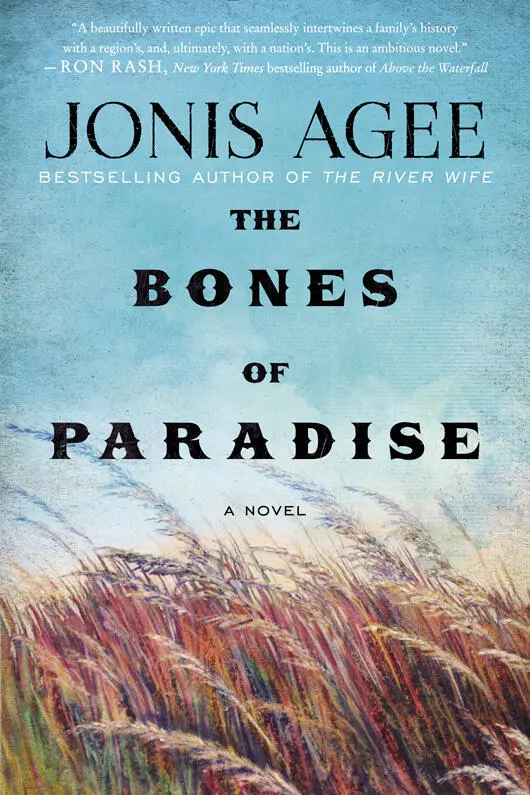
- Название:The Bones of Paradise
- Автор:
- Издательство:William Morrow
- Жанр:
- Год:2016
- ISBN:нет данных
- Рейтинг книги:3 / 5. Голосов: 1
-
Избранное:Добавить в избранное
- Отзывы:
-
Ваша оценка:
The Bones of Paradise: краткое содержание, описание и аннотация
Предлагаем к чтению аннотацию, описание, краткое содержание или предисловие (зависит от того, что написал сам автор книги «The Bones of Paradise»). Если вы не нашли необходимую информацию о книге — напишите в комментариях, мы постараемся отыскать её.
returns with a multi-generational family saga, set in the unforgiving Nebraska Sandhills in the years following the massacre at Wounded Knee—an ambitious tale of history, vengeance, race, guilt, betrayal, family, and belonging, filled with a vivid cast of characters shaped by violence, love, and a desperate loyalty to the land. Ten years after the 7th Calvary massacred more than 200 Lakota men, women, and children at Wounded Knee, J. B. Bennett, a white rancher, and Star, a young Native American woman, are murdered in a remote meadow on J. B.’s land. The deaths bring together the scattered members of the Bennett family: his cunning and hard father, Drum; his estranged wife, Dulcinea; and his young sons, Cullen and Hayward. As the mystery of these twin deaths unfolds, the history of the dysfunctional Bennett’s and their damning secrets are revealed exposing the conflicted heart of a nation caught between past and future.
At the center of
are two remarkable women. Dulcinea, returned after bitter years of self-exile, yearns for redemption and the courage to mend her broken family and reclaim the land that is rightfully hers. Rose, scarred by the terrible slaughters that have decimated and dislocated her people, struggles to accept the death of her sister, Star, and refuses to rest until she is avenged.
A kaleidoscopic portrait of misfits, schemers, chancers, and dreamers, Jonis Agee’s bold new novel is a panorama of America at the dawn of a new century. A beautiful evocation of this magnificent, blood-soaked land—its sweeping prairies, seas of golden grass and sandy hills, all at the mercy of two unpredictable and terrifying forces, weather and lawlessness—and the durable men and women who dared to tame it. Intimate and epic,
is a remarkable achievement: a mystery, a tragedy, a romance, and an unflagging exploration of the beauty and brutality, tenderness and cruelty that defined the settling of the American west.
The Bones of Paradise — читать онлайн бесплатно полную книгу (весь текст) целиком
Ниже представлен текст книги, разбитый по страницам. Система сохранения места последней прочитанной страницы, позволяет с удобством читать онлайн бесплатно книгу «The Bones of Paradise», без необходимости каждый раз заново искать на чём Вы остановились. Поставьте закладку, и сможете в любой момент перейти на страницу, на которой закончили чтение.
Интервал:
Закладка:
He sipped his coffee. It was cold. He got used to cold coffee and cold jerky that first winter in the hills. By the time he decided to settle in the Sand Hills, it was too late to build. He deposited a small amount of gold in the Cattleman’s Bank in Babylon under the pretense that he had made his stake in the California strike. He buried the rest, planned to use it only when desperate, to avoid drawing attention. Plenty out there would take advantage of a lone man holding a fortune in gold. The mules were stolen almost immediately, leaving him with the horse that ran off the first big snowstorm, true to its nature. Drum hunkered down then, figuring to winter on the Niobrara, where he was told the season was usually mild with thaws following storms. It was not that kind of winter.
He looked at his hands, the two fingers he couldn’t quite close, and the dark nails that never regained normal color after frostbite. Come spring, with the cow pregnant and Mary Morning gone, he found his land and began to build a small house, spare and plain. He figured he would build a bigger one later, using some of the gold. He tried not to touch it, kept it in reserve to back up any play he made to acquire more land, cattle, and horses, but as it was he went twice a year to the hidey-hole, always toward dawn. He was lucky the rattlers that frequented the mounds of stone chose not to bother him. He figured it was part of a grim blessing on the gold, on his fortune and life. Except for women and the boy. No blessing there. Mary Morning had stayed until spring, helped him with the chores and cooked his meals. They shared a bed in the silence that grew from winter on, no whispered endearments, no declarations. She must have known how he felt, he reasoned. He wasn’t a man to give things away to just any passerby. Later he would realize that he loved this strange Indian woman more than anyone in his life. He would have shared his fortune with her, he told himself, although he wondered if that was true. He certainly would have cared for her and the child. He would have done that at least. No reason for her to slip away on the buckskin mare. How she even mounted with the belly in front of her, he never knew. Maybe she walked away leading the horse. That image always made him sad, and he shook it off. He could have bought her material to make a dress, combs for her hair, shoes or beads or whatever she desired. A mirror, a better mirror than the small cracked one he used to shave his face. He thought less about the child she carried. He couldn’t say why that was, either.
CHAPTER TWENTY-ONE
As he watched now, the rooster came out, inspected the sunrise, and commenced crowing. When nothing happened, he clucked to himself and minced back into the henhouse. That new dog of Dulcinea’s came down the stair, pressed its face against the screen door, and whined to get out. Drum hooked his cane on the door handle and pulled it wide enough for the dog to slip through. An ungodly mutt, it gave him a courtesy nod, then ambled down the stairs and out into the yard to relieve itself on the lilac bushes.
The white woman he married was a whole different story. Drum shook his head and grinned ruefully. What the hell was he thinking? On a horse-buying trip to Missouri, he stayed with a family that raised fox trotters and before he knew it he had foundation stock and the man’s only daughter to herd home. Turned out she wasn’t much interested in Sand Hills ranching and as soon as she dropped the baby boy she took off to Omaha and beyond. He told J.B. she died so he wouldn’t have to answer for it later. She did die, he learned from her father, on a ship that sank in the Atlantic, on its way to Europe. She married a duke of some sort and was going to live the life she’d always wanted. As far as Drum knew, they were never divorced, but it hadn’t mattered. Silly woman. If she’d waited long enough, he would have used the gold to buy her pleasure. At least he told himself that when he was in a generous mood.
Which brought him to his current problem. He reached inside his shirt and pulled out the envelope that had been sitting on the dresser upstairs. J.B.’s new will and a copy of Drum’s. Who was he going to tell about the gold? Who was he going to leave it to? He never trusted his lawyer enough to put the fact of its existence in his will. He certainly didn’t want Dulcinea to have it. Cullen wasn’t ready, it would spoil him. Hayward wasn’t old enough. He’d be damned if he was going to ruin those boys with too much money. He had spent the last month in bed ruminating on the problem and still hadn’t come up with an answer. It was time to ride out and check on it.
And it was time to put his plans into action, before the county judge held his hearing. Right now he could do just about anything to bring the two ranches together and J.B.’s widow couldn’t do a thing to stop him. He smiled grimly, slapped the envelope softly in his palm. Maybe the gold could buy the judge or even pay off the woman so she’d leave the Bennett men in peace once and for all. Today he’d get word to Stubs to come over to help him ride out for the gold. Have to blindfold the old fool, or get him so drunk he couldn’t find his way there or back. Doubted he could ride yet with this damn foot, though, need to take a wagon, pretend to go to town or some—
“You’re up.” Dulcinea’s voice startled him. Damn woman to sneak around like a thief in the night.
“Coffee’s on the stove,” he said gruffly, flinging the cold remains from his cup off the porch. The dog came up the steps and wagged its long tail at him briefly, saw the disapproval in the man’s eyes, sighed, and flopped down beside him, bones hitting the wood floor with a cracking thump.
“I’m not your friend,” Drum said and felt like those were some of the truest words he’d ever uttered.
When she returned with the cup in her hands he wished he could’ve asked for another. He leaned back and raised his bad leg to rest on the porch railing covered in curls and scales of old white paint. His son hadn’t done much work these past few years. Drum had to admit the cattle and horses were in good shape, but the rest of the place had taken on that run-down shabbiness of a man about to give up. Who would’ve guessed J.B. would take on after a woman like that? Fortunately, Drum had been there to do the right thing.
“Do you have any idea who killed him?”
Drum looked at her for a long moment. “Don’t you think I’d be the first to put a rope on his neck if I knew?” He thought about the Indians lurking around town, the sense he was always being followed on his way to the gold, the rough lot he employed—any one of them would slice his throat for a dollar—the lawyer fella he encountered twice riding their land with a shovel and a pair of binoculars, this Graver who showed up at just the right time, and finally, Cullen. Would he shoot his own father? Drum couldn’t be certain—maybe he’d bred too much meanness into that boy.
“I thought you were supposed to protect him . . . that was our bargain.”
“I did the best I could.” He felt a quick stab of guilt in the middle of his back. He couldn’t very well tell her that he’d made up a bunch of lies to get her to leave.
“You lied.” She grimaced and sipped her coffee. The silence between them grew more uneasy as the corralled horses began to mill and argue like their morning hay was late. A flock of sparrows wheeled up and out of the cottonwoods, then splattered down again and began furiously pecking at the ground beneath.
“Is the sheriff from Valentine doing anything?” she asked.
Drum snorted. “Man’s about as useful as a three-legged horse. Told me it wasn’t his concern if we hills ranchers want to kill each other off.”
Читать дальшеИнтервал:
Закладка:
Похожие книги на «The Bones of Paradise»
Представляем Вашему вниманию похожие книги на «The Bones of Paradise» списком для выбора. Мы отобрали схожую по названию и смыслу литературу в надежде предоставить читателям больше вариантов отыскать новые, интересные, ещё непрочитанные произведения.





Обсуждение, отзывы о книге «The Bones of Paradise» и просто собственные мнения читателей. Оставьте ваши комментарии, напишите, что Вы думаете о произведении, его смысле или главных героях. Укажите что конкретно понравилось, а что нет, и почему Вы так считаете.