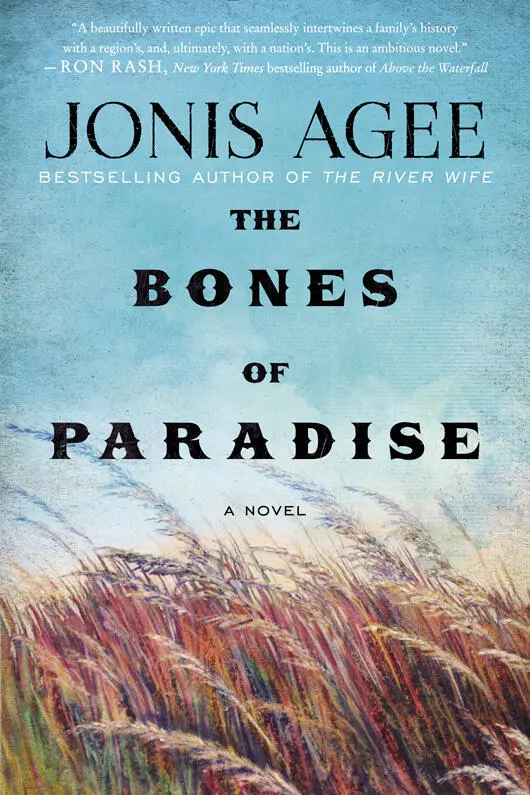
Jonis Agee - The Bones of Paradise
Здесь есть возможность читать онлайн «Jonis Agee - The Bones of Paradise» весь текст электронной книги совершенно бесплатно (целиком полную версию без сокращений). В некоторых случаях можно слушать аудио, скачать через торрент в формате fb2 и присутствует краткое содержание. Год выпуска: 2016, Издательство: William Morrow, Жанр: Современная проза, на английском языке. Описание произведения, (предисловие) а так же отзывы посетителей доступны на портале библиотеки ЛибКат.
- Название:The Bones of Paradise
- Автор:
- Издательство:William Morrow
- Жанр:
- Год:2016
- ISBN:нет данных
- Рейтинг книги:3 / 5. Голосов: 1
-
Избранное:Добавить в избранное
- Отзывы:
-
Ваша оценка:
The Bones of Paradise: краткое содержание, описание и аннотация
Предлагаем к чтению аннотацию, описание, краткое содержание или предисловие (зависит от того, что написал сам автор книги «The Bones of Paradise»). Если вы не нашли необходимую информацию о книге — напишите в комментариях, мы постараемся отыскать её.
returns with a multi-generational family saga, set in the unforgiving Nebraska Sandhills in the years following the massacre at Wounded Knee—an ambitious tale of history, vengeance, race, guilt, betrayal, family, and belonging, filled with a vivid cast of characters shaped by violence, love, and a desperate loyalty to the land. Ten years after the 7th Calvary massacred more than 200 Lakota men, women, and children at Wounded Knee, J. B. Bennett, a white rancher, and Star, a young Native American woman, are murdered in a remote meadow on J. B.’s land. The deaths bring together the scattered members of the Bennett family: his cunning and hard father, Drum; his estranged wife, Dulcinea; and his young sons, Cullen and Hayward. As the mystery of these twin deaths unfolds, the history of the dysfunctional Bennett’s and their damning secrets are revealed exposing the conflicted heart of a nation caught between past and future.
At the center of
are two remarkable women. Dulcinea, returned after bitter years of self-exile, yearns for redemption and the courage to mend her broken family and reclaim the land that is rightfully hers. Rose, scarred by the terrible slaughters that have decimated and dislocated her people, struggles to accept the death of her sister, Star, and refuses to rest until she is avenged.
A kaleidoscopic portrait of misfits, schemers, chancers, and dreamers, Jonis Agee’s bold new novel is a panorama of America at the dawn of a new century. A beautiful evocation of this magnificent, blood-soaked land—its sweeping prairies, seas of golden grass and sandy hills, all at the mercy of two unpredictable and terrifying forces, weather and lawlessness—and the durable men and women who dared to tame it. Intimate and epic,
is a remarkable achievement: a mystery, a tragedy, a romance, and an unflagging exploration of the beauty and brutality, tenderness and cruelty that defined the settling of the American west.
The Bones of Paradise — читать онлайн бесплатно полную книгу (весь текст) целиком
Ниже представлен текст книги, разбитый по страницам. Система сохранения места последней прочитанной страницы, позволяет с удобством читать онлайн бесплатно книгу «The Bones of Paradise», без необходимости каждый раз заново искать на чём Вы остановились. Поставьте закладку, и сможете в любой момент перейти на страницу, на которой закончили чтение.
Интервал:
Закладка:
They almost missed it in the dark corner of a lower shelf behind a box of candles. The pack was old, the canvas stiff and cracked with dirt as Dulcinea untied and opened the flap. First she lifted out a six-inch-tall wooden figure that looked Indian, but not like something from the local tribes. Rose took it before she could set it on the floor, turned it over in her hands. A green snake twisted in the fist of a man, if he could be called that—a creature with a large square head, black stripe down its face, turquoise earrings and necklace, fur ruff around the neck, small carved bird feathers tacked to the head, a leather tail, and a red-and-black canvas skirt with a black snake oozing across the front. The legs of the figure were clad in red felt boots. There was bulk and overpowering energy in the form, coming partially, Dulcinea realized, from fierce black eyes that seemed to rage against all they saw. The mouth was open, too, a black maw that promised only ill will. “Kachina,” Rose said and pulled out a tattered shirt to wrap around the figure cradled in her arms, an uneasy expression on her face.
Letters addressed to someone named Arthur Wilke fell on the floor, along with a string-tied packet of photographs of a young woman, several people in a group on a white porch of a farmhouse, and a group of cocky men gripping rifles and wearing Union uniforms. Dulcinea picked them up and quickly tied them together. There was a razor and strop, a small round metal mirror cloudy with corrosion, and a silver pen knife of the sort gentlemen carried, engraved with the same W as the journal in Drum’s bedroom. She pulled out a book, Plutarch’s Lives, and felt along the bottom of the pack. Out of frustration, she turned it upside down and shook it hard, releasing a brief shower that sparkled in the dim light. Dulcinea knelt, wet her fingertip, and picked up some of the grainy dust.
“Gold. Someone named Wilke had gold in here.” She shook the pack again and flung it to the floor, kneeling to look at the meager goods. “Drum’s hiding something.” She looked at Rose, who glanced at the wooden figure in her arms.
“Are you taking that?” Dulcinea asked.
Rose looked horrified. “Nooo—” She pulled the faded blue cotton shirt tighter and lifted her chin for Dulcinea to hold open the pack. “These spirits—I don’t mess with them.” She carefully lowered the figure inside, untied the bag of cornmeal, reached in, and sprinkled a small handful over it. “Put those other things away and close it up,” she ordered. “We need to leave.” She stood and walked quickly from the storeroom while Dulcinea restored the pack and thrust it back into the dark corner. Returning to the bedroom, she replaced the dirty window, plunging the room into dusk again. When she left, she caught a quick glimpse of the bare room that her son must have used at the end of the hall. The sight made her stomach knot.
Outside Rose had untied their horses and was already mounted. “We need to get away from here,” she said, putting heels to the spotted pony. Dulcinea swung up on the gray and followed her at a gallop. She was disappointed in what they’d seen. There was nothing but evidence of a spartan life that bore down on the men until they broke or ran. She understood her son better now. Maybe even to the point where she could imagine him killing his father for betraying him.
They slowed the horses and were circling a small hill when Rose put out her hand to stop, then pointed to the far side of the meadow, where a man was digging with a shovel. As they watched he straightened and peered closely at something in his hand, then opened it and let dirt and sand fall. The women looked at each other.
“Chance,” Rose whispered. “That’s his horse.”
“What’s he doing?” Dulcinea asked with a frown.
Rose shrugged. “Something he doesn’t want you to know about.”
They watched as he mounted and left the valley in the other direction.
CHAPTER TWENTY-THREE
The hands rode in just before dark, quiet and tired from the day’s work. Irish Jim had a bum knee from a roped steer that had twisted back on him as he dismounted to doctor its eye, and the new hire, Black Bill, wore a bloody scarf tied around his neck from a gouge when the barbed wire he was tightening had snapped. The flies followed the blood scent and buzzed lazily around his face and his constant slapping, waving hand startled the horse he was trying to unsaddle. Finally Graver took over and Bill nodded his thanks.
“Get Vera to look at that,” Irish Jim advised. “She’s more doctor than that yahoo in town.”
Jorge, the oldest hand, walked his horse in so quietly he startled Graver. A good man with a horse, he’d already tamed the little dun mustang so he could slide off its back end without getting kicked. He wore the traditional large rowel spurs but never gave a horse more than a flicker. Most of the Mexican cowboys Graver had known were good horsemen and fearless around cattle. He’d rather have Jorge than almost anyone else back him in a culling pen. The two men nodded to each other, covertly noted that their horses weren’t as wrung-out tired as the others. Jorge was always the last cowboy in because he walked his horse at the end so it’d be dry enough to get a quick curry before he grained it.
It was Saturday and the men would be cleaning up, grabbing a bite, if they could stand the wait, and riding hell-bent for leather to town. J.B. had usually kept the men closer to the ranch on Saturdays so they could quit while it was still light and make it to town before dark, but Dulcinea wanted them to put in a full day’s work and Higgs hadn’t figured out how to explain the situation to her. Graver had overheard the men mutter about it the past two weeks. They were beginning to see Higgs as weak in the face of a woman, but they were all united about steering clear of Drum and his ragtag outfit of hard cases.
“You coming?” Larabee asked Graver as they stood side by side at the washbasin. “You should come. New girl at Reddy’s Place. She sings some, but it’s hard on the ears.” He glanced at Graver, who slicked back his wet hair with a broken-tooth comb. “Man gets too meditative . . . well anyway, we need another hand. Townfolk aren’t taking to us much these days. Elected their first peace officer in ten years, and he promises to throw us in jail we do more than talk polite to the ladies and drink tea.”
Graver watched the excitement in the other man’s eyes and nodded with a grim smile. This was what he was now: thirty dollars and found. Not even riding his own horse or wearing his own boots. Hell, he might as well go bust up town on a Saturday night. Might could talk to the sheriff about the killings. Maybe someone with authority would take an interest before they all died of old age. He’d seen the sheriff out here, but nothing came of it. Leastways, nothing was said to him. Was he in the clear, then?
As they trooped in to supper, the men drew up short, milling uneasily as cattle at a sullied water tank. The table was set like always, but it was clear the men were eating alone, while Dulcinea, the lawyer, Drum, and Higgs waited in the parlor to partake of a more leisurely repast without the hired help. He noticed that while Rose placed the food on the table, she kept an eye on him. The bread Graver usually enjoyed stuck in a muddy wad in his throat, and he quickly made a sandwich with the steak and left the table. The other men followed until they were all out on the porch chewing the last of their hasty meal and not speaking. By the time they saddled up fresh horses and loped out of the ranch yard, their mood had turned sour and Graver was sure they’d find their fight in town. He hoped the new girl was something to look at, and he hoped he wouldn’t bust up his healing shoulder. Clouds that had moved in before supper now lay in a thick, ropy mass overhead, and the wind gusted enough that the men had to tie on their hats as they rode toward town. The blowing dust was heavy with the smell of rain falling somewhere in the hills.
Читать дальшеИнтервал:
Закладка:
Похожие книги на «The Bones of Paradise»
Представляем Вашему вниманию похожие книги на «The Bones of Paradise» списком для выбора. Мы отобрали схожую по названию и смыслу литературу в надежде предоставить читателям больше вариантов отыскать новые, интересные, ещё непрочитанные произведения.





Обсуждение, отзывы о книге «The Bones of Paradise» и просто собственные мнения читателей. Оставьте ваши комментарии, напишите, что Вы думаете о произведении, его смысле или главных героях. Укажите что конкретно понравилось, а что нет, и почему Вы так считаете.