Jonis Agee - The Bones of Paradise
Здесь есть возможность читать онлайн «Jonis Agee - The Bones of Paradise» весь текст электронной книги совершенно бесплатно (целиком полную версию без сокращений). В некоторых случаях можно слушать аудио, скачать через торрент в формате fb2 и присутствует краткое содержание. Год выпуска: 2016, Издательство: William Morrow, Жанр: Современная проза, на английском языке. Описание произведения, (предисловие) а так же отзывы посетителей доступны на портале библиотеки ЛибКат.
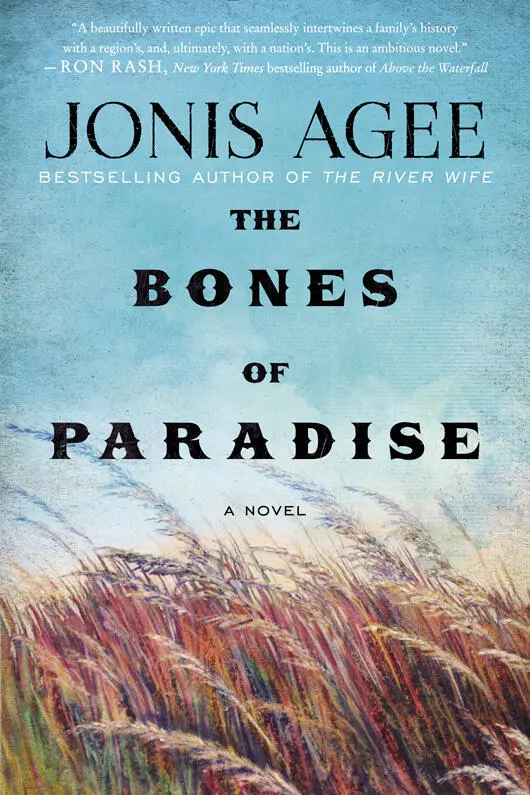
- Название:The Bones of Paradise
- Автор:
- Издательство:William Morrow
- Жанр:
- Год:2016
- ISBN:нет данных
- Рейтинг книги:3 / 5. Голосов: 1
-
Избранное:Добавить в избранное
- Отзывы:
-
Ваша оценка:
The Bones of Paradise: краткое содержание, описание и аннотация
Предлагаем к чтению аннотацию, описание, краткое содержание или предисловие (зависит от того, что написал сам автор книги «The Bones of Paradise»). Если вы не нашли необходимую информацию о книге — напишите в комментариях, мы постараемся отыскать её.
returns with a multi-generational family saga, set in the unforgiving Nebraska Sandhills in the years following the massacre at Wounded Knee—an ambitious tale of history, vengeance, race, guilt, betrayal, family, and belonging, filled with a vivid cast of characters shaped by violence, love, and a desperate loyalty to the land. Ten years after the 7th Calvary massacred more than 200 Lakota men, women, and children at Wounded Knee, J. B. Bennett, a white rancher, and Star, a young Native American woman, are murdered in a remote meadow on J. B.’s land. The deaths bring together the scattered members of the Bennett family: his cunning and hard father, Drum; his estranged wife, Dulcinea; and his young sons, Cullen and Hayward. As the mystery of these twin deaths unfolds, the history of the dysfunctional Bennett’s and their damning secrets are revealed exposing the conflicted heart of a nation caught between past and future.
At the center of
are two remarkable women. Dulcinea, returned after bitter years of self-exile, yearns for redemption and the courage to mend her broken family and reclaim the land that is rightfully hers. Rose, scarred by the terrible slaughters that have decimated and dislocated her people, struggles to accept the death of her sister, Star, and refuses to rest until she is avenged.
A kaleidoscopic portrait of misfits, schemers, chancers, and dreamers, Jonis Agee’s bold new novel is a panorama of America at the dawn of a new century. A beautiful evocation of this magnificent, blood-soaked land—its sweeping prairies, seas of golden grass and sandy hills, all at the mercy of two unpredictable and terrifying forces, weather and lawlessness—and the durable men and women who dared to tame it. Intimate and epic,
is a remarkable achievement: a mystery, a tragedy, a romance, and an unflagging exploration of the beauty and brutality, tenderness and cruelty that defined the settling of the American west.
The Bones of Paradise — читать онлайн бесплатно полную книгу (весь текст) целиком
Ниже представлен текст книги, разбитый по страницам. Система сохранения места последней прочитанной страницы, позволяет с удобством читать онлайн бесплатно книгу «The Bones of Paradise», без необходимости каждый раз заново искать на чём Вы остановились. Поставьте закладку, и сможете в любой момент перейти на страницу, на которой закончили чтение.
Интервал:
Закладка:
She shook her head. “Babylon sheriff believes it was the boys. I’m thinking of hiring Pinkertons.”
He glanced at her. “That’s a goddamned bad idea.”
She stared straight ahead now, her shoulders rigid, voice flat. “You have something to worry about?”
Drum ignored her. Damn wastefulness. Sometimes it seemed that was all life had to offer. A man worked hard, too hard even, only to see what he’d built sheer away and dissolve like salt in water. Did he want to find his son’s killer? Had it made a bit of difference when he avenged his grandfather’s death? Maybe Wilke had survived after all, waited all these years to track him down and finish off his family. The thought, crazy as it was, made him uneasy. He thought of his gold and some Pinkerton following him around. He shook his head.
“Won’t nobody talk to a stranger out here. You know that.” He hadn’t meant to antagonize her, but could tell from the flush that rose up her neck to her cheeks that she took it personal again, like she always did.
But when she spoke her voice stayed even. “You might be right. I just don’t want to let it go, act like it was an accident. We’re living with a murderer. Who knows what his plans are?”
“You don’t think it was someone passing through?”
She turned toward the corral again and shook her head. “That Indian girl and Graver. Maybe J.B. was the innocent bystander. Something’s odd. Who was the killer’s intended victim? Or was he a madman of some sort, but wouldn’t there be others then? It can’t be the boys.”
She’d thought about it more than he had, Drum had to admit. Maybe he was too old, too used to the way things happened out here in the hills. Maybe he was more concerned about the ranches and his money than about why his only son was killed, or who did it. Think harder, he scolded. What had J.B. done to deserve killing? What did he have that another person would want so badly they’d kill for it? Drum couldn’t think of a single thing so he sat silent, conscious there was a force out there moving against him and his that he might not be able to stop.
“You remember that last time I came to take Cullen home? You told me there could be accidents in the hills. It was a dangerous place to live and you were the only one who could keep my family safe, but I’d have to leave? You even said you’d take Hayward if I didn’t stop. And J.B. wouldn’t stop you. Is that what happened? He decided to stop you?”
He stared at her.
“I think maybe you shot J.B.” She stroked the coffee mug with her fingertips. “I just have to be sure, and then I’m going to kill you.”
CHAPTER TWENTY-TWO
Graver was assigned to check fence, windmills, water tanks, and cattle in the pastures between the two ranches. Some Horses and the other cowboys were finishing the branding while Drum’s men were spot branding almost a day’s ride away. Cullen had made it clear that he wasn’t taking orders anymore now that Drum couldn’t raise a stick or hand to him. Hayward was simply gone. Dulcinea hated to leave, but she and Rose had to seize the opportunity.
They moved swiftly on the gray stallion and the Indian pony, eating up the miles past the round and contented cattle that dotted the hills with calves gamboling nearby, butting each other and splaying their legs in imitation of their mothers to snatch at grass they didn’t want. The hills were green and rain came often enough to keep them from turning golden brown.
Drum’s ranch was quiet in the early afternoon, chickens nesting in the shade through the heat, horses sleeping in the corral, hind legs cocked, heads down. There were no dogs to greet them. Instead they saw a big orange tomcat lolling on the porch of the plain square house as if he were enough to scare intruders. The house had never been painted; now the boards were warped and pulled away from the nails. Dulcinea tied her horse to the hitching rail and walked up the dirt path to the step made from an old buggy seat with Rose beside her. When they stepped on the porch, the unpainted boards sighed, threatened to drop them through until they moved to either side. Twists of grass and oilcloth and newspaper were stuffed in between the boards where the wood pulled away, and nails had been driven randomly to stop the siding from springing off the house, leaving only the black tarpaper beneath. Dulcinea pushed open the door, half expecting to meet with a gun as the squealing hinges announced them. The cat darted inside, and she reminded herself to make sure the damn thing was out when she left. Apparently Drum left his door unlocked because he figured his reputation would deter thieves.
The smell hit them like an axe handle to the nose, and Dulcinea could feel it soak into her skin and clothes. Glancing around, her first thought was a dead body, but she saw the culprit immediately. The sink was stacked with dirty dishes and pans, crusted with rotting food, and blackened with the bodies of flies. On the table, the plates and bowls were filled with squirming maggots. They left the kitchen area and glanced into the parlor, where a desiccated gray striped cat curled into a painful howl of death on the sofa, mouth stretched open in rictus snarl, teeth bared. The orange tom prowled the furniture, sniffed the air around the gray body, and avoided it by rope walking over the top of the sofa, meowing loudly.
Rose ducked her head and went through the doorway to the three rooms in back. The first, clearly the old man’s bedroom, was as spartan as the house, wall cracks stuffed with newspaper and rags. The floor was covered in mouse droppings, and the oversweet smell of dead mice added another note to the fetid air from the front room. On pegs along the wall hung the old man’s few clothes, including an ancient black suit, thick with dust. A barely worn Stetson hung on the peg next to it, and a pair of black boots sat on the floor beneath. Dulcinea picked one up and turned it upside down. A flattened brown field mouse, with big, paper-thin ears and long tail hardened by time, dropped to the floor. Big flies thunked lazily against the filthy windows on either side of the bed, and when she went to open the nearest window, the frame came out in her hands. It’d never been properly sealed. Rose shook her head and nodded at the candle wax stuck to the edges. She set the window down on the floor, waiting for the big flies to find their way out. On top of the small bureau beside the bed sat a candle in a pool of melted wax, a pair of store-bought spectacles, and a battered journal of some sort, all wearing the light powder of abandonment. Was Drum Bennett a keeper of memories?
Dulcinea reached for the journal, then pulled back her hand. If she took it, the old man would know. When she leaned in, she saw a W embossed in the scratched brown leather cover. She opened it, careful not to tear the brittle pages. The only contents were crude drawings of mountains and what looked like maps. She closed the book. Then she opened the top drawer of the bureau, which held extra socks and a pair of long johns. Nothing hidden underneath. The second drawer contained a woman’s ivory-colored camisole and silk stockings with lace tops. She drew the silk length between her fingers and the two women looked at each other.
When she picked up the camisole and held it to admire the pale pink and ivory roses lining the top, she saw a small silver bangle. A closer inspection revealed tiny marks—it was a baby’s teething ring. In dim letters on the inside, she made out J.B. and a date obscured by the teeth marks. Hard to fathom Drum being sentimental. She thrust it back inside, covered it, and closed the drawer. They went across the hall to a smaller space, which turned out to be a storeroom, the walls lined with shelves of canned goods and supplies. Either the smell had lessened or they were getting used to it. Rose pointed to the poison set out on scraps of newspaper beside the bags of dried beans, sugar, flour, and cornmeal. No mice in here.
Читать дальшеИнтервал:
Закладка:
Похожие книги на «The Bones of Paradise»
Представляем Вашему вниманию похожие книги на «The Bones of Paradise» списком для выбора. Мы отобрали схожую по названию и смыслу литературу в надежде предоставить читателям больше вариантов отыскать новые, интересные, ещё непрочитанные произведения.





Обсуждение, отзывы о книге «The Bones of Paradise» и просто собственные мнения читателей. Оставьте ваши комментарии, напишите, что Вы думаете о произведении, его смысле или главных героях. Укажите что конкретно понравилось, а что нет, и почему Вы так считаете.