Alan Moore - Jerusalem
Здесь есть возможность читать онлайн «Alan Moore - Jerusalem» весь текст электронной книги совершенно бесплатно (целиком полную версию без сокращений). В некоторых случаях можно слушать аудио, скачать через торрент в формате fb2 и присутствует краткое содержание. Год выпуска: 2016, Издательство: Liveright Publishing Corporation, Жанр: Современная проза, на английском языке. Описание произведения, (предисловие) а так же отзывы посетителей доступны на портале библиотеки ЛибКат.
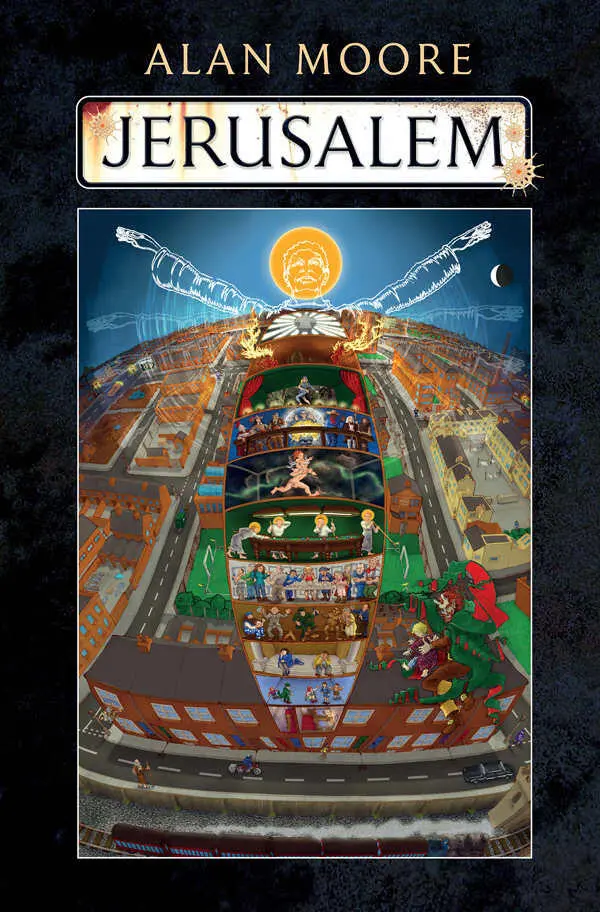
- Название:Jerusalem
- Автор:
- Издательство:Liveright Publishing Corporation
- Жанр:
- Год:2016
- ISBN:нет данных
- Рейтинг книги:4 / 5. Голосов: 1
-
Избранное:Добавить в избранное
- Отзывы:
-
Ваша оценка:
Jerusalem: краткое содержание, описание и аннотация
Предлагаем к чтению аннотацию, описание, краткое содержание или предисловие (зависит от того, что написал сам автор книги «Jerusalem»). Если вы не нашли необходимую информацию о книге — напишите в комментариях, мы постараемся отыскать её.
Disappeared lanes yield their own voices, built from lost words and forgotten dialect, to speak their broken legends and recount their startling genealogies, family histories of shame and madness and the marvellous. There is a conversation in the thunderstruck dome of St. Paul’s cathedral, childbirth on the cobblestones of Lambeth Walk, an estranged couple sitting all night on the cold steps of a Gothic church-front, and an infant choking on a cough drop for eleven chapters. An art exhibition is in preparation, and above the world a naked old man and a beautiful dead baby race along the Attics of the Breath towards the heat death of the universe.
An opulent mythology for those without a pot to piss in, through the labyrinthine streets and pages of Jerusalem tread ghosts that sing of wealth and poverty; of Africa, and hymns, and our threadbare millennium. They discuss English as a visionary language from John Bunyan to James Joyce, hold forth on the illusion of mortality post-Einstein, and insist upon the meanest slum as Blake’s eternal holy city. Fierce in its imagining and stupefying in its scope, this is the tale of everything, told from a vanished gutter.
Jerusalem — читать онлайн бесплатно полную книгу (весь текст) целиком
Ниже представлен текст книги, разбитый по страницам. Система сохранения места последней прочитанной страницы, позволяет с удобством читать онлайн бесплатно книгу «Jerusalem», без необходимости каждый раз заново искать на чём Вы остановились. Поставьте закладку, и сможете в любой момент перейти на страницу, на которой закончили чтение.
Интервал:
Закладка:
After the wall’s fall, financiers launch into an epic victory binge. Free to proliferate, capitalism mutates fast. Not even a free-market frenzy like the Thatcher-Reagan years, this is something entirely new, but with a few old faces. Alan Greenspan, guiding U.S. finance under Reagan, George Bush, Clinton and Bush Junior, is a big fan of libertarian Ayn Rand and it’s on his watch that some J.P. Morgan wizards invent Credit Default Swaps in 1994. What these are, briefly, is insurance. You lend somebody a lot of dosh at a good interest rate, but they’re all hillbillies with Cyclops babies and you’re worried they’ll default. So you pay a third party to insure the debt. Assuming that the hillbillies pay up, everyone wins. And if the babies one day need to go to Cyclops college and the loan goes bad, no problem. The insurer coughs up, and assuming you’ve not only loaned to Cyclopses it probably won’t bother them much either. This apparently removes the final obstacle to making serious money, which is risk. The banks and companies can now do pretty much exactly as they please, with someone else obliged to pay for their mistakes. Predictably, they go berserk; make record-breaking profits doing so. When the warmed-over Tories now known as New Labour come to power in 1997, which is when Rome leaves the party, they provide the Bank of England with control over the interest rate and thus the whole economy. Profits like that, they must know what they’re doing.
After lots of hassle, Dean and Roman trade their flat off Lower Harding Street for a whole council house in Delapré. The new place is much nicer, though they have a neighbour who complains when Dean pops out into the back yard for a smoke one night and unleashes a torrent of loud swearing after stepping in the garden pond. This is the business that the council try to talk up to an ASBO when they’re trying to get at Rome through Dean, through his Hercules Heel. Oddly enough, their old digs in St. Luke’s House end up being used by CASPAR, the shoestring community support group to whom all of the modest improvements in the area can be attributed. Rome only finds this out last night when he’s down at the nursery with Burt Reagan, setting up for Alma’s exhibition, and he meets Lucy, who’s arranging it and gets it in the neck if anything goes wrong. Turns out she works for CASPAR, labouring where him and Dean first make a go of it, make love, make breakfast. She and Rome chat while him and Burt hang the paintings and put the big sculpture or whatever it’s called on the pushed-together tables in the centre of the room. They bond over his old flat’s inconveniently tiny toilet, there amidst the stupefying images of river-monsters rearing over Spencer Bridge, of multiple-exposure charcoal children flickering in a wasteland and the raging giants in nightgowns with their arcing billiard cues, their spraying golden blood like fire.
The economic watchword is not caution now but innovation, new ways to make loot that are not tested or thought through. Enron borrows upon future derivatives from areas of technology not yet invented, such as shares in Daleks or Transporter Beams but evidently nowhere near as solid. Enron’s bubble bursts as Dubya Bush takes over in 2000, the worst monetary catastrophe in U.S. history, and when the facts emerge nobody can believe the catalogue of madness, the horrific warning that this poses for economy in general. People call for tighter regulation, which would hinder making money, so the Enron business is dismissed as a statistical anomaly, some of its execs go to jail and then everyone carries on as normal. The big market in the U.K. and the U.S. now is housing, and those Credit Default Swaps mean banks can offer mortgages to almost anyone, a million Cyclops hillbillies, safe in the knowledge that insurers pay if it goes wrong. Unless, of course, all of the hillbillies default at once. If Rome’s correct, the world’s swollen financial markets are all resting on the least dependable and most impoverished section of society, on people almost guaranteed to fuck up. People like those in this very district. Schemes intended to reduce risk instead spread it through the whole system like woodworm, until from Beverly Hills to Bermondsey those folk who’d never dream of visiting an area like the Boroughs find instead that it has come to visit them.
Roman has a capacity for violence, never a propensity. It’s just been part of the equation, scuffling with coppers in an alley or outside the U.S. embassy in Grosvenor Square, just as it’s always been there in the money markets during their own troubled adolescence. When the Bacaleri di Norhan stage economic protests in 1263, Henry the Third sends in the troops to bash some heads together. When the Poll Tax riots kick off in the late 1980s — also economic protests — Thatcher sends in riot police to bash some heads together. Rome imagines that when the balloon goes up in our hi-tech twenty-first century, whoever’s running things will very probably send in Atari hunter-killer robots to — well, you get the idea. Violence, or at least the threat of it, is always there, hence Rome’s lifelong easy association between finances and criminality. There’s always hired goons somewhere in the mix, bruisers or bailiffs, or riot-samurais, or soldiers. Rome sits in the dark of Ted Tripp’s borrowed car and waits until the half-a-dozen squaddies stagger pissed and bellowing out of the cellar bar to fall into a minibus that’s evidently their ride back to base. It pulls away down Abington Street, most probably bound for Bridge Street, South Bridge and the motorway beyond. Rome gives it a few seconds and then starts Ted’s car up, following the soldiers out past the bright lights of town to where the darkness gathers round Northampton like an angry and protective mother.
Just last year in 2005, amidst the tube-bombs and ongoing nightmare of Iraq, big Gordon Brown sells off the last of Britain’s gold reserves right when the going rate is at a temporary low. There’s nothing solid holding things up anymore, not even paper, only electronic impulses and mathematics swirling in the ether. Rome, as a manic depressive, entertains dark possibilities: when banks begin to crash, as any airborne vessels held aloft by bubbles surely will, how will governments deal with that? The money’s bound up in the banks, especially in Britain where they’ve run the show since 1997, and if they go down the whole economy goes with them. No one’s going to let that happen. In effect, the banks are now immune to government control or reprimand. They have, by stealth, become a monarchy. It’s not even capitalism anymore, not the brutal Darwinian free-for-all proposed by Adam Smith and Maynard Keynes and Margaret Thatcher. This is some refried early seventeenth century arrangement, with a coddled and capricious ruler dominating even parliament. Rome’s not sure what you’d call the set-up — it’s a moneylenderocracy or something like that — but it would seem that the banking sector sees itself as royalty. Roman agrees. He sees them, more precisely, as King Charles the First. And everybody round these parts knows how all that ends up: in fire and pikes, wet innards and dry powder. Worlds turned upside down. Screams in the night.
The B-roads outside town are submerged in a rural blackness. There’s nobody else about, no other cars. Roman accelerates, pulls alongside the mini-bus. They think he’s overtaking until he slams into them, BDANK ! The bus squeals, trying to regain control, with everybody on board thinking it’s a dreadful accident, when Rome lurches across, deliberately ramming them again, BDANK ! This time they swerve into a ditch, roll over and land upside down. Rome stops a few yards further on, retrieves the billiard cue from the Black Lion that he’s got stashed in the back, then slides out of the car. He takes his time walking back up the road, the pole over his scrawny shoulder. No one’s going anywhere. The nearside door of the crashed troop-transporter turns out to be open. Roman climbs aboard. The soldiers are all dangling in their safety belts, concussed and bleeding. Out of those who can focus their eyes, nobody’s what you might call pleased to see him. He walks down the aisle between the seats, well, actually he walks along the inside of the bus’s roof but it’s the same thing. He walks down the aisle and scrutinises all the stunned, inverted faces, picking out the ones who’d given him the aggro. “You.” The thick end of the billiard cue jabs forward, into teeth. “And you.” Again the cue comes down, again. He pots a black eye, a pink throat, a cue-ball skull. Again. Again. Rome clears the table in a single visit and the crowd here at the Crucible goes wild.
Читать дальшеИнтервал:
Закладка:
Похожие книги на «Jerusalem»
Представляем Вашему вниманию похожие книги на «Jerusalem» списком для выбора. Мы отобрали схожую по названию и смыслу литературу в надежде предоставить читателям больше вариантов отыскать новые, интересные, ещё непрочитанные произведения.






Обсуждение, отзывы о книге «Jerusalem» и просто собственные мнения читателей. Оставьте ваши комментарии, напишите, что Вы думаете о произведении, его смысле или главных героях. Укажите что конкретно понравилось, а что нет, и почему Вы так считаете.