Alan Moore - Jerusalem
Здесь есть возможность читать онлайн «Alan Moore - Jerusalem» весь текст электронной книги совершенно бесплатно (целиком полную версию без сокращений). В некоторых случаях можно слушать аудио, скачать через торрент в формате fb2 и присутствует краткое содержание. Год выпуска: 2016, Издательство: Liveright Publishing Corporation, Жанр: Современная проза, на английском языке. Описание произведения, (предисловие) а так же отзывы посетителей доступны на портале библиотеки ЛибКат.
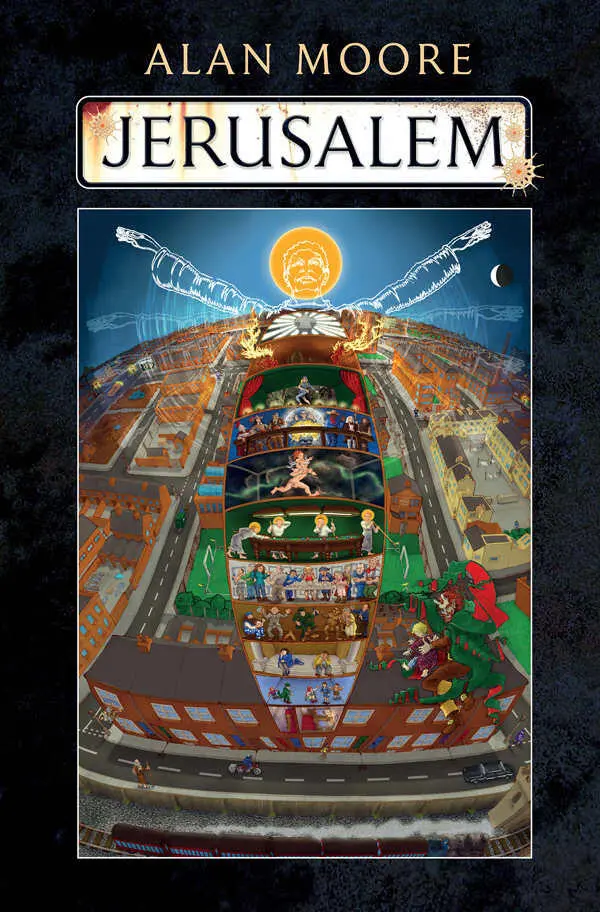
- Название:Jerusalem
- Автор:
- Издательство:Liveright Publishing Corporation
- Жанр:
- Год:2016
- ISBN:нет данных
- Рейтинг книги:4 / 5. Голосов: 1
-
Избранное:Добавить в избранное
- Отзывы:
-
Ваша оценка:
Jerusalem: краткое содержание, описание и аннотация
Предлагаем к чтению аннотацию, описание, краткое содержание или предисловие (зависит от того, что написал сам автор книги «Jerusalem»). Если вы не нашли необходимую информацию о книге — напишите в комментариях, мы постараемся отыскать её.
Disappeared lanes yield their own voices, built from lost words and forgotten dialect, to speak their broken legends and recount their startling genealogies, family histories of shame and madness and the marvellous. There is a conversation in the thunderstruck dome of St. Paul’s cathedral, childbirth on the cobblestones of Lambeth Walk, an estranged couple sitting all night on the cold steps of a Gothic church-front, and an infant choking on a cough drop for eleven chapters. An art exhibition is in preparation, and above the world a naked old man and a beautiful dead baby race along the Attics of the Breath towards the heat death of the universe.
An opulent mythology for those without a pot to piss in, through the labyrinthine streets and pages of Jerusalem tread ghosts that sing of wealth and poverty; of Africa, and hymns, and our threadbare millennium. They discuss English as a visionary language from John Bunyan to James Joyce, hold forth on the illusion of mortality post-Einstein, and insist upon the meanest slum as Blake’s eternal holy city. Fierce in its imagining and stupefying in its scope, this is the tale of everything, told from a vanished gutter.
Jerusalem — читать онлайн бесплатно полную книгу (весь текст) целиком
Ниже представлен текст книги, разбитый по страницам. Система сохранения места последней прочитанной страницы, позволяет с удобством читать онлайн бесплатно книгу «Jerusalem», без необходимости каждый раз заново искать на чём Вы остановились. Поставьте закладку, и сможете в любой момент перейти на страницу, на которой закончили чтение.
Интервал:
Закладка:
Electing to take up their new address, there in the grey and tan Northampton avenues of 1954, demands that Joyce and Bernard make some hard decisions. Clearly, the “no children” rule presents the biggest obstacle to living in the Sheep Street flat and thus to Bernard taking up his best and thus far only offer of a job, but he thinks he can see a way around it. Up by train from London in a cloud of steam and coal-smoke for a visit to the premises he meets a would-be neighbour from the rooms downstairs, an amiable idealist from the International Friendship League. This is some form of thankfully entirely ineffectual English socialist conglomerate of the variety that Bernard generally avoids, but in this instance the old chap appears to offer Bernard a solution to his “no children allowed” predicament: the man suggests that he has room to hide a child in his downstairs accommodation during those occasions when the landlord comes to pay a visit, which would go at least halfway to solving Bernard’s quandary, the other half of which is his and Joyce’s second baby, little Andrew. Their new neighbour clearly doesn’t have the room to hide two infants, and as Bernard’s firstborn it seems only right that the two-year-old David should take precedence. After an unusually heated consultation with his wife, Bernard decides it would be best if Andrew were to stay in Brixton with some relatives of Joyce’s until they’re established in the town and can arrange a mortgage, can arrange a permanent address with room for all the family. In Bernard’s view, with Andrew being still a few months shy of his first birthday he’s less likely to have formed a strong attachment to his mother and will therefore miss her less than David would do. Bernard doubts so small a child will even be aware that anything is different. And besides, in later life the baby won’t be able to remember anything about it. It will be as if this admittedly less than ideal situation hasn’t happened. At last everything’s arranged, everything goes ahead and on their first night in the new flat with its view of that peculiar and hardly Christian-looking church across the street, Joyce doesn’t sleep and weeps until the morning. Bernard, frankly, doesn’t understand why she can’t just resign herself and make the best of it. They’re only doing what they have to do, and in perhaps a year it will all work out fine for everyone. Andrew will be all right. There’s no harm done.
Henry and his Selina make their way down Sheep Street to the market square so he can go collect his wages from the Welsh House that they have there, and he knows from the way everybody’s looking at him that he’s got the only black face in the town. It’s not that they appear resentful or they’re giving him the hard eye like he shouldn’t be there, how it would have been in Tennessee. The people of Northampton look to be more plain amazed, regarding Henry like they would one of them big giraffes that he’s seen pictures of, or something else so rarefied and out-the-way that no one had expected to see nothing like it in their town or in their lifetime. People smile or some of them look shocked but mostly they just stand there with their faces hanging out as if they don’t know what to do with them. For his part, Henry figures he must look the same way, gawping at the ancient town in all its queerness. It’s like Henry and Northampton are dumbstruck with mutual astonishment. First that round church, been standing on its spot eight hundred years, while down the street there’s that big beech tree must be pretty near as old, and then you’ve got a market square that’s from around the same time, from around the year ten hundred-something. That’s a long time, long enough to make his head spin. Why, back then the slave trade between countries hadn’t been invented, far as Henry knows. There’s no United States, no Tennessee, and white people have never heard of Africa. There’s just the circle-church, the beech tree and the woollen river winding between here and Wales. To Henry it seems like all of these centuries the place has been here are a kind of breadth or depth that he can’t see but which conspires to give the town a feeling of great magnitude that’s bigger than its visible real size. After they pick up Henry’s pay the pair of them go for a walk up from the market square and back to Sheep Street, where they make their way down this old alley with a sign up says it’s Bullhead Lane, so steep and narrow it feels like one of them nonsense-places in a dream, and that’s how they descend into the Boroughs. From the start it’s all around them, clamouring for their attention. There’s some tough old girls look fit to pull each other’s heads off rolling in the street outside one of the beer establishments, and anywhere you’re standing you can see around a dozen similar public houses, there’s that many of them. There’s a blind man playing on a barrel-organ, rabbits hopping right there on the cobbles, everybody’s got a hat on and nobody’s got a gun. There’s every kind of call and conversation, and in Scarletwell Street, where they spend a piece of Henry’s wages in advance rent on a house they take a shine to, they see Newton Pratt’s astounding beast drinking its beer and trying to stay upright just across the street there. Henry and Selina take it for a sign and move in right away. They’ve got a whole house to themselves, and though it’s small and wedged into its sooty terrace like a book jammed in a bookshelf it seems much too big at first, but that’s before the babies start to pour out of Selina in a happy babbling flood that rises to their ankles, then their knees, and in what seems like just a year or two they’re standing shoulder-deep in children.
As a grown man David Daniels can’t remember much about his origins there at the flat in Sheep Street, his two years as an official Boroughs resident. His infancy, that endless continuity of moments when each moment is a saga, has evaporated to leave only a thin residue of pictures and associations, brittle sepia snapshots taken from floor-level with the details and the context bleaching out around the edges. He recalls the endless plain of carpet in the living room, soft beige with fronds and curlicues that are an acre of gold fuzz now in his memory, stabbed by slanting blades of sunlight. There’s a flickering internal film-loop, a few seconds long, of David hooked up to his mother Joyce by leather reins and stumbling uncertainly downhill along a sloping path with crumbled loose-tooth tombstones rising up to either side, which he now realises must be in the graveyard of the Holy Sepulchre, the old church just across the way. When he gets taken out for walks it’s always to the north or east of Sheep Street, never to the west or south. It’s always to the Racecourse just a little up past Regent’s Square and never down into the Boroughs, a disreputable neighbourhood where unbeknownst to him his future playmate Alma Warren sleeps sound in the bosom of her ordinarily peculiar clan. David’s initial recollections of his dad are more like memories of a ship than of a person, with the chest and gentle paunch thrown forward like a brocade mainsail swelled by tailwind. Thumbs hooked presidentially in waistcoat pockets and up past the crow’s nest of his tie-knot, Bernard’s proud face like a flag; a better-nourished Jolly Roger with its twinkling glass sockets gilded at their rims, sailed here upon spiced currents from High Barbary, from the lion hills of the old country in which David was conceived and which his parents very seldom mention. Then there are the days of mystery and adventure when his mother takes him on the huffing dragon train to London so that she can visit friends or family, he’s not sure which, and David spends the afternoons in unfamiliar Brixton parlours playing with a little boy called Andrew who seems nice enough, but whom he doesn’t know. When David’s four years old in 1956, Bernard and Joyce at last discover a white couple who’ll arrange a mortgage with the racially mistrustful banks. They move into a pleasant house in Kingsthorpe Hollow, funny little Andrew turns up unexpectedly to live with them and for the first time David comes to understand he has a brother, that he’s had a brother all this time and never heard a thing about it until now. He starts to wonder how much of his life is going on without his knowledge, starts to speculate on where and who his parents might have been before they suddenly materialise as a home-owning married couple in Northampton, just as though they’ve always been here. Why don’t David and his baby brother seem to have grandparents? Are his mother and his father born like gods out of the mud and sky, from the Northampton landscape with no mortal ancestors preceding them? He has the sense of a big, complicated story that he’s come in at the middle of, and an impression of a history that’s kept apart from him, in quarantine, like Andrew. How could they not tell him that he’s got a brother? He begins to worry about any more astonishing surprises that might be in store for him. Given their new house and new neighbours, given the way his family are encouraged to regard themselves now they’re not living in the Boroughs anymore, David begins to wonder whether he’s even actually black, if David is indeed his real name.
Читать дальшеИнтервал:
Закладка:
Похожие книги на «Jerusalem»
Представляем Вашему вниманию похожие книги на «Jerusalem» списком для выбора. Мы отобрали схожую по названию и смыслу литературу в надежде предоставить читателям больше вариантов отыскать новые, интересные, ещё непрочитанные произведения.








Обсуждение, отзывы о книге «Jerusalem» и просто собственные мнения читателей. Оставьте ваши комментарии, напишите, что Вы думаете о произведении, его смысле или главных героях. Укажите что конкретно понравилось, а что нет, и почему Вы так считаете.