Alan Moore - Jerusalem
Здесь есть возможность читать онлайн «Alan Moore - Jerusalem» весь текст электронной книги совершенно бесплатно (целиком полную версию без сокращений). В некоторых случаях можно слушать аудио, скачать через торрент в формате fb2 и присутствует краткое содержание. Год выпуска: 2016, Издательство: Liveright Publishing Corporation, Жанр: Современная проза, на английском языке. Описание произведения, (предисловие) а так же отзывы посетителей доступны на портале библиотеки ЛибКат.
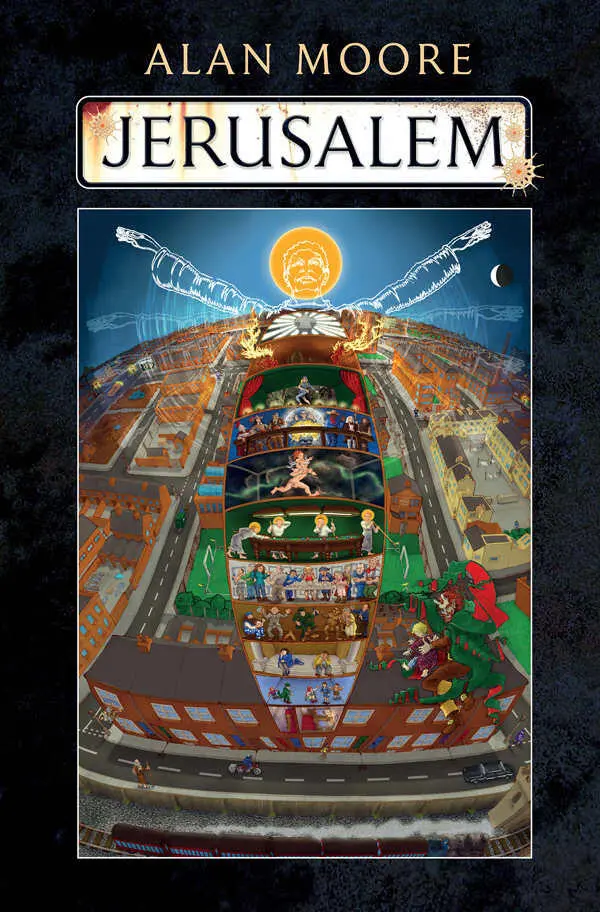
- Название:Jerusalem
- Автор:
- Издательство:Liveright Publishing Corporation
- Жанр:
- Год:2016
- ISBN:нет данных
- Рейтинг книги:4 / 5. Голосов: 1
-
Избранное:Добавить в избранное
- Отзывы:
-
Ваша оценка:
Jerusalem: краткое содержание, описание и аннотация
Предлагаем к чтению аннотацию, описание, краткое содержание или предисловие (зависит от того, что написал сам автор книги «Jerusalem»). Если вы не нашли необходимую информацию о книге — напишите в комментариях, мы постараемся отыскать её.
Disappeared lanes yield their own voices, built from lost words and forgotten dialect, to speak their broken legends and recount their startling genealogies, family histories of shame and madness and the marvellous. There is a conversation in the thunderstruck dome of St. Paul’s cathedral, childbirth on the cobblestones of Lambeth Walk, an estranged couple sitting all night on the cold steps of a Gothic church-front, and an infant choking on a cough drop for eleven chapters. An art exhibition is in preparation, and above the world a naked old man and a beautiful dead baby race along the Attics of the Breath towards the heat death of the universe.
An opulent mythology for those without a pot to piss in, through the labyrinthine streets and pages of Jerusalem tread ghosts that sing of wealth and poverty; of Africa, and hymns, and our threadbare millennium. They discuss English as a visionary language from John Bunyan to James Joyce, hold forth on the illusion of mortality post-Einstein, and insist upon the meanest slum as Blake’s eternal holy city. Fierce in its imagining and stupefying in its scope, this is the tale of everything, told from a vanished gutter.
Jerusalem — читать онлайн бесплатно полную книгу (весь текст) целиком
Ниже представлен текст книги, разбитый по страницам. Система сохранения места последней прочитанной страницы, позволяет с удобством читать онлайн бесплатно книгу «Jerusalem», без необходимости каждый раз заново искать на чём Вы остановились. Поставьте закладку, и сможете в любой момент перейти на страницу, на которой закончили чтение.
Интервал:
Закладка:
Dying 1727, in his eighties and still at the mint, Newton sees the beginning of the shift to paper money. In 1725 banks issue notes where the pound sign is printed, but the date, amount and other details are hand-written by the signatory, like a cheque. Cash gradually becomes more abstract, but a greater sleight of hand takes place hundreds of years before with the invention of derivatives, the concept that helps scupper Newton. A derivative — a bond deriving from the actual goods for sale — occurs when someone makes a deal to sell their goods for an agreed sum at some future date. Whether the market price rises or falls before that time determines who’s made the best bet, but what’s important is that the derivative bond now has a potential value and can be sold on, with its projected worth continually increasing. This uncoupling of money and real goods contributes to the Tulip Craze and South Sea Bubble, while the current value of the world’s derivatives, from what Rome hears, is up to ten times larger than the sixty or so trillion dollars that is the whole planet’s fiscal output. The divide between reality and economics is a hairline fissure widening across the centuries to a deep ocean vent from which unprecedented forms of life squirm up with dismal regularity: bubbles and crazes, Wall Street crashes and Black Wednesdays, Enron and whatever bigger fuck-up is inevitably coming next; the bad dreams of a rational age that good old William Blake calls “Newton’s sleep”.
Rome combs the Boroughs streets looking for trouble. In some of the last remaining council dwellings there’s asbestos that the council won’t own up to, much less take away. Attempts to entice people into private housing schemes by entering them in a draw for prizes that are never won; do not exist. There’s endless scams or deprivations to attend and Rome has mission-creep, as likely to campaign against the selling-off of eighteenth-century houses in Abington Park as to bellow abuse through a loudhailer when they bring in Yvette Cooper, housing minister, to launch the NEWLIFE towers flogged to a housing company by former councillor Jim Cockie just before he joins their board. And there’s always some new affront on the horizon. At the moment there’s moves to put Euro-dosh meant for the Boroughs into a big needle like the Express Lifts Tower, but on Black Lion Hill. Roman suspects that this is to facilitate backhanders from whichever company lands the deal. Rome plans to feign disinterest, let them think his eye is off the ball. They’ll set dates for a secret ballot, to vote the proposals through without constituents knowing that they’ve backed this clearly bad idea. Then, on the afternoon before, Rome will call in a favour from someone with council clout, get them to change it to an open ballot, lift the stone to shed light on the wriggling things beneath and make them vote against it if they want to keep their seats. It’s all a complicated business, but then he’s a complicated man.
Money continues to evolve — particularly after the remarkable events at a Northampton cornmill that Rome has related to a slack-jawed Alma not an hour ago. 1745 sees partly-printed notes from twenty to a thousand pounds. Fifty years later, after the Napoleonic Wars, the bank stops paying gold for notes in what’s called the Restriction Period. This is when Sheridan calls the bank “an elderly lady in the City”, which cartoonist Gilray artfully tarts up as “the Old Lady of Threadneedle Street”. In 1821 the gold standard’s reinstituted and endures in a robust condition up until the First World War. The part-handwritten papers are made legal tender for all sums over five pounds in 1833, becoming proper modern banknotes. Then in 1855 they go the whole hog with the notes completely printed. Britain finally leaves the gold standard in 1931, its currency now backed up by paper securities rather than bars of precious metal. By the middle of the twentieth century, as Roman sees it, we’ve a world economy relying more and more upon the logic of a huge casino, and we’re just about to see a wave of post-war innovation that will change the planet. When these new ideas impact on the money markets they create the preconditions for a scale of ruin never previously witnessed or imagined. Eddies in the cash flow deepen into whirlpools, maelstroms, and we have the makings of a catastrophic storm. As they say in the ’Sixties, it don’t take a weatherman.
Not all Rome’s tasks are so dramatic. There’s fundraisers like the poster Alma does, and slogging door to door to make sure everyone’s informed. Like yesterday: Rome spends it letting people know about Alma’s do at the nursery while walking off the tail-end of a downer, one of Rome’s bear markets of the soul. Fresh air makes him feel bullish, while attempting all those stairways in the flats should do some cardio-vascular good. Trudging the tower blocks he checks on some of the older residents. They won’t be interested in the exhibition, but it’s an excuse to see if they’re okay. Near Tower Street he spots Benedict Perrit setting out on a day’s drinking and then pretends not to notice minor local drug czar Kenny Nolan, an amoral little shit who’s running down the district when he’s not even a councillor; not even being paid to do it. Crossing Bath Street, Roman mounts the scabby ziggurat of front steps to look in on little Marla Stiles, who’s on the skids, the game and crack, respectively. Her hungry lemur eyes dart everywhere when she comes to the door. She isn’t listening as Rome gives her the spiel on Alma’s show, but at least he can see she’s still alive. How long for, well, that’s anybody’s guess. He goes on up the flat-blocks’ central walk to visit other causes for concern around St. Katherine’s House, and on his way back later has to veer around a fresh-laid dog turd distantly resembling a dollar sign. It’s funny, isn’t it, the little details that you notice?
Economics as art starts out figurative, goes abstract, although not until the twentieth century will it become surrealism. Britain starts to leave the gold standard in 1918 which, coincidentally, is when the fifty-year dismantling of the Boroughs kicks off. Nearly all its terraces are gone by the late ’Sixties, when that decade’s fiscal innovations are beginning to come into play. Rome hears about a paper published, early ’Seventies, with new equations to help calculate the value of derivatives based on that of the goods that they’re derived from. Theoretically, this makes such deals a safer bet, and to the money markets that’s a chequered flag. Mathematics-wonks are suddenly the saviours of the industry. There are now new ways to make money, if there weren’t these regulations in the way. At decade’s end Thatcher and Reagan come to power, two eighteenth century Free Market Liberals who share Adam Smith’s mystical conviction that the market somehow regulates itself and subsequently start removing its restraints, just as the 1980s’ big computer boom gets underway. Keeping an eye on stocks, computers can gain or lose fortunes in a millisecond, adding to the system’s volatility. Crashes and crunches come and go, ruining countless thousands, but the bigger players keep on making bigger profits. Then in 1989 the Berlin Wall comes down and it’s like a dam bursting. Scenting blood with its only major competitor’s sudden demise, capitalism slips its leash.
When Rome’s own crashes come, fiscal analogies break down. He always ends up in the black. Black doves, black ice cream, a black wedding, a black Christmas, simmering in a stock of his own fuck-ups and nothing to do but live through it, to take those long walks up the colour gradient from deepest ebony to manageably neutral grey. Tom Hall calls it “the black dog”, after Winston Churchill’s name for the phenomenon. Back in the early days with his soon-to-be wife Diane, Tom goes for a lie-down on the Racecourse when he’s done something to test her patience, which is often. He can see the dark hound through his half-closed eyelids, sitting calmly on the summer-yellowed grass beside him. Roman misses Tom, but then, who doesn’t miss that planetary presence that kept half the town revolving with its gravity, its levity? That night in the Black Lion after Roman’s brush with the new model army, Tom is playing brag when Roman drops by to nick Ted Tripp’s motor; almost certainly sees Roman swipe the keys but only chuckles to himself and goes on with his game. Rome leaves them to it and, after he picks up something else he’s going to need from the back room, he takes the car from the pub car park. Furiously calm, he drives it round to Abington Street and pulls up beside the Grosvenor Centre’s entrance with his lights off, waiting. Obviously, with the street now pedestrianized you couldn’t do that sort of thing today. It’s Health and Safety gone mad.
Читать дальшеИнтервал:
Закладка:
Похожие книги на «Jerusalem»
Представляем Вашему вниманию похожие книги на «Jerusalem» списком для выбора. Мы отобрали схожую по названию и смыслу литературу в надежде предоставить читателям больше вариантов отыскать новые, интересные, ещё непрочитанные произведения.





Обсуждение, отзывы о книге «Jerusalem» и просто собственные мнения читателей. Оставьте ваши комментарии, напишите, что Вы думаете о произведении, его смысле или главных героях. Укажите что конкретно понравилось, а что нет, и почему Вы так считаете.