Alan Moore - Jerusalem
Здесь есть возможность читать онлайн «Alan Moore - Jerusalem» весь текст электронной книги совершенно бесплатно (целиком полную версию без сокращений). В некоторых случаях можно слушать аудио, скачать через торрент в формате fb2 и присутствует краткое содержание. Год выпуска: 2016, Издательство: Liveright Publishing Corporation, Жанр: Современная проза, на английском языке. Описание произведения, (предисловие) а так же отзывы посетителей доступны на портале библиотеки ЛибКат.
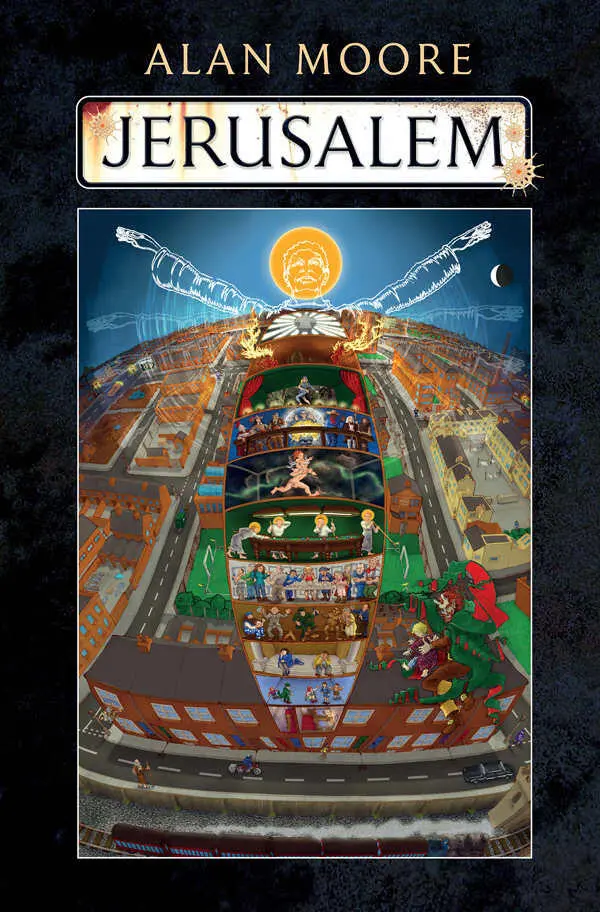
- Название:Jerusalem
- Автор:
- Издательство:Liveright Publishing Corporation
- Жанр:
- Год:2016
- ISBN:нет данных
- Рейтинг книги:4 / 5. Голосов: 1
-
Избранное:Добавить в избранное
- Отзывы:
-
Ваша оценка:
Jerusalem: краткое содержание, описание и аннотация
Предлагаем к чтению аннотацию, описание, краткое содержание или предисловие (зависит от того, что написал сам автор книги «Jerusalem»). Если вы не нашли необходимую информацию о книге — напишите в комментариях, мы постараемся отыскать её.
Disappeared lanes yield their own voices, built from lost words and forgotten dialect, to speak their broken legends and recount their startling genealogies, family histories of shame and madness and the marvellous. There is a conversation in the thunderstruck dome of St. Paul’s cathedral, childbirth on the cobblestones of Lambeth Walk, an estranged couple sitting all night on the cold steps of a Gothic church-front, and an infant choking on a cough drop for eleven chapters. An art exhibition is in preparation, and above the world a naked old man and a beautiful dead baby race along the Attics of the Breath towards the heat death of the universe.
An opulent mythology for those without a pot to piss in, through the labyrinthine streets and pages of Jerusalem tread ghosts that sing of wealth and poverty; of Africa, and hymns, and our threadbare millennium. They discuss English as a visionary language from John Bunyan to James Joyce, hold forth on the illusion of mortality post-Einstein, and insist upon the meanest slum as Blake’s eternal holy city. Fierce in its imagining and stupefying in its scope, this is the tale of everything, told from a vanished gutter.
Jerusalem — читать онлайн бесплатно полную книгу (весь текст) целиком
Ниже представлен текст книги, разбитый по страницам. Система сохранения места последней прочитанной страницы, позволяет с удобством читать онлайн бесплатно книгу «Jerusalem», без необходимости каждый раз заново искать на чём Вы остановились. Поставьте закладку, и сможете в любой момент перейти на страницу, на которой закончили чтение.
Интервал:
Закладка:
Still, that seventeenth century: a bastard from the outset and then it builds up to Isaac fucking Newton as its big finale. It kicks off with the gunpowder plot and Francis Tresham’s head impaled down at the end of Sheep Street, then it picks up pace with the Enclosures Act when all the toffs are given liberty to fence off areas of common land, legally sanctioned smash-and-grab with all the main protestors being local, all the doomed and dashing Captains, Swing and Slash and Pouch, this last one landing on a spike in Sheep Street within eighteen months of his posh adversary Francis Tresham. You can see what makes the land-reclaiming Diggers and the class-war Levellers so popular when they arrive in the mid-1640s to support Oliver Cromwell, alongside all of the other ranting, quaking dissidents that use Northampton as a millenarian theme-park in those years. The town backs Cromwell. He turns out to be like Stalin but without the sense of humour. Anyway, he’s dead by 1658, his son and heir fucks off to France and so by 166 °Charles the Second’s on the throne. Upset about Northampton’s role in getting his dad’s head lopped off he has its castle torn down as a punishment, but he’s concerned about the currency as well. Charles’s reign sees the introduction of milled edges to some of the previously hammered coins to prevent clipping, but the practice is still rife in ’96 when Isaac Newton comes to town, the Eliot Ness of English finance in the sixteen-hundreds.
If Roman’s in bed, his arms around his boyfriend, drifting off into the dark behind his corrugated eyelids, all the madness in his life makes perfect sense. When him and Dean first hook up in the early 1990s, that’s when his and Sharon’s young son Jesse starts to come unglued. Part of the Rave scene, Jesse necks assorted disco biscuits — ecstasy and ketamine and Christ knows what — halfway to a drug-aggravated breakdown, like Bert Regan’s stepson Adam, Jesse’s best mate at the bleary, blurry sunrise parties. Jesse takes Rome’s coming out hard, undeniably, but there’s a lot of other factors in the mix. Pal Adam goes spectacularly crazy and decides he’s gay as well; a gay male angel with his wings torn off by treacherous women — this meant literally. For Jesse it must seem reality has suddenly become untrustworthy so he stops going out, starts drinking to damp his by-now perpetual hallucinations, to blot out the cats with human faces, and then somewhere down the line he learns that in the blotting-out stakes heroin beats booze. His junkie new best mate is first to overdose, to fall off of the world in Jesse’s bedroom back at Sharon’s place, and then a few months later Jesse’s dead as well, bang, just like that. Ah, fuck. Sharon blames Rome for everything, won’t even have him at the funeral. It’s black, and doctors finally put a name to Roman’s driving fire, his contradictory soul: manic depression. Like police car sirens or economies, it seems Rome has his ups and downs.
This role as warden of the mint is meant as a seat-warming post, but Isaac takes it seriously, smells blood and money in the water. Coming to the job in 1696 when forgery and clipping still degrade the currency, Newton begins his Great Recoinage, where he recalls and replaces all the hammered silver coin in circulation. It takes two years and reveals that getting on a fifth of all the coins recalled are counterfeit. While forgery is classed as treason, punishable by evisceration, getting a conviction is a bugger, but the gravity man rises to the task. Disguised as a habitué of taverns Newton loiters, eavesdrops, gathers evidence. He then gets himself made a Justice of the Peace in all of the Home Counties so that he can cross-examine suspects, witnesses, informers, and by Christmas 1699 he has successfully sent twenty-eight rogue coiners to be drawn, hung, and then quartered, off down Tyburn way. In recognition of a job well done, in that same year he’s made the master of the mint, his wages bumped from Montague’s five or six hundred pounds to between twelve and fifteen hundred quid a year. Newton’s recoinage has reduced the need for low-denomination hand-scrawled bank notes so that anything under a fifty is withdrawn. Of course, it’s only those in Newton’s income bracket who will ever notice, given that for most people their yearly earnings in seventeenth century England are far less than twenty pounds and they will never see a bank note in their lives.
When Rome’s first diagnosed as a bit swings and roundabouts they stick him on the new anti-depressants, the SSRIs, Selective Serotonin Re-uptake Inhibitors like Prozac, that in 1995 appear to be the British medical profession’s first response to anything from clinical depression to occasional ennui. The drugs, in Rome’s opinion, are born of the probably-American idea that those in the developed world have an inalienable right to be contented every hour of their existence. So what if these happy-pills haven’t been around long enough for any adverse side-effects to show up so far; are effectively untested? There’s a market eager for an end to all their troubles, there are pharmaceutics corporations eager to make money, and the blue sky ethos of that endless economic boom-time stipulates instant gratification. Anyone dissenting from this mandatory manic optimism is a Gloomy Gus, a scaremonger or pessimist, is out of step with all the laissez-faire euphoria and would most probably feel better on a course of Prozac. Rome gives it a go, not having been informed that one occasional by-product of SSRIs is suicidal black depression. When Dean asks what’s wrong Rome drop-kicks him across the living room. He throws the pills away and in the dark troughs he goes for long walks and sorts it out himself. The manic peaks he saves for council meetings, for campaigns or organising protests. Energy efficiency. It’s one of the first principles you learn in engineering.
Newton, who’s familiar with the principle, brings chemical and mathematic know-how to the mint. After his Great Recoinage he’s asked to repeat the trick in Scotland, 1707. This leads to a common currency and the new kingdom of Great Britain. Not content yet, in 1717 the seventy-six-year-old first proclaims his bi-metallic standard where twenty-one silver shillings equals one gold guinea. England’s policy of paying for imports with silver while receiving payment for exports in gold means there’s a silver shortage, so what Newton’s doing here is moving Britain’s standard from silver to gold without announcing it. Personally he’s doing nicely, coining it, well-minted. Trusting his ability with sums to double up his cash he invests in the sure-fire high-return world of the South Sea Bubble, dropping twenty grand — three million by the current reckoning — when in 1721 the whole thing goes tits up. The fiscal genius of the day loses his shirt. He lets greed override his risk-assessment faculties, displays an expert’s fatal overconfidence in his abilities, the way that it’s mostly mycologists who end up killing themselves with a death cap omelette. And what brings Sir Isaac down is dabbling where he should know better, in a market bloated by a form of bonds known as derivatives, partly responsible for the Dutch Tulip-bulb fiasco that occurs in 1637 five years before Newton’s birth, and probably about to sink the world economy nearly three hundred years after his death.
Roman and Dean get digs in St. Luke’s House, a block between St. Andrew’s Street and Lower Harding Street, where Bellbarn used to be. He’s known the Boroughs all his life but this is the first time he’s lived there. Roman finds himself in love with its crushed population, with its relic tower blocks braced against the rain. Blanched grass sprouts from the seams of maisonettes and in it Rome can read an English bottom line. This area is up in the top two per cent of UK deprivation. Simply living here takes ten years off your life. These people at the shitty end of economic theory are the product of all that creative number-crunching. Individuals betrayed by bankers, governments and, yes, Rome sticks his hand up, by the left wing. Dean’s mixed race and they’re both gay, but neither of them see much benefit from the left wing’s promotion of racial and sexual equality. How does it help that Peter Mandelson and Oona King are doing okay, when the inequality between the rich and poor that socialism was intended to put right remains conspicuously unaddressed? Rome turns in his red star in ’97 at the first whiff of New Labour and its rictus-grinning frontman, to become an anarchist and activist. The malcontents that he attracts are sometimes “Defend Council Housing”, sometimes “Save Our NHS”, depending what will look most swinish to oppose. Thompson the Leveller has found his sticking place: the levelled ground where he can stage his gunsmoke stand.
Читать дальшеИнтервал:
Закладка:
Похожие книги на «Jerusalem»
Представляем Вашему вниманию похожие книги на «Jerusalem» списком для выбора. Мы отобрали схожую по названию и смыслу литературу в надежде предоставить читателям больше вариантов отыскать новые, интересные, ещё непрочитанные произведения.







Обсуждение, отзывы о книге «Jerusalem» и просто собственные мнения читателей. Оставьте ваши комментарии, напишите, что Вы думаете о произведении, его смысле или главных героях. Укажите что конкретно понравилось, а что нет, и почему Вы так считаете.