Alan Moore - Jerusalem
Здесь есть возможность читать онлайн «Alan Moore - Jerusalem» весь текст электронной книги совершенно бесплатно (целиком полную версию без сокращений). В некоторых случаях можно слушать аудио, скачать через торрент в формате fb2 и присутствует краткое содержание. Год выпуска: 2016, Издательство: Liveright Publishing Corporation, Жанр: Современная проза, на английском языке. Описание произведения, (предисловие) а так же отзывы посетителей доступны на портале библиотеки ЛибКат.
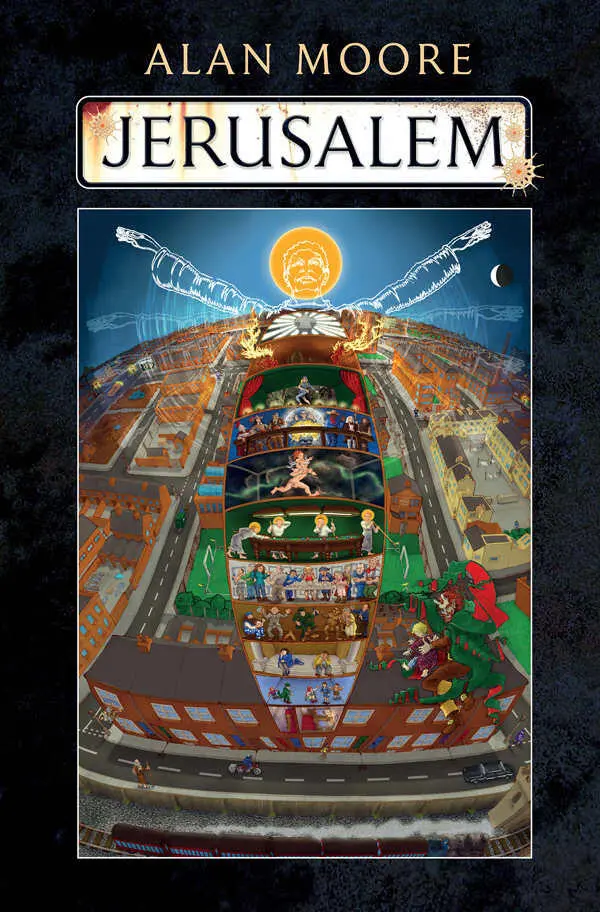
- Название:Jerusalem
- Автор:
- Издательство:Liveright Publishing Corporation
- Жанр:
- Год:2016
- ISBN:нет данных
- Рейтинг книги:4 / 5. Голосов: 1
-
Избранное:Добавить в избранное
- Отзывы:
-
Ваша оценка:
Jerusalem: краткое содержание, описание и аннотация
Предлагаем к чтению аннотацию, описание, краткое содержание или предисловие (зависит от того, что написал сам автор книги «Jerusalem»). Если вы не нашли необходимую информацию о книге — напишите в комментариях, мы постараемся отыскать её.
Disappeared lanes yield their own voices, built from lost words and forgotten dialect, to speak their broken legends and recount their startling genealogies, family histories of shame and madness and the marvellous. There is a conversation in the thunderstruck dome of St. Paul’s cathedral, childbirth on the cobblestones of Lambeth Walk, an estranged couple sitting all night on the cold steps of a Gothic church-front, and an infant choking on a cough drop for eleven chapters. An art exhibition is in preparation, and above the world a naked old man and a beautiful dead baby race along the Attics of the Breath towards the heat death of the universe.
An opulent mythology for those without a pot to piss in, through the labyrinthine streets and pages of Jerusalem tread ghosts that sing of wealth and poverty; of Africa, and hymns, and our threadbare millennium. They discuss English as a visionary language from John Bunyan to James Joyce, hold forth on the illusion of mortality post-Einstein, and insist upon the meanest slum as Blake’s eternal holy city. Fierce in its imagining and stupefying in its scope, this is the tale of everything, told from a vanished gutter.
Jerusalem — читать онлайн бесплатно полную книгу (весь текст) целиком
Ниже представлен текст книги, разбитый по страницам. Система сохранения места последней прочитанной страницы, позволяет с удобством читать онлайн бесплатно книгу «Jerusalem», без необходимости каждый раз заново искать на чём Вы остановились. Поставьте закладку, и сможете в любой момент перейти на страницу, на которой закончили чтение.
Интервал:
Закладка:
As does England after 1272 when Henry’s dead. The number of mints are reduced to six — rebellious Northampton not included — with the main one at the Tower of London from 1279 onwards, housed there for the next five hundred years, the only game in town by 1500, a monopoly. Northampton, far from being King Alfred’s de facto capital, is on its way to being somewhere that’s unmentionable. Roman doesn’t think this is because the place is unimportant, more that it’s important in a way that’s toxic to authority’s best interests, churning out its Doddridges, its Herewards, its Charlie Bradlaughs, its Civil War agitators, Martin Marprelates, Gunpowder Plotters, Bacaleri di Norhan or its Diana Spencers. At best huge embarrassments and at worst riots or heads on poles. Perhaps Northampton has become the anti-matter capital, an insurrectionist parallel universe, not to be spoken of. While this is clearly just how everything was always going to work out, Roman blames Henry the Third, a spiteful little fucker at the best of times. And his son Edward’s even worse. In 1277 some three hundred of the Jewish population centred around Gold Street are all executed — stoned to death as Rome hears it: accused of clipping bits from the old hammered coins to melt down and make new ones. Actually, the royals owe the Jews a wad of cash. Survivors are first driven out of town and then all Jews are banished from the land, brutally welching on the debt, putting the plan into Plantagenet.
All about will and flammability, so Alma says, and Roman thinks she’s right. Having the fire of will and spirit is a must, but useless if your fuel’s damp or goes up like tinder. What’s important is the way you burn. He can remember Alma telling him about how she has Jimmy Cauty and Bill Drummond from the KLF turn up one day at her house on East Park Parade to show the film of them torching a million quid up on the Isle of Jura, where George Orwell completes 1984 . She says she likes a movie where you can see every penny of the budget up there on the screen but Roman’s not sure how he feels at first about all that potentially life-saving lucre going up the chimney. Still, as Alma points out, if the million had gone up their noses nobody would raise an eyebrow. In the end, Rome comes to the conclusion that it’s glorious, more than just a gesture. It’s the whole idea of money being burned, not just the actual loot. It’s saying that the golden dragon that enslaves us, that allows a tiny fraction of the global population to own nearly all the wealth, that ensures almost universal human poverty by its very existence, doesn’t actually exist at all, is made of worthless paper, can be taken care of with a half-box of Swan Vestas. Drummond is Northampton reared, a hulking Scot from Corby who goes to the art school here and works at the St. Crispin’s nuthouse for a while. Rome fancies you can see the town’s brand on the renegade rock-god: incendiary, justified and ancient.
This is money from a local point of view, a shell-game with evolving rules, a long con given centuries to hone its act; achieve a peak of predatory sophistication. Looking at the hundred or so years after the Norman occupation, with the number of mints dwindling as the manufacture of the coin is centralised and brought under control, Roman can see the obstacle that money-hungry kings are left with. Cash is still too real, too physical. Getting the planet to accept that discs of precious metal represent a crop or herd is an immense accomplishment, but coins with their smooth hammered edges are still vulnerable to clipping, and material gold and silver pieces are less easy to manipulate and conjure with than something that is hardly there at all. It’s in the twelfth or thirteenth century that the Knights Templar, hanging out at the round church in Sheep Street and collecting dues from local businesses as an ecclesiastical protection racket, come up with the idea of the internationally-valid promissory note or money order. They invent the cheque, have the idea of money as a piece of paper long before 1476 when William Caxton’s earliest English printing press makes banknotes possible, just in time for the Tower of London’s mint to assume its monopoly in 1500. Given all the harm caused by the Templar’s fiscal origami, Rome feels it’s an insult that they get wiped out because Pope Clement claims they’re gay, two men on one horse, all that Catholic bollocks.
Roman’s own epiphany comes with the heart attack that marks his fiftieth birthday. It’s around the sleeping-in-a-campfire period of Rome’s existence, when the mania that drives him is at its most phosphorescent. His behaviour at this point is already more than halfway to dismantling his family so he’s alone there in the house all night, on his own, when the left-arm lightning hits. He sprawls there, on his back in the dark living room, and can’t move. There’s no one to call for help and Roman knows that this is it. He’s going to die, and in a few days he’ll be back under the dirt like that time down Paul Baker’s yard except with no Ted Tripp to haul him out. Under the dirt forever, and with so much unresolved. During his long hours in the twilight between quick and dead, Roman reviews his life and is astonished to discover that his foremost fear is dropping off the twig before he gets the nerve up to tell anyone, himself included, that he’s homosexual. All those years he’s taken pride in never backing down to anyone or anything, not to police or management or to those drunken square-bashers or even to the element of fire, to find that he’s been bottling the biggest, pinkest challenge of them all. Roman resolves that if by some chance he survives this he’ll go out for some queer fun and then tell everyone about it. As it turns out that’s what happens, but he’s not expecting love. He’s not expecting Dean, the two of them together on the one horse from then on.
Gay or not, the Knights Templar clearly aren’t the first people to think of folding money — Roman reckons that he can remember something about paper notes in seventh century China — but they are the first to introduce the notion to the West. It still isn’t until the nineteenth century that you see proper printed English dosh, but back at the exclusive Tower of London mint in 1500 you can tell they’re warming up to the idea. The goldsmith-bankers of the sixteenth century issue these receipts called running cash notes, written out by hand and promising to pay the bearer on demand. Even with Caxton’s press, the near-impossibility of printing counterfeit-proof wealth means England’s paper currency will be at least partially scribbled for the next three hundred years or more. The paper concept only gains momentum when the Bank of England is established during 1694 and straight away is raising funds for William the Third’s war on France by circulating notes inscribed on specially-produced bank paper, signed by the cashier with the sum written down in pounds, shillings and pence. In the same year Charles Montague, later the Earl of Halifax, becomes the Chancellor of the Exchequer. Two years on, in need of a new warden of the mint, he offers the position — “ ’Tis worth five or six hundred pounds per annum, and has not too much business to require more attendance than you can spare” — to a fifty-five-year-old man previously passed over for high office: Isaac Newton.
Roman tells Bert Regan, Ted Tripp and the others that the most feared and respected of their formidable number is officially now travelling on the other bus. Endearingly, given the reputation of the working class for homophobia, they merely take the piss the way they would if he’d told them he was part Irish or developed comically deforming facial cancer, and then carry on as normal. They treat Dean respectfully despite the fact that his OCD impulses do tend to put him at the “Ooh, look at the muck in here” end of the homosexual spectrum. Ted Tripp asks Rome who’s the horse and who’s the jockey, and Rome patiently explains that it’s less about sex than you might think and more about the love. Ted may make arse-related jokes around the situation but he understands, has always been there when Rome needed him, will lend Rome anything, particularly if he doesn’t know he’s doing it. The night when Rome exits the cellar bar with military mockery still ringing in his ears he marches down to the Black Lion in St. Giles Street and there in the notoriously haunted hostelry he finds Ted Tripp in the front room, playing a hand of brag with rotund troubadour Tom Hall and junkyard-owner Curly Bell. Rome sits with Ted and idly chats for a few minutes while Ted’s mind is on the game, and then gets up and leaves. Ted barely registers Rome’s visit, much less that his car keys, which should be on the pub table next to his tobacco, are no longer there.
Читать дальшеИнтервал:
Закладка:
Похожие книги на «Jerusalem»
Представляем Вашему вниманию похожие книги на «Jerusalem» списком для выбора. Мы отобрали схожую по названию и смыслу литературу в надежде предоставить читателям больше вариантов отыскать новые, интересные, ещё непрочитанные произведения.





Обсуждение, отзывы о книге «Jerusalem» и просто собственные мнения читателей. Оставьте ваши комментарии, напишите, что Вы думаете о произведении, его смысле или главных героях. Укажите что конкретно понравилось, а что нет, и почему Вы так считаете.