C Hribal - The Company Car
Здесь есть возможность читать онлайн «C Hribal - The Company Car» весь текст электронной книги совершенно бесплатно (целиком полную версию без сокращений). В некоторых случаях можно слушать аудио, скачать через торрент в формате fb2 и присутствует краткое содержание. Город: New York, Год выпуска: 2005, ISBN: 2005, Издательство: Random House, Жанр: Современная проза, на английском языке. Описание произведения, (предисловие) а так же отзывы посетителей доступны на портале библиотеки ЛибКат.
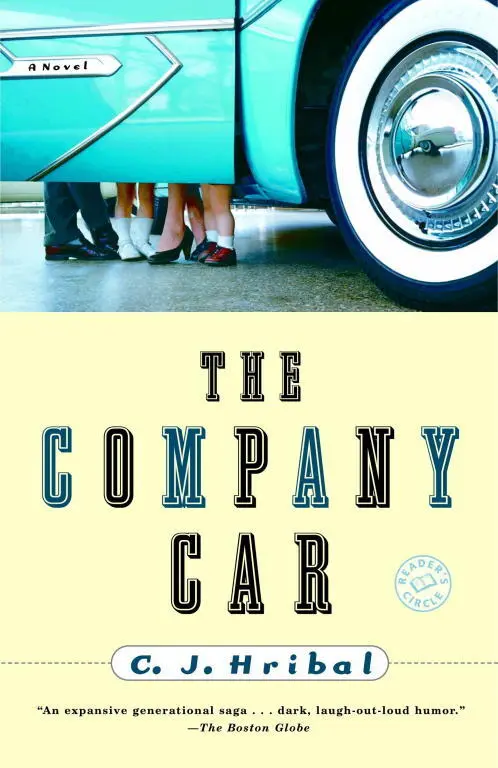
- Название:The Company Car
- Автор:
- Издательство:Random House
- Жанр:
- Год:2005
- Город:New York
- ISBN:1-58836-468-2
- Рейтинг книги:3 / 5. Голосов: 1
-
Избранное:Добавить в избранное
- Отзывы:
-
Ваша оценка:
The Company Car: краткое содержание, описание и аннотация
Предлагаем к чтению аннотацию, описание, краткое содержание или предисловие (зависит от того, что написал сам автор книги «The Company Car»). Если вы не нашли необходимую информацию о книге — напишите в комментариях, мы постараемся отыскать её.
“Are we there yet?” It’s the time-honored question of kids on a long family car trip—and Emil Czabek’s children are no exception. Yet Em asks himself the same thing as the family travels to celebrate his parents’ fiftieth wedding anniversary, and he wonders if he has escaped their wonderfully bad example.
The midwestern drive is Em’s occasion to recall the Czabek clan’s amazing odyssey, one that sprawls through the second half of the twentieth century. It begins with his parents’ wedding on the TV show It’s Your Marriage, and careens from a suburban house built sideways by a drunken contractor to a farm meant to shelter the Czabeks from a country coming apart. It is the story of Em’s father, Wally—diligent, distant, hard-drinking—and his attempts to please, protect, or simply placate his nervous, restless, and sensual wife, Susan, all in plain sight of the children they can’t seem to stop having.
As the tumultuous decades merge in his mind like the cars on the highway, Em must decide whether he should take away his parents’ autonomy and place them in the Heartland Home for the Elders. Beside him, his wife, Dorie, a woman who has run both a triathlon and for public office, makes him question what he’s inherited and whether he himself has become the responsible spouse of a drifting partner—especially since she’s packing a diaphragm and he’s had a vasectomy.
Wildly comic and wrenchingly poignant, The Company Car is a special achievement, a book that drives through territory John Irving and Jonathan Franzen have made popular to arrive at a stunning destination all its own.
The Company Car — читать онлайн бесплатно полную книгу (весь текст) целиком
Ниже представлен текст книги, разбитый по страницам. Система сохранения места последней прочитанной страницы, позволяет с удобством читать онлайн бесплатно книгу «The Company Car», без необходимости каждый раз заново искать на чём Вы остановились. Поставьте закладку, и сможете в любой момент перейти на страницу, на которой закончили чтение.
Интервал:
Закладка:
It was the same thing with paper. Our mother couldn’t throw anything out. Neither could our father. The result was that our house was soon inundated by years’ and years’ worth of paper. Paper piled in uneven, tottering stacks, which fell and slid together, forming larger, more uneven stacks, which grew and formed the base, the genesis, for even more stacks, the paper breeding underneath the piles, paper increasing incrementally and exponentially until the paper itself linked staples and paper clips and self-sealing return envelopes and became one single, hulking, impenetrable mound, a mountain range of paper cascading from living room to dining room to kitchen to hallway to bedroom to office and back again. There was no beginning and no end to it; it was a Möbius strip of clutter and waste, and any attempt to meet the enemy, to attack it, to put a dent in the mounds, was greeted by either our mother or our father with a crescendoing denial that it needed to be dealt with by anyone but themselves.
No doubt there was something comforting in all that detritus. When the world is a shaky place, feathering—papering—your nest must seem like a comfort. No doubt that urge explains why I am spending more and more hours now at the bookstores. They’re havens from the sadness occurring at my home. Though there’s sadness there, too. And frustration. If Dorie and I split up, I don’t want to think about what’s going to happen to them—it was, after all, Dorie’s money that made them possible. Even if we stay together it’s possible that one, two, or maybe all three of these stores aren’t long for this world. And she might make that call for me, as she so graciously informed me this evening. Could I buy her out? Only if I leveraged myself to the hilt. And even if it doesn’t come to that, the stores might not make it. In a down economy, books, for a lot of people, are a frill they can live without. Independent bookstores are right up there with restaurants in rates of failure. So I shuttle from one store to the next, my heart filled to bursting with the fragility of what I’ve accomplished.
It doesn’t help that when I get there I’m confronted by a customer who says she was told by a staff member that her choice of a book—the latest legal thriller—was poor and she should read instead this “serious” story collection by a promising but unknown writer. “Who told you that?” I ask, and it is, of course, my best employee in terms of energy and exuberance, Jillian Kowalska, on whom, I am sure, I am developing a crush. After I deal with the customer—no, no, we really want her to have the thriller—I speak with Jillian. “It was my Pick of the Month,” Jillian defends herself. “It’s right there.” She points to the wall of “Our Staff Recommends” books. “I tell them what to buy, and they always ignore me.” “Well, that’s their prerogative.” “Yes, but their prerogatives are stupid,” Jillian says, leaving me to wonder how I’m going to keep this afloat when my employees are haranguing the customers. I briefly wonder, too, under what circumstances a harmless crush might turn into something else, but I abandon the thought on account of its general stupidity and impossibility. What I really would like right now is simply to build a wall of books around me and not have to deal with another living soul for a very long time.
Still, what was at our parents’ house was junk. And there was no end to it, no matter how much we tried to help get rid of it. We’d fill a few shopping bags, maybe a Hefty garbage bag or two, stack newspapers and tie them with twine, and then the litany of protest would begin. “Not that. I was just looking at that. Let me handle that.”
We felt ashamed, living with all that junk. It was a failure of character. And of course we blamed our mother. She seemed to be competing with our father for “most debilitated while serving a parental role,” but we granted our father indulgences we never granted our mother. Our father was the mystery in the center of our lives. The absent center, but still the center. And our mother? Our mother was… ordinary. Commonplace. How dare she collapse like this! How dare she not be able to breathe! She would pick at the papers for a little while and then give up, the dust was affecting her, the mold spores, everything. I don’t think we ever quite forgave her for falling apart on us like that.
It would be safe to say that our mother gave up, except that she didn’t. She was rebelling.
We did not know this at the time, but like any crafty, small, benighted country threatened by powerful neighbors—and our father, a larger-than-life blustery and blustering man, tormented by his own smallness, was in his infrequent visits to the kingdom of his family more like an invading neighbor than a principal ruler—our mother was resisting through surrender.
She never breathed a word of protest, at least not in front of us, except sometimes to say, “Your father seems to think money grows on trees” or “Your father sometimes gets possessed by strange and costly ideas.” She might cry, she might weep for her lost and always-promised-but-still-far-off kitchen (the once and future kitchen, we liked to say), she might rail at him in private, and we might overhear the heat and passion of her anger, but in front of us she kept up a brave front. When he realized, from time to time, just what a shit he was, he’d say to us, “You know, your mother is a trouper,” and then he’d feel better, having sainted her. He would not change his own behavior, of course. Saints, after all, have fewer material needs than sinners.
Was it any wonder our mother collapsed, took to her bed, came down with a thousand and one ailments? She was being buried alive, she was drowning in a sea of paper, and after a while her resistance was to give up breathing itself. Asthma, bronchitis, bronchial asthma, pneumonia—if TB were still possible to catch, she’d have come down with that.
That Christmas we all piled into the company car, our bloated mother up front looking froglike, the rest of us stacked in the familiar feet-to-hips arrangement. The seats were down. It was a Friday night, and we were going to spend Christmas visiting the relatives in Beverly, and bouncing from one household to another. During the long drive to Chicago I pretended, for the sake of the little kids, that the red lights on the high-tension electrical wire towers were the winking lights of Rudolph, the red-nosed reindeer. Our mother usually took on this role, and we were simply required to play along, but on this drive she was strangely silent. Cinderella was moody, too, and Robert Aaron had gotten a smart mouth and for now couldn’t be trusted with the family myths. So it was up to me to explain to the littler kids how if they saw lots of lights in procession—a field of high-wattage lines—then what we were looking at was the whole crew: Dancer, Prancer, Vixen, Blitzen, et cetera. They had received the red noses as badges of their courage. For it took a lot of courage to navigate these night skies with all those planes about. “What else could it be?” I asked Wally Jr. and Ernie and Peg Leg Meg.
“Yeah,” said Ike, “what else could it be?”
“It could be they’re warning lights on the tops of high-tension towers,” said Robert Aaron.
“Shut up,” I told him. “It’s reindeers’ noses. What else could it be?” I repeated, and Ernie and Wally Jr. silently nodded agreement. Peg Leg Meg was already asleep.
“How do I look?” my mother asked my father as we coasted to the curb in front of Grandma Hubie’s.
“You look wonderful,” said my father, and I watched the look that passed between them, a look I could not decipher except to understand that part of it was founded in love, and that part of being in love was agreeing to take part in a deception.
Читать дальшеИнтервал:
Закладка:
Похожие книги на «The Company Car»
Представляем Вашему вниманию похожие книги на «The Company Car» списком для выбора. Мы отобрали схожую по названию и смыслу литературу в надежде предоставить читателям больше вариантов отыскать новые, интересные, ещё непрочитанные произведения.








Обсуждение, отзывы о книге «The Company Car» и просто собственные мнения читателей. Оставьте ваши комментарии, напишите, что Вы думаете о произведении, его смысле или главных героях. Укажите что конкретно понравилось, а что нет, и почему Вы так считаете.