C Hribal - The Company Car
Здесь есть возможность читать онлайн «C Hribal - The Company Car» весь текст электронной книги совершенно бесплатно (целиком полную версию без сокращений). В некоторых случаях можно слушать аудио, скачать через торрент в формате fb2 и присутствует краткое содержание. Город: New York, Год выпуска: 2005, ISBN: 2005, Издательство: Random House, Жанр: Современная проза, на английском языке. Описание произведения, (предисловие) а так же отзывы посетителей доступны на портале библиотеки ЛибКат.
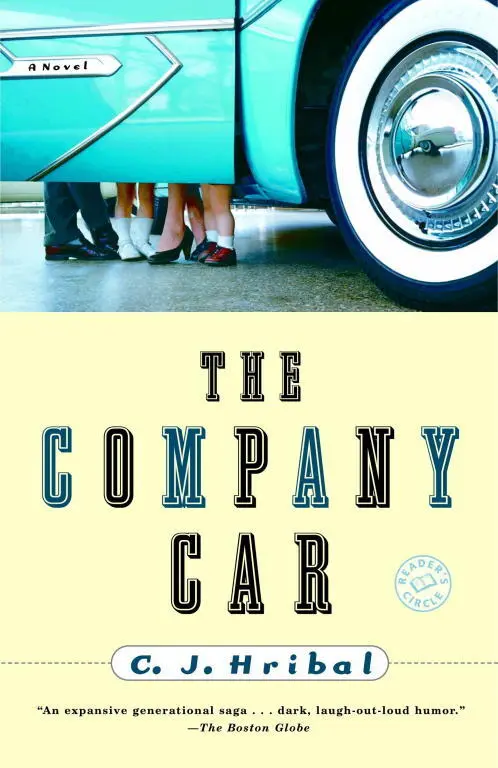
- Название:The Company Car
- Автор:
- Издательство:Random House
- Жанр:
- Год:2005
- Город:New York
- ISBN:1-58836-468-2
- Рейтинг книги:3 / 5. Голосов: 1
-
Избранное:Добавить в избранное
- Отзывы:
-
Ваша оценка:
The Company Car: краткое содержание, описание и аннотация
Предлагаем к чтению аннотацию, описание, краткое содержание или предисловие (зависит от того, что написал сам автор книги «The Company Car»). Если вы не нашли необходимую информацию о книге — напишите в комментариях, мы постараемся отыскать её.
“Are we there yet?” It’s the time-honored question of kids on a long family car trip—and Emil Czabek’s children are no exception. Yet Em asks himself the same thing as the family travels to celebrate his parents’ fiftieth wedding anniversary, and he wonders if he has escaped their wonderfully bad example.
The midwestern drive is Em’s occasion to recall the Czabek clan’s amazing odyssey, one that sprawls through the second half of the twentieth century. It begins with his parents’ wedding on the TV show It’s Your Marriage, and careens from a suburban house built sideways by a drunken contractor to a farm meant to shelter the Czabeks from a country coming apart. It is the story of Em’s father, Wally—diligent, distant, hard-drinking—and his attempts to please, protect, or simply placate his nervous, restless, and sensual wife, Susan, all in plain sight of the children they can’t seem to stop having.
As the tumultuous decades merge in his mind like the cars on the highway, Em must decide whether he should take away his parents’ autonomy and place them in the Heartland Home for the Elders. Beside him, his wife, Dorie, a woman who has run both a triathlon and for public office, makes him question what he’s inherited and whether he himself has become the responsible spouse of a drifting partner—especially since she’s packing a diaphragm and he’s had a vasectomy.
Wildly comic and wrenchingly poignant, The Company Car is a special achievement, a book that drives through territory John Irving and Jonathan Franzen have made popular to arrive at a stunning destination all its own.
The Company Car — читать онлайн бесплатно полную книгу (весь текст) целиком
Ниже представлен текст книги, разбитый по страницам. Система сохранения места последней прочитанной страницы, позволяет с удобством читать онлайн бесплатно книгу «The Company Car», без необходимости каждый раз заново искать на чём Вы остановились. Поставьте закладку, и сможете в любой момент перейти на страницу, на которой закончили чтение.
Интервал:
Закладка:
Ernie Ott waited a minute. Two minutes. He bit his lip. Clearly he was gathering himself. He couldn’t understand it, either. Finally he said, more to himself than to us, “The red house. I always turn at the red house.” He shrugged and grinned like the idiot he was.
And this is what has always puzzled me. Our father clapped him on the back, helped him to his feet. “Well,” our father said, “that happens.” And that was what I couldn’t understand, our father’s conviviality in the face of man who’d torn out our fence, left his car wheezing in our field, and suggested his son mate with our sister. Yet here was our dad suddenly as affable as Monsignor Kahle telling us about his parishioners drinking right after Mass on Sunday. It was horrible for me to see these three men yoked like that, and our father and Monsignor Kahle went down a peg in my esteem for consorting, philosophically, with the likes of drunken Ernie Ott. It was not until I had to deal regularly with drunks myself that I realized what a great salesman our father was, and I think now that part of his success was this ability to nod pleasantly at other people’s inanities as though he agreed with them. He suffered fools lightly.
“We’re not safe here, Wally,” said our mother after our father had gotten Ernie Ott out of our house and back to his own.
“We are perfectly safe. We are more safe here than we would be in Elmhurst.”
“In Elmhurst we did not have people driving into our fields.”
“In Elmhurst if this had happened they would have driven into our living room.”
“I don’t know if I can take this, Wally.”
“Sure you can.” Our father kissed our mother’s forehead and held her. He was still in his blue robe. Ernie Ott’s car was still in our field. “You’re a trouper.”
“Oh, Wally.” Our mother collapsed against our father’s chest and belly. They were sharing a moment. It was one of those times when we as children disappeared for them, and they could be wholly themselves with each other, loving and vulnerable, two people, not parents. We did the decent thing. We retreated, at least as far as the mudroom, which was on the landing before we went to our bedrooms downstairs.
“I don’t have any friends, Wally.”
“Sure you do. Didn’t you just say you’d made a friend last week?”
“One, Wally, one. And that was an emergency.”
“Does it matter how you make them? We made babies during a national emergency.” He kissed her forehead again; the sound was different from when they kissed on the lips.
“That was different.”
“How was it different?”
“We didn’t know what we were doing. And lots of other couples were in the same boat.”
“We’re all in the same boat, honey. Still. It’s just that there’s more space between us.”
“What does that mean, Wally-Bear?” Our mother was sniffling.
“It means you’ll find friends. You’ll make friends. It’ll just take time is all.”
“Easy for you to say. You aren’t cooped up here all week not knowing how to drive.”
“Sarah Lucinda will have her license soon.”
“Not soon enough.”
“You’ll make friends,” repeated our father. “It’s just it’s a big ocean out here. Ships don’t go bump in the night so easily. But we do, honey.”
“We do what?”
“You know—go bump in the night.”
“Oh, Wally.” Our mother blew her nose, and then they were quiet for a time, just making the mmmm, mmmm noises people make when they are tied up and have duct tape across their mouths. It sounded like they were both trying to escape, but who could set them free? Then we heard our mother gasp. “Oh, Wally, Wally, not here, the children might hear us,” and then they made more escaping noises, though it didn’t seem to us like they were getting anywhere. Then our mother started screaming, “More! More! Oh, Wally, more! More!”
“What’s going on?” I asked, though I knew it was a stupid question. Years later I would ask the same question to myself, and feel the same way about the answer, when I discovered that Dorie was packing her diaphragm on her bicycling trips even though I’d been snipped years before. You know the answer to your question before you ask it, even if you don’t know or understand the particulars. I knew that what our parents called “you know” referred to the great mysteries that occurred once their bedroom door was closed. We knew it had to do with our mother being “the greatest” in the same way that Alice Kramden in The Honeymooners was “the greatest” to Ralph. When Ralph and Alice disappeared into what we assumed was their bedroom, something happened in there, and what happened was so awesome, mysterious, and mystical that, like the name for God in the Jewish religion, it could not be stated directly.
As for Dorie, I wanted to believe it was force of habit, meaningless, the way some guys, monogamous twenty or thirty years, still carry condoms in their wallets, an impotent ode to possibility. With Dorie, though, I knew better. You don’t pack a negligee and a diaphragm in your pannier unless you plan to use them. There was no mystery as to why. It made me think of when I first met her. Then as now, she was curious but indifferent regarding the consequences of actions, other people’s in general, her own in particular.
Our father was right, our mother had found a friend. Sort of. The week before Ernie Ott stranded his car in our field our mother was still painting the west side of our house. She wanted to finish the trim for our father, who was coming home in the middle of the week—a rarity for him—as a present for his birthday. Robert Aaron and Cinderella had taken the little kids into the woods on a hike. They were going to find “natural gifts” for our father—birds’ nests, pheasant tail feathers, interesting rocks, et cetera. I’d opted to go bike riding instead, on the big hill to our east. I wanted the plain, unadulterated thrill of going very fast, the wind roaring in my ears.
I had not counted on the gravel. Nor had I counted on the movers having removed the front wheel of my Schwinn to make it fit in the truck and bolting it back on loosely. I’d hardly ridden the bike since we’d moved; there’d been so many other things to do. So when I hit the gravel, and my arms shook trying to hold the bike steady, the last thing I expected to see was the front wheel parting company from the rest of my bike.
Our mother heard me screaming from a half mile away. I found this out later. What I remembered came in fragments. Feeling with a thickened tongue the stump of one front tooth, the bloody cavity where another had been. The shock of standing up and not being able to see anything, then feeling my face where it hurt and feeling large, wet breaks in the skin. My fingers coming away all bloody. Looking down at my white T-shirt, now crimson. Staring at the back of my hand, which had no skin covering two knuckles. I started screaming.
A woman in jeans and barn boots and a paisley blouse came running up the drive I was now staggering down, half-blinded by my own blood. She didn’t say anything. Just took my wrist and with her other hand between my shoulder blades guided me toward her house. In her kitchen she used one washcloth after another to clean me up. “Whose boy are you?” she asked. Once she got a part of my face cleared, she pressed the washcloth hard on it. Whenever she took one away I could feel the blood pulse out of me. In sucking back my blood, I could feel my lip all ragged and swollen and split. I glanced down my arm where I felt blood trickling off my fingers. On the silver and gold squares of the yellowing linoleum, a pool was forming from the patterings of my blood. I felt faint. I hadn’t answered her question yet. Over the woman’s shoulder I saw a girl, about my age, staring at me. She didn’t seem shocked, just curious.
Читать дальшеИнтервал:
Закладка:
Похожие книги на «The Company Car»
Представляем Вашему вниманию похожие книги на «The Company Car» списком для выбора. Мы отобрали схожую по названию и смыслу литературу в надежде предоставить читателям больше вариантов отыскать новые, интересные, ещё непрочитанные произведения.






Обсуждение, отзывы о книге «The Company Car» и просто собственные мнения читателей. Оставьте ваши комментарии, напишите, что Вы думаете о произведении, его смысле или главных героях. Укажите что конкретно понравилось, а что нет, и почему Вы так считаете.