C Hribal - The Company Car
Здесь есть возможность читать онлайн «C Hribal - The Company Car» весь текст электронной книги совершенно бесплатно (целиком полную версию без сокращений). В некоторых случаях можно слушать аудио, скачать через торрент в формате fb2 и присутствует краткое содержание. Город: New York, Год выпуска: 2005, ISBN: 2005, Издательство: Random House, Жанр: Современная проза, на английском языке. Описание произведения, (предисловие) а так же отзывы посетителей доступны на портале библиотеки ЛибКат.
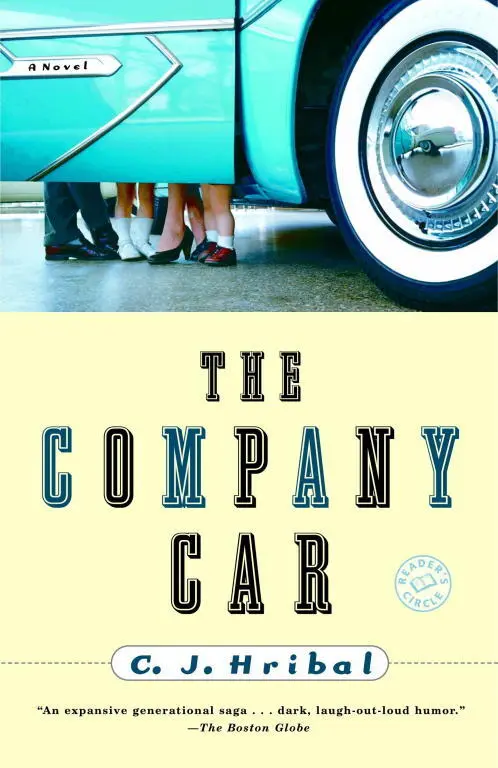
- Название:The Company Car
- Автор:
- Издательство:Random House
- Жанр:
- Год:2005
- Город:New York
- ISBN:1-58836-468-2
- Рейтинг книги:3 / 5. Голосов: 1
-
Избранное:Добавить в избранное
- Отзывы:
-
Ваша оценка:
The Company Car: краткое содержание, описание и аннотация
Предлагаем к чтению аннотацию, описание, краткое содержание или предисловие (зависит от того, что написал сам автор книги «The Company Car»). Если вы не нашли необходимую информацию о книге — напишите в комментариях, мы постараемся отыскать её.
“Are we there yet?” It’s the time-honored question of kids on a long family car trip—and Emil Czabek’s children are no exception. Yet Em asks himself the same thing as the family travels to celebrate his parents’ fiftieth wedding anniversary, and he wonders if he has escaped their wonderfully bad example.
The midwestern drive is Em’s occasion to recall the Czabek clan’s amazing odyssey, one that sprawls through the second half of the twentieth century. It begins with his parents’ wedding on the TV show It’s Your Marriage, and careens from a suburban house built sideways by a drunken contractor to a farm meant to shelter the Czabeks from a country coming apart. It is the story of Em’s father, Wally—diligent, distant, hard-drinking—and his attempts to please, protect, or simply placate his nervous, restless, and sensual wife, Susan, all in plain sight of the children they can’t seem to stop having.
As the tumultuous decades merge in his mind like the cars on the highway, Em must decide whether he should take away his parents’ autonomy and place them in the Heartland Home for the Elders. Beside him, his wife, Dorie, a woman who has run both a triathlon and for public office, makes him question what he’s inherited and whether he himself has become the responsible spouse of a drifting partner—especially since she’s packing a diaphragm and he’s had a vasectomy.
Wildly comic and wrenchingly poignant, The Company Car is a special achievement, a book that drives through territory John Irving and Jonathan Franzen have made popular to arrive at a stunning destination all its own.
The Company Car — читать онлайн бесплатно полную книгу (весь текст) целиком
Ниже представлен текст книги, разбитый по страницам. Система сохранения места последней прочитанной страницы, позволяет с удобством читать онлайн бесплатно книгу «The Company Car», без необходимости каждый раз заново искать на чём Вы остановились. Поставьте закладку, и сможете в любой момент перейти на страницу, на которой закончили чтение.
Интервал:
Закладка:
“But those people,” protested our mother, “right after Mass—they streamed right over.”
Monsignor Kahle shrugged, the shrug of a man who’s seen everything twice and who is not going to get all worked up over changing what he can’t. “Sometimes,” he said, “sometimes after my sermons what everyone wants is a good stiff belt.” He leaned in close, his eyes twinkling, his lips pulled back in an abashed to-err-is-human grin. “Me, too,” he whispered.
The place suited our father. It suited us as well. It did not suit our mother. We kids had each other, and our father had Tony Dederoff—Uncle Louie was “nesting” right then—and when he came home he could buy a round at the Dog Out or Banana’s and acquire a lifetime of friendship for that afternoon. But who did our mom have—Tillie Bunkas?
Our mother could see this more clearly than we could. In Augsbury we were the odd birds, the queer ducks, the flightless fowl. We had come from the city at a time when no one was doing that, and it would be another ten to fifteen years before people did that in numbers large enough to make a difference (which meant they came and changed everything to make it seem more like the suburbs). In 1967 the only people “moving back to the land” were beatniks and hippies (the terms were still interchangeable), and the farmers of Augsbury, with the notable exception of Tony Dederoff, did not want us city folk in their midst any more than they’d’ve wanted a bunch of unshaven hippies and beatniks. It would take our parents a good dozen years before they were accepted as locals. I could tell the change had finally occurred when I went into town to get some U-bolts. Art at Art’s Hardware squinted at me and said, “You’re Wally Czabek’s boy, aren’t you?” Wally Czabek’s boy—we were in. Up until then he’d have said, “You live on the old Hoveling place, don’t you?” as though the Hovelings, gone ten years by then, were anytime soon planning on returning from California and claiming what they’d left behind.
Our mother understood this long before we did, how attitudes in the Midwest changed slowly, if at all. When you’re in, you’re in. And when you’re not, you’re our mother.
It didn’t help that all day, while she was painting, she was subjected to the well diggers’ incessant yammering, nor did it help that our father’s propensity for buying tools he thought we needed, along with the expense of putting in a new well, and the fact that our house in Elmhurst hadn’t yet sold, was driving us into the poorhouse. Our mother was keeper of the finances, and while our father was buying rounds for new friends he’d never see again, our mother was calculating how little we had to buy groceries.
What made it worse was that after the Hovelings moved out, our two-hundred-foot-long driveway had become a lovers’ lane. And because we were one of the few farms in the area without a yard light, our moving in had not discouraged the amorous. Once our lights went off, cars crept down our drive, gravel crunching. Our mother would wake us. She wanted us ready to bolt in case something awful happened—say a man with an ax came to the door. She had horrible night vision—night blindness, really—and she was terrified that she wouldn’t be able to protect us. “What’s going on?” she’d whisper. “What do you see?” The headlights on the car had just gone out. We were at the windows, just barely peeping our heads over the frames while our mother danced furtively behind us. Our lights were doused, the storm windows open. Our faces pressed against the screens. From our windows we saw jerky, furtive movements, the kind of wrestling people do in confined spaces. It was summertime; the car windows were open. Over the hum of crickets and the buzzing of June bugs, we heard the engine ticking heat and the heavy sighs of people administering love to each other. Also the occasional clink of a bottle being dropped onto our drive, which we would find in the morning, glass testimonials to love, or something like it.
Our mother wanted a crime light put in. This seemed odd to me. I had only the vaguest idea of what the occupants of those Dodge Darts and Chevy Camaros were doing, but it wasn’t a crime, was it? They just sat there, faces welded tight, bodies writhing like snakes in a blanket, and after an hour or so they started the car, backed out our drive, and were gone.
“Look,” our mother whispered to our father those nights he was home. “They’re at it again.” Our father got the same half grin on his face Monsignor Kahle got on his, and then he, too, shrugged. “I’m sure it’s nothing, Susan. Just harmless fun.” “They can be harmless somewhere else,” said our mother. “Do you want your children—your daughter Sarah—looking at that every evening?” That clinched it. The crime light went in. Nobody parked in our drive anymore. We were safe. We’d moved from Chicago, and now nothing could hurt us.
That idea was undone twice just as our mother was finishing up the house painting. We awoke one night to a terrific series of crashes and thumps. Something metal was being torn from its moorings and ferociously bumping its way down our field. A big hulking Buick—one of those 1950s jobs with the clipper ship steering wheel—had leapt the ditch, plowed through our fence line, and come to a rest two hundred yards down the field. “Good God, what is that?” shrieked our mother, doing a very good impression of a startled Nomi. Although we wouldn’t know this for some minutes yet, it was our neighbor Ernie Ott, driving himself home from the Dog Out. Our father threw on a blue terry-cloth robe and boots and struggled across the field to where Ernie’s Buick sat, the cone of its headlights still wobbling in the fog that had settled over the field, its wheels deep between two furrows. No doubt Ernie Ott had a broken axle.
We watched from the upstairs window as our father helped Ernie stagger across the furrows back to our house. There was a clumping up the stairs of our mudroom, and then there he was, in our kitchen. Our mother was making coffee.
Ernie Ott was huge. Imagine a bowling ball in overalls, with another bowling ball, much smaller, sitting on top of that, and three rubber donuts for the chins which connected them. He was wearing one of those plaid Canadian baseball caps, the brim of which was pointing toward the corner of the ceiling.
“What happened?” our father asked. Our mother eased a cup of coffee across the kitchen table to Ernie Ott’s waiting fists. Ernie looked dazed. Even the coffee didn’t seem familiar to him. His eyes were marbled with tiny broken veins, and they rolled slightly in his head the way those of cartoon animals do when they’ve been whupped upside the head with a two-by-four or a crowbar. His head tilted slowly to take in Cinderella, who’d recently turned fourteen. Ernie’s eyes got big, and I suddenly understood what the word leering meant.
“I’ve got a son about her age,” he said, his eyes cutting across to our father and then centering back on our sister. “Maybe you and me can work out a deal. My boy and her boy, eh?” Our father nodded in stiff-lipped agreement even though Ernie Ott had misspoken the deal. This was the nod our father gave in bars when somebody said something particularly heinous and our father, being a salesman, didn’t want to contradict or offend anybody. Our mother shooshed Cinderella a little farther back behind her brothers. There were five of us; we made a pretty uneven picket fence.
I was in the front row now, and I could see how heavily Ernie Ott sat. Like a sack of concrete, sagging. “So tell me what happened,” our father said affably, as though he would really like to hear the story. “Wally,” our mother said. Our father held his hand up, meaning it was all right, he could handle this.
Читать дальшеИнтервал:
Закладка:
Похожие книги на «The Company Car»
Представляем Вашему вниманию похожие книги на «The Company Car» списком для выбора. Мы отобрали схожую по названию и смыслу литературу в надежде предоставить читателям больше вариантов отыскать новые, интересные, ещё непрочитанные произведения.






Обсуждение, отзывы о книге «The Company Car» и просто собственные мнения читателей. Оставьте ваши комментарии, напишите, что Вы думаете о произведении, его смысле или главных героях. Укажите что конкретно понравилось, а что нет, и почему Вы так считаете.