C Hribal - The Company Car
Здесь есть возможность читать онлайн «C Hribal - The Company Car» весь текст электронной книги совершенно бесплатно (целиком полную версию без сокращений). В некоторых случаях можно слушать аудио, скачать через торрент в формате fb2 и присутствует краткое содержание. Город: New York, Год выпуска: 2005, ISBN: 2005, Издательство: Random House, Жанр: Современная проза, на английском языке. Описание произведения, (предисловие) а так же отзывы посетителей доступны на портале библиотеки ЛибКат.
- Название:The Company Car
- Автор:
- Издательство:Random House
- Жанр:
- Год:2005
- Город:New York
- ISBN:1-58836-468-2
- Рейтинг книги:3 / 5. Голосов: 1
-
Избранное:Добавить в избранное
- Отзывы:
-
Ваша оценка:
The Company Car: краткое содержание, описание и аннотация
Предлагаем к чтению аннотацию, описание, краткое содержание или предисловие (зависит от того, что написал сам автор книги «The Company Car»). Если вы не нашли необходимую информацию о книге — напишите в комментариях, мы постараемся отыскать её.
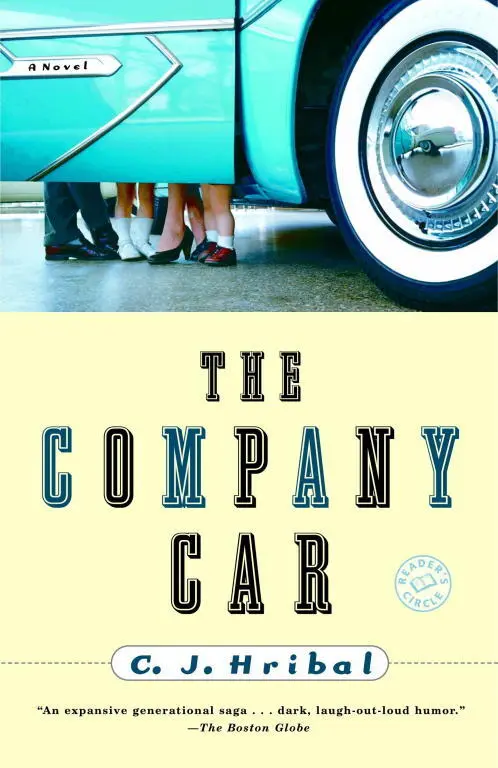
“Are we there yet?” It’s the time-honored question of kids on a long family car trip—and Emil Czabek’s children are no exception. Yet Em asks himself the same thing as the family travels to celebrate his parents’ fiftieth wedding anniversary, and he wonders if he has escaped their wonderfully bad example.
The midwestern drive is Em’s occasion to recall the Czabek clan’s amazing odyssey, one that sprawls through the second half of the twentieth century. It begins with his parents’ wedding on the TV show It’s Your Marriage, and careens from a suburban house built sideways by a drunken contractor to a farm meant to shelter the Czabeks from a country coming apart. It is the story of Em’s father, Wally—diligent, distant, hard-drinking—and his attempts to please, protect, or simply placate his nervous, restless, and sensual wife, Susan, all in plain sight of the children they can’t seem to stop having.
As the tumultuous decades merge in his mind like the cars on the highway, Em must decide whether he should take away his parents’ autonomy and place them in the Heartland Home for the Elders. Beside him, his wife, Dorie, a woman who has run both a triathlon and for public office, makes him question what he’s inherited and whether he himself has become the responsible spouse of a drifting partner—especially since she’s packing a diaphragm and he’s had a vasectomy.
Wildly comic and wrenchingly poignant, The Company Car is a special achievement, a book that drives through territory John Irving and Jonathan Franzen have made popular to arrive at a stunning destination all its own.
The Company Car — читать онлайн бесплатно полную книгу (весь текст) целиком
Ниже представлен текст книги, разбитый по страницам. Система сохранения места последней прочитанной страницы, позволяет с удобством читать онлайн бесплатно книгу «The Company Car», без необходимости каждый раз заново искать на чём Вы остановились. Поставьте закладку, и сможете в любой момент перейти на страницу, на которой закончили чтение.
Интервал:
Закладка:
Elsewhere, it was the tail end of the Summer of Love. In Augsbury, on the old Hoveling farm, we were gathered like extras for an updating of Frankenstein —the villagers-storming-the-castle scene, ready to burn or shoot or pitchfork to death anything that moved.
Of course, there were casualties. This began when the bottles were first thrown onto the piles. Our father’s didn’t break. Tony Dederoff’s did, and a huge roar went up from the pile on the east. Our father was just reaching into the pile to retrieve his cocktail when the heat and some flicker of flame from Tony’s pile set off the kerosene-gasoline–motor oil mix in our father’s. The concussive WHOOOMPH! of all those inflammatories going off at once knocked our father backward, blackened and seared his face, and burned off his eyebrows and most of the hair on his knuckles. He lay there stunned. The cocktail was in his hand, still burning, as he sat up, dazed. Given our father’s girth, sitting up in itself was an ordeal. By the time he noticed the cocktail in his hand, the fire was running down inside the bottle. Our father had barely launched it when it struck a board projecting at an odd angle from the great jumbled pile and exploded a few feet from his face. Glass erupted everywhere. Our father screamed and fell back, his second wounding. Blood was pouring from his face and hands from a thousand tiny and not so tiny cuts. And underneath the smell of burning gas and wood, the stench of burning oil, there was the smell of burning protein—hair, fur, flesh. Something alive was going up in flames.
“Here they come,” yelled Tony Dederoff, and I felt like I was that guy at the end of the movie Wake Island, where the last you see of the doomed Americans wearing World War I–issue helmets is a lone guy spraying death from a machine gun, twisting and turning to ensure the largest field of fire.
The rabbits were first. They bolted, zigzagging as they leapt, and we let them go. The rats came next. They were big and quick, some of them like house cats. We had mowed around the piles to give us a clear line of fire, but that was good for only thirty feet or so before the long grass started, and behind us was the drop-off into the ruined barn, with its nooks and crannies, into which a rat could disappear. We had to be quick or they’d escape. Fortunately, the bloodlust was upon us. Or at least upon my fellow villagers. They fired and hacked and beat with efficiency. I watched as Wally Jr. speared one with his pitchfork and flung it, trailing blood, back into the fire, the rat making a little fliiiiip sound as it came off the pitchfork. I watched the rats dying and tried firing, but it froze me, seeing them scurry and die. My aim, with a pellet gun and a bent sight, was pitiful. I led them too much, I aimed too high. Invariably, just as they were about to reach the grass, or had reached the grass, Tony Dederoff or Borowski or my older brother, Robert Aaron, or my younger brother Ike would swing and fire, and the escaping rat would die, or lie there wounded, or turn little circles in the dirt, like Curly from the old Three Stooges shorts, or turn and do flips and cough its death throes. Wally Jr. or Ernie had the job of impaling the survivors or scooping up the dead and throwing them back into the flames.
The flames, the flames. Perhaps I shouldn’t admit this, but the other reason I was not doing my part in the great rat hunt of 1967 was I was as mesmerized by the flames as I was by the rats running their invisible mazes as they tried to escape. Given the broadness of the two piles and their intersection, it was amazing to me that the flames shot up not in twin columns but in a single conflated pyramid of fire that narrowed as it reached the sky. A good Catholic boy, I recognized that imagery: the flames—red, yellow, and edged in black—traced, inverted, the sacred heart of Jesus. Joan of Arc died in flames like these. Joan of Arc—not much younger than Patty Duckwa. And if I could hold the image of those two women in my head simultaneously, it must mean that, yes, indeed, we were in one of the lesser rings of hell.
The fire and the heat were tremendous—you could feel them as a physical presence. The shimmering waves kept you at bay, and we worked on the outside edge of that, killing and killing and killing. Surely God would reward us for this glorious and necessary evil.
Suffice it to say I was all mixed up. I felt bad—rats, too, were God’s creatures. They wouldn’t have survived this long if Noah hadn’t brought them on the ark, but I felt good, too. There was something beautiful about the way the flames leapt into the sky, the air shimmering around you, distorting everything you viewed into elongated sine waves—the trees, the clouds, a bird flying, your father lying on the grass.
Our father. We had forgotten about him. Crazed with bloodlust, heady with our accomplishment, we had not noticed that our father was still on the ground. He was no longer bleeding profusely, but he was bleeding, and his face looked scorched, the eyebrows missing, his forehead a great red bullet. He was still stunned, still looking up at the sky. It had been only a few moments, really, since he’d first been blown backward. Everything was happening in a nether time, both quickly and in slow motion. Was it like this at Custer’s Last Stand, I wondered, things winding down in a frenzy? We were still killing things, and I was celebrating what might have been my only kill, a rat I’d caught in the teeth, spinning him around where he lay very still, facing what he’d been fleeing, when I saw a baby rat leave the pile and make a beeline for my father’s trouser leg, which was big and loose and open and inviting.
Of course no one saw this but me. And I knew why we were killing these rats in the first place. They were evil. They ate chicken eggs and carried disease. If one were to bite my father, he could get rabies or bubonic plague and die a horrible, slow, lingering death, and there would be nothing anybody could do for him except amputate the parts that turned green and comfort him in his misery while he lay dying. It would be against everything we knew and held dear to put him out of his misery. We could do that for rats; we could not do that for a rabid and gangrenous father. So I had to stop this panicky rat from inflicting a slow and painful death on our father. One problem, though, was that I panicked. The other was that I was a lousy shot. I led the rat too much. The first shot entered just above our father’s heel, in the fleshy part of his ankle. He had ignored the advice he had given us about wearing work boots or Wellingtons. He had on a pair of canvas deck shoes offering no protection from a well-meaning son with lousy aim. The second shot, when the rat was going up his trouser leg, hit his calf, the third, his thigh. My father was screaming, the rat was burrowing—no doubt both were in panic as to where my next shot might go—and it was Wally Jr., little Wally, who solved matters by skewering the rat with his pitchfork. Only a single tine pierced our father’s leg, but it went deep, and our father jittered and danced like one of the wounded and dying rats before Wally removed his pitchfork from both the rat and our father’s thigh.
“Jesus, sweet Jesus,” choked our father, trying not to scream. All about us the carnage was nearly complete. We gathered around him. He was still looking up at the sky, his great bulk of a stomach heaving like a stone that had acquired the ability to breathe.
“Wally, you okay, Wally?” asked Tony Dederoff. With a hunting knife he cut open my father’s trouser leg. The rat fell out—it’s entirely possible that it died of a heart attack before my brother skewered it—and we examined my father’s wounds. Fortunately a pellet gun does not create projectiles with a whole lot of force behind them. The wounds in my father’s leg were tiny, round circles that bled a little but not much, the pellets not having penetrated deeply, so near the surface that Tony Dederoff dug them out on the spot with a needle-nose pliers he kept in his truck—the same needle-nose pliers he used to dig hooks out of fish gullets. Tony also produced a hip flask of Jack Daniel’s, which he first poured over the wounds and the pliers and then offered to our father. Tony had a drink himself before he commenced digging. Our father winced and grunted and gritted his teeth, but he did not scream, and for that I was grateful.
Читать дальшеИнтервал:
Закладка:
Похожие книги на «The Company Car»
Представляем Вашему вниманию похожие книги на «The Company Car» списком для выбора. Мы отобрали схожую по названию и смыслу литературу в надежде предоставить читателям больше вариантов отыскать новые, интересные, ещё непрочитанные произведения.



Обсуждение, отзывы о книге «The Company Car» и просто собственные мнения читателей. Оставьте ваши комментарии, напишите, что Вы думаете о произведении, его смысле или главных героях. Укажите что конкретно понравилось, а что нет, и почему Вы так считаете.