C Hribal - The Company Car
Здесь есть возможность читать онлайн «C Hribal - The Company Car» весь текст электронной книги совершенно бесплатно (целиком полную версию без сокращений). В некоторых случаях можно слушать аудио, скачать через торрент в формате fb2 и присутствует краткое содержание. Город: New York, Год выпуска: 2005, ISBN: 2005, Издательство: Random House, Жанр: Современная проза, на английском языке. Описание произведения, (предисловие) а так же отзывы посетителей доступны на портале библиотеки ЛибКат.
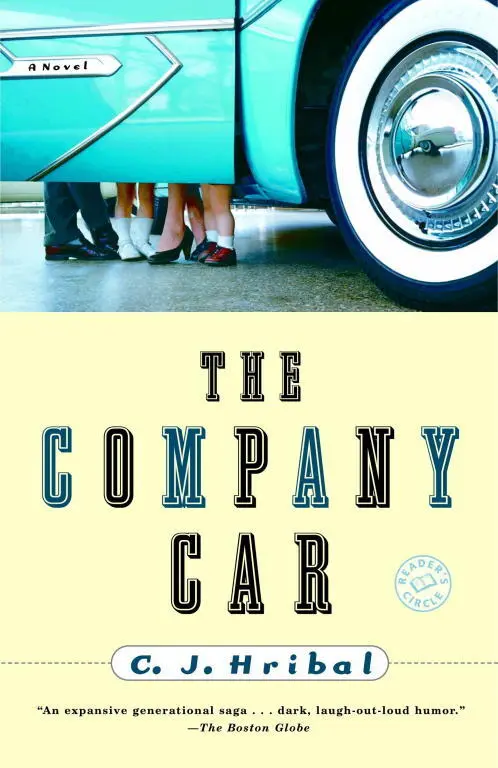
- Название:The Company Car
- Автор:
- Издательство:Random House
- Жанр:
- Год:2005
- Город:New York
- ISBN:1-58836-468-2
- Рейтинг книги:3 / 5. Голосов: 1
-
Избранное:Добавить в избранное
- Отзывы:
-
Ваша оценка:
The Company Car: краткое содержание, описание и аннотация
Предлагаем к чтению аннотацию, описание, краткое содержание или предисловие (зависит от того, что написал сам автор книги «The Company Car»). Если вы не нашли необходимую информацию о книге — напишите в комментариях, мы постараемся отыскать её.
“Are we there yet?” It’s the time-honored question of kids on a long family car trip—and Emil Czabek’s children are no exception. Yet Em asks himself the same thing as the family travels to celebrate his parents’ fiftieth wedding anniversary, and he wonders if he has escaped their wonderfully bad example.
The midwestern drive is Em’s occasion to recall the Czabek clan’s amazing odyssey, one that sprawls through the second half of the twentieth century. It begins with his parents’ wedding on the TV show It’s Your Marriage, and careens from a suburban house built sideways by a drunken contractor to a farm meant to shelter the Czabeks from a country coming apart. It is the story of Em’s father, Wally—diligent, distant, hard-drinking—and his attempts to please, protect, or simply placate his nervous, restless, and sensual wife, Susan, all in plain sight of the children they can’t seem to stop having.
As the tumultuous decades merge in his mind like the cars on the highway, Em must decide whether he should take away his parents’ autonomy and place them in the Heartland Home for the Elders. Beside him, his wife, Dorie, a woman who has run both a triathlon and for public office, makes him question what he’s inherited and whether he himself has become the responsible spouse of a drifting partner—especially since she’s packing a diaphragm and he’s had a vasectomy.
Wildly comic and wrenchingly poignant, The Company Car is a special achievement, a book that drives through territory John Irving and Jonathan Franzen have made popular to arrive at a stunning destination all its own.
The Company Car — читать онлайн бесплатно полную книгу (весь текст) целиком
Ниже представлен текст книги, разбитый по страницам. Система сохранения места последней прочитанной страницы, позволяет с удобством читать онлайн бесплатно книгу «The Company Car», без необходимости каждый раз заново искать на чём Вы остановились. Поставьте закладку, и сможете в любой момент перейти на страницу, на которой закончили чтение.
Интервал:
Закладка:
“Right here, putting a new fence in.”
“Exactly. You don’t want to be messing with all this. With steel you can go electrified or not, either way. It’s easier maintenance, too—you go out each spring with a wire stretcher, some spare insulators, and insulator wire. Scythe down the weeds, stretch, replace, you’re done. You got time to pop a cold one. This—this’ll take you weeks, especially doing it just on the weekends, like you’ve got to.” Tony raised his beer to his lips. “Of course, if you’re doing this as a character-building exercise for your boys, that’s another story.” He grinned.
We were not amused. The cedar posts were our father’s idea of picturesque fencing.
We had no idea at the time, but this was the first (or second, if you counted moving up here, too) grand, misguided idea he’d had since the boat, which rested now behind the house on matching sawhorses, a two-piece puzzle that he hadn’t quite gotten around to solving. And like all of his other misguided ideas, he was determined to see it through, at least for a while.
Our father raised his beer bottle and indicated the two of us. “This’ll put hair between their toes.”
“But, Dad,” I panted. “What if we don’t want hair between our toes?”
“Then this will reflect on your merit review.” He removed a pocket spiral notebook from his bib overalls and made a notation.
“You have to write it down?” asked Tony Dederoff. “For my kids I keep it all up here.” He tapped his temple with his forefinger.
“You’re not on the road all the time like I am. I don’t write it down, I forget. Then where would I be?”
“Then where would you be,” agreed Tony Dederoff. They were having a gay old time. Robert Aaron and I hated them.
But you could not hate him—our father—for long. And you could not hate Tony Dederoff at all. Tony was our father’s guide and spiritual mentor, at least in regards to farming. And Tony was a good guy, cheerful and blunt. His wife was happily pumping out babies, just as our mother had a decade ago, and at the age of thirty, with his own farm and the respect of his peers, he had the world by the tail. But he was always well-meaning. “Wally,” he told our father now, “I gotta tell you, Wally, you bought the least promising farm I can think of.”
“Will that reflect on my merit review?”
“Not if you fork over another beer.”
“Done. And done,” said our father, and in the dark we heard the pfsst of the church key doing its work. We kept doing ours, taking dirt out of a hole we could no longer see, while Tony instructed our father as to the order of the projects needed to make the farm a paying enterprise again.
“Nobody’s done jack on this place in ten years,” said Tony, “but you could. You got the horses.”
“Horses?”
“Five boys, if I’m counting right. You got another couple stashed I don’t know about?”
“Naw, that’s the full complement.”
Tony Dederoff found this very funny. “The full complement. I like that. You got a big family, you gotta see everything as a military campaign.” The suck of a bottle. “Well, General—”
“Admiral.”
“Admiral. The first thing I’d do, Admiral, is replow this field and plant alfalfa. You get a good root system with alfalfa. You won’t get a crop this year, but if it takes, with any luck you’ll have three cuttings a summer for the next seven, eight years. And the first thing I’d do before that is take that wagon of yours and clean out the rocks.”
“The rocks?”
“You can’t plow till you clean out the rocks. You hit a boulder with a plow blade, you’ll break the blade. These fields haven’t been cleaned in a decade. You’re gonna have yourself a bumper crop of rocks. Take this ship of yours”—Tony’s hand slapped the wagon—“drive it real slow over the fields with your troops fanned out behind it, and throw anything bigger’n a quarter into the wagon. You’ll have yourself quite a harvest. Course you’ll have to do it again next spring—the freeze and thaw cycle pushes ’em up every year like flowers. It’s amazing, really, the world don’t run out of rocks.”
We liked Tony. He was a sober, happier version of Uncle Louie. He’d come over, have his one or two beers, then leave. Of course, we never saw our father have more than one or two beers, either. It was what he was drinking when he wasn’t around us that was the problem.
But in those early days, our father’s enthusiasm for all things rural kept his drinking more or less in check. And he heeded Tony’s advice. We hauled rocks. The fields were littered with them. Our father did a slow ka-bump, ka-bump over the fields, and we fanned out in a line and threw rocks in the wagon. We found dozens of arrowheads, too. We felt we were gleaning sacred earth. We were in touch with our Bohemian ancestors, that mythical tribe of blond-haired, green-eyed Indians in which I, only too recently, had believed.
Borrowing Tony’s equipment, our father plowed, spring-toothed, dragged. He planted seed in the now-level earth. With our father watching the furrow ahead, we rode the Ferguson’s fenders and kept a close watch on the seed spilling out behind. When it stopped we’d yell, jump off the tractor, and muscle—with our father’s help—another bag of seed into the bins.
If you discounted our mother—and all too frequently we did—it was a time of great family happiness. Every week we had a project. We took lumber and corrugated sheet metal from the barn that had collapsed and reroofed the sheds. Lumber, tar paper, tin—it took two days. The rusty tin heated up something fierce, and you had to be careful not to cut yourself on the sheet metal or Mom would insist on a tetanus shot, but it was glorious work. We were fixing things, making things! This! This is what farmers do! After we pulled all the usable lumber from the leaning barn, our father looped a chain around a corner pole, hooked the chain to the tractor, and pulled down the barn. That was glorious, too, watching it collapse with a great woof! of exhaled dust. So this was why that bulldozer driver merely shrugged when he destroyed our clubhouse. He was having too good a time to be disturbed. Destruction could be as much fun as—maybe more fun than—construction was. Who needed a balsa-wood airplane burning out an attic window when you could take down an entire barn and watch it woof chaff and smoke?
Or set fire to an immense pile of rubble and lumber?
We did that in the fall, when farmers burned their ditch lines and leaves. The air smelled wonderful. Acrid, pungent, sweet—there are few smells that can transport you to another time quite like the smell of burning leaves. The smell of an ex-lover’s perfume glimpsed on a city street, perhaps, but what did I know of that then?
Our contribution to the fall burning would be our lumber piles, swollen with torn out fencing. Our father ran a hose—two hundred feet of it—out to the piles and stationed us around them with pellet guns and twenty-twos and pitchforks and spade forks and scoop shovels. Our father wielded a pistol and a four-ten shotgun—what he called his squirrel gun. The idea was we’d kill all the rats and mice as they ran out, not give them a chance to relocate in the newly sided sheds, where we hoped to keep chickens and horses and sheep and some beef cattle someday.
Although our father had trained us in gun safety, and was a dues-paying NRA member, the notion of seven or eight or nine people in a circle all shooting at the same objects running out from the center did not raise any red flags for him. I mention this only in hindsight. It didn’t occur to anyone else at the time, either.
Our father circumnavigated the piles with five-gallon cans of gasoline. He sprinkled liberally. He added an oil change’s worth of old motor oil for good measure. We stood back, our weapons poised. Tony came over to help. He had a twenty-two rifle; his oldest son, Matt, had a Daisy BB gun; and Borowski, his hired hand—a kid not much older than Cinderella—had a sixteen-gauge shotgun. There was soda and beer in a washtub of ice water back at the house. It would be a party. When everything was ready, our father took two empty pop bottles and filled them halfway with kerosene. Then he took two strips from an old bedsheet and poked them into the bottles, leaving three or four inches of wick sticking outside. We recognized these—Molotov cocktails. We’d seen them on television. We just didn’t know you could use them for this. And we were surprised our father knew how to make them. We thought only student radicals and Negroes in inner-city ghettos knew about these things. But maybe it was something you learned in the Navy, too. He lit them with a Zippo lighter, then handed one to Tony. The flame was long and smoky. Our father said, “Ready?” and Tony Dederoff nodded. “On three,” said our father. “One, two…” And they lofted them together.
Читать дальшеИнтервал:
Закладка:
Похожие книги на «The Company Car»
Представляем Вашему вниманию похожие книги на «The Company Car» списком для выбора. Мы отобрали схожую по названию и смыслу литературу в надежде предоставить читателям больше вариантов отыскать новые, интересные, ещё непрочитанные произведения.






Обсуждение, отзывы о книге «The Company Car» и просто собственные мнения читателей. Оставьте ваши комментарии, напишите, что Вы думаете о произведении, его смысле или главных героях. Укажите что конкретно понравилось, а что нет, и почему Вы так считаете.