C Hribal - The Company Car
Здесь есть возможность читать онлайн «C Hribal - The Company Car» весь текст электронной книги совершенно бесплатно (целиком полную версию без сокращений). В некоторых случаях можно слушать аудио, скачать через торрент в формате fb2 и присутствует краткое содержание. Город: New York, Год выпуска: 2005, ISBN: 2005, Издательство: Random House, Жанр: Современная проза, на английском языке. Описание произведения, (предисловие) а так же отзывы посетителей доступны на портале библиотеки ЛибКат.
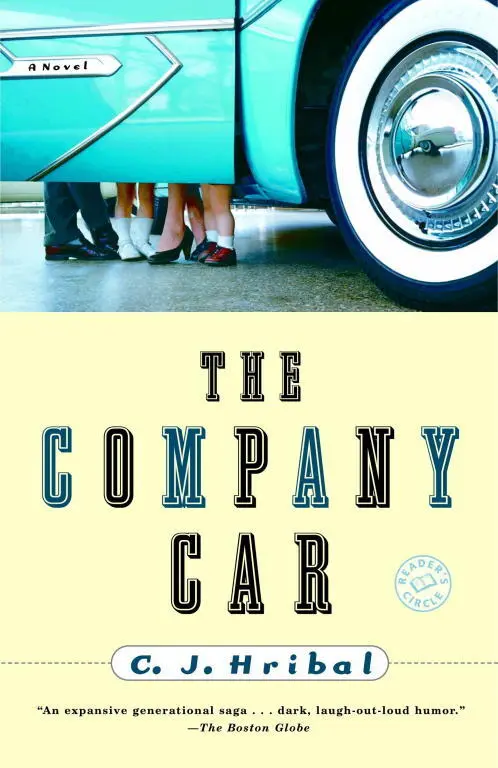
- Название:The Company Car
- Автор:
- Издательство:Random House
- Жанр:
- Год:2005
- Город:New York
- ISBN:1-58836-468-2
- Рейтинг книги:3 / 5. Голосов: 1
-
Избранное:Добавить в избранное
- Отзывы:
-
Ваша оценка:
The Company Car: краткое содержание, описание и аннотация
Предлагаем к чтению аннотацию, описание, краткое содержание или предисловие (зависит от того, что написал сам автор книги «The Company Car»). Если вы не нашли необходимую информацию о книге — напишите в комментариях, мы постараемся отыскать её.
“Are we there yet?” It’s the time-honored question of kids on a long family car trip—and Emil Czabek’s children are no exception. Yet Em asks himself the same thing as the family travels to celebrate his parents’ fiftieth wedding anniversary, and he wonders if he has escaped their wonderfully bad example.
The midwestern drive is Em’s occasion to recall the Czabek clan’s amazing odyssey, one that sprawls through the second half of the twentieth century. It begins with his parents’ wedding on the TV show It’s Your Marriage, and careens from a suburban house built sideways by a drunken contractor to a farm meant to shelter the Czabeks from a country coming apart. It is the story of Em’s father, Wally—diligent, distant, hard-drinking—and his attempts to please, protect, or simply placate his nervous, restless, and sensual wife, Susan, all in plain sight of the children they can’t seem to stop having.
As the tumultuous decades merge in his mind like the cars on the highway, Em must decide whether he should take away his parents’ autonomy and place them in the Heartland Home for the Elders. Beside him, his wife, Dorie, a woman who has run both a triathlon and for public office, makes him question what he’s inherited and whether he himself has become the responsible spouse of a drifting partner—especially since she’s packing a diaphragm and he’s had a vasectomy.
Wildly comic and wrenchingly poignant, The Company Car is a special achievement, a book that drives through territory John Irving and Jonathan Franzen have made popular to arrive at a stunning destination all its own.
The Company Car — читать онлайн бесплатно полную книгу (весь текст) целиком
Ниже представлен текст книги, разбитый по страницам. Система сохранения места последней прочитанной страницы, позволяет с удобством читать онлайн бесплатно книгу «The Company Car», без необходимости каждый раз заново искать на чём Вы остановились. Поставьте закладку, и сможете в любой момент перейти на страницу, на которой закончили чтение.
Интервал:
Закладка:
Don’t go there, I tell myself. Don’t say a word. But I can’t stop myself. “What’s that supposed to mean?” and she says, “Don’t you think it’d be great if there were time bubbles?” “Time bubbles?” I say. “Like one of those Mylar balloons,” she says, “or one massive soap bubble, nicely appointed,” and she goes off on this whole riff about how with time bubbles you could go away with someone you were attracted to and romp to your heart’s content, and meanwhile, outside the bubble, time would have stopped, and you’d return to your life with no time off the clock. With no time missing, no gaps in your life with your spouse, you could feel perfectly safe doing something for yourself without hurting anyone else. “Time bubbles,” I say.
“Oh, come on. Tell me you haven’t thought of it.” We’ve been putting away groceries, the phone rang, and the next thing I know we’re talking about time bubbles and Dorie’s saying, “I don’t think there’s any difference between wanting to fuck somebody and fucking them. If you’re married and you want to sleep with somebody else, you may as well sleep with them.”
The logic here astounds me. “You really don’t think there’s any difference between the thought and the act? Isn’t that what got Jimmy Carter ridiculed?”
“He thought it was a sin, didn’t he?”
“But don’t you get any credit for wanting to do something and choosing not to?”
“Why should you?”
About a year and a half later—right before this past Christmas—she tells me, “Remember that argument we had about the difference between wanting to fuck someone and doing so? I think you’re right. Wanting to do something and actually doing it are two different things.”
Which begged the question “What made you change your mind?”
“Nothing. I just thought about it some more and decided there really is a difference.”
I wanted to believe nothing had happened, that our life together might have lost its magic but we could find it again, simply from the will of wanting it to return to us. I did not want to imagine or believe—but I was tormented by the thought—that my wife was finding that magic somewhere else. With someone else. That was the mystery of our life together—that Dorie had turned elsewhere for magic in her life, but she had chosen to remain with me, and so she lived a double life, and I did, too: the life of a man who acts as though nothing is wrong in his marriage, and the one of a man who believes—knows—otherwise.
Not long after that Dorie announced that she was going to visit her friend Mia in Darien, Connecticut, this coming summer and that she was going to get there by bike. Dorie and Mia go way back, to when Dorie had first left Augsbury when she was seventeen and had recently been impregnated by one of her dirtbag boyfriends. Mia was her confidante and partner in crime for a good half dozen years. Probably was also, for a brief while way back when, her lover. Mia is married now, the mother of two, and having an affair with her supervisor at her brokerage house. Dorie tells me this, and immediately I know it was to Mia that Dorie was speaking when she offered up her advice/philosophy about the limitations of marriage. “So, what, you’re going out there to compare notes? Want to see what the difference is between the wanting and the doing?”
Again with the look on her face—exasperation, impatience, maybe even loathing. “It’s a two-way street, Ace,” Dorie says. “People in affairs don’t get there by accident. Whoever they’re married to is at least partly responsible for the affair having happened.”
Then comes the clincher, the thing meant to undo me, which it does. Something so dripping with scorn and condescension that when she says it I flinch. “What, Ace, is this going to ‘reflect on my merit review’? If I had an affair would that reflect on my merit review?” Our father’s phrase. But coming out of Dorie’s mouth it is meant as a reproach against the long-suffering of my mother and the antics of my father. It is a reproach against the kind of marriage our parents had, against me, against, even, the kind of marriage I thought we had. And we are a long way from the kind of marriage my parents had. Or maybe we’re not, it’s just that the roles are reversed, and I am only beginning to understand just how hard everything was for our mother, living with a man who was so frequently elsewhere, so completely caught up in his own desires.
Our father, coming home after a long week, a little soused and perhaps feeling guilty over having stopped at the Dog Out for three or five or eight quick ones before heading home to hearth and family, tries to make light of everything, even his own intoxication. “This will reflect on your merit review,” he tells our crying mother. Or he will ask her, a little abashed at himself, “This is going to reflect on my merit review, isn’t it?” before he collapses on the sofa and falls asleep.
But mostly he will say it to us. When we screw up, when we break something or do something so badly that we need to redo it, but especially when we do ourselves harm—cutting ourselves on broken glass, trimming under the electrified fence with a hand sickle and knocking ourselves on our asses when the blade makes contact, smashing our thumbs nailing bluebird houses together—he will try to cheer us up, make light of our anguish and pain by saying, “This will reflect on your merit review.” And after we’re bandaged he’ll say, “Back in the saddle again,” and find some other work for us to do. Perhaps we will measure instead of hammer, or paint instead of saw—whatever, he will keep us busy.
There was plenty to keep us busy. That first summer we had to replace all the doors and trim inside the house, sand, stain, seal, and varnish (three coats) all the wood, then hang or nail it all into place. With our father we put up fencing. He bought a tractor—a small gray Massey-Ferguson—and a posthole digger, and at the Farm and Fleet store he’d gotten rolls and rolls of barbwire and electrical fencing. He’d also purchased wire cutters and wire stretchers, fence staples and insulators and fencing nails and insulating wire and heavy gloves for all of us. He bought chain, circular, and crosscut saws. Our father was taking no chances in the tool department. He loved gadgets and gizmos of any kind. Having a farm gave him license to buy just about anything his little heart desired. The one thing he didn’t buy was a wagon. The Hovelings had left one behind, one with wood sides and open ends that could be linchpinned to the tractor, and it was the generally decrepit—antique—appearance of this wagon that enticed our father to keep it. It rode on a couple of bald truck tires, and he could throw just about everything he needed for fencing, including a couple dozen split rails, into its bed and still have room for us kids to sit on the back of the wagon, our feet dangling over the side.
Fencing is slow, hard, hot work, at least the way we did it, with cedar split-rail fence posts. Tony Dederoff tried to dissuade our father. “Use steel posts. They’re straight, easy to drive, and they don’t rot. Those posts you got there—they’ll rot.”
“They’re cedar,” said our father. “They won’t rot.” He and Tony were taking a break. It was early evening. Tony had come over on his way home from the Kafka Feed and Seed, and our father was standing him to a beer. Robert Aaron and I were cleaning out a hole with a clamshell.
“Termites or wood borers will get ’em, I don’t care what they told you at Farm and Fleet. If they ain’t slathered with pine tar, same as the telephone poles, they’ll succumb to insects or rot—one or the other. Three, five years, maybe, they’ll start going, and then where will you be?”
Читать дальшеИнтервал:
Закладка:
Похожие книги на «The Company Car»
Представляем Вашему вниманию похожие книги на «The Company Car» списком для выбора. Мы отобрали схожую по названию и смыслу литературу в надежде предоставить читателям больше вариантов отыскать новые, интересные, ещё непрочитанные произведения.






Обсуждение, отзывы о книге «The Company Car» и просто собственные мнения читателей. Оставьте ваши комментарии, напишите, что Вы думаете о произведении, его смысле или главных героях. Укажите что конкретно понравилось, а что нет, и почему Вы так считаете.