C Hribal - The Company Car
Здесь есть возможность читать онлайн «C Hribal - The Company Car» весь текст электронной книги совершенно бесплатно (целиком полную версию без сокращений). В некоторых случаях можно слушать аудио, скачать через торрент в формате fb2 и присутствует краткое содержание. Город: New York, Год выпуска: 2005, ISBN: 2005, Издательство: Random House, Жанр: Современная проза, на английском языке. Описание произведения, (предисловие) а так же отзывы посетителей доступны на портале библиотеки ЛибКат.
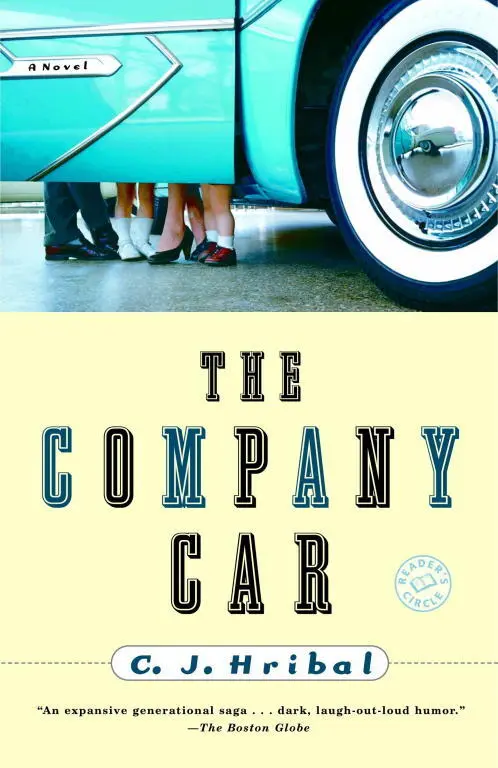
- Название:The Company Car
- Автор:
- Издательство:Random House
- Жанр:
- Год:2005
- Город:New York
- ISBN:1-58836-468-2
- Рейтинг книги:3 / 5. Голосов: 1
-
Избранное:Добавить в избранное
- Отзывы:
-
Ваша оценка:
The Company Car: краткое содержание, описание и аннотация
Предлагаем к чтению аннотацию, описание, краткое содержание или предисловие (зависит от того, что написал сам автор книги «The Company Car»). Если вы не нашли необходимую информацию о книге — напишите в комментариях, мы постараемся отыскать её.
“Are we there yet?” It’s the time-honored question of kids on a long family car trip—and Emil Czabek’s children are no exception. Yet Em asks himself the same thing as the family travels to celebrate his parents’ fiftieth wedding anniversary, and he wonders if he has escaped their wonderfully bad example.
The midwestern drive is Em’s occasion to recall the Czabek clan’s amazing odyssey, one that sprawls through the second half of the twentieth century. It begins with his parents’ wedding on the TV show It’s Your Marriage, and careens from a suburban house built sideways by a drunken contractor to a farm meant to shelter the Czabeks from a country coming apart. It is the story of Em’s father, Wally—diligent, distant, hard-drinking—and his attempts to please, protect, or simply placate his nervous, restless, and sensual wife, Susan, all in plain sight of the children they can’t seem to stop having.
As the tumultuous decades merge in his mind like the cars on the highway, Em must decide whether he should take away his parents’ autonomy and place them in the Heartland Home for the Elders. Beside him, his wife, Dorie, a woman who has run both a triathlon and for public office, makes him question what he’s inherited and whether he himself has become the responsible spouse of a drifting partner—especially since she’s packing a diaphragm and he’s had a vasectomy.
Wildly comic and wrenchingly poignant, The Company Car is a special achievement, a book that drives through territory John Irving and Jonathan Franzen have made popular to arrive at a stunning destination all its own.
The Company Car — читать онлайн бесплатно полную книгу (весь текст) целиком
Ниже представлен текст книги, разбитый по страницам. Система сохранения места последней прочитанной страницы, позволяет с удобством читать онлайн бесплатно книгу «The Company Car», без необходимости каждый раз заново искать на чём Вы остановились. Поставьте закладку, и сможете в любой момент перейти на страницу, на которой закончили чтение.
Интервал:
Закладка:
“Who was the wiseacre who shot his father?” Tony asked nonchalantly as he plucked first one pellet and then another from my father’s leg.
“That would be me,” I managed to choke out.
“Well, you’re lucky. Your old man is going to live. He’ll need a tetanus shot for these pokes”—he indicated the wounds Wally Jr. and I had made in our father’s leg—“but he’ll live. Just remind me never to go hunting with you. I’m liable to wind up gutted on your kitchen table and my head mounted over your fireplace before you realize your mistake.”
It was several minutes, I think, before I heard my father calling to me, and by that time Ike had run to the house and come back with our mother and a first-aid kit. He would still need to go to the hospital, where maybe they’d need to take a stitch or two in his face, and they would need to bring the rat in and check it for rabies, but it did look like he was going to be all right. He would not lose his foot or his leg or have it swell green with pus and require amputation. He was even smiling/grimacing, like a man who’d survived his own chemistry set explosion—and he’d done that as well. Tony Dederoff and Robert Aaron helped him to his feet. I tried, but I was afraid to touch him, afraid he wouldn’t let me, so I trailed a little behind, my arms out but not quite touching (not unlike Ira Hayes at the flag raising on Mount Suribachi). I was in such a state I did not hear him calling my name.
“Emmie,” my father said. It was one of the few times he called me by the name our mother always used. “Emmie, Emmie, Emmie, Emmie.”
Finally it dawned on me that he was speaking to me. At that point, though, after shooting him three times, I couldn’t manage speech. I could barely look him in the face. My father, I think, understood this. Despite having been shot by me, he felt sorry for me. He wanted to make me feel better. He wanted to let me know it was okay, that everything was going to turn out all right. He clamped a hand on my shoulder. I do not think that anything he could have said right then would have made me feel better, but he tried, and despite my best efforts to the contrary, I did feel better. He gave my shoulder a little shake, which was meant to make me look at him. I did. His face was bleeding from a dozen tiny cuts, his nose and forehead had the look of rare beef, and his remaining hair was cooked and curlicued, but he was grinning, and I have to give him credit for that. And credit, too, for making me grin back.
“Emmie,” he said, giving my shoulder another shake, “this will reflect on your merit review.”

13. Observations from the Wayback
“I used to be a lean, mean fighting machine,” laments Wally Jr., hauling himself up the tower again using only his arms. He has massive, slablike arms, but what’s more impressive is the body he’s trailing, shaped like a cross between a barrel and a pomegranate. “No more,” he says. “Not since I achieved gimphood.” He flops like a potbellied carp when he gets to the roof. Ernie’s the same when he heaves himself onto the roof. Both lie there for a moment, as though a fifteen-foot climb up an aerial was on a par with scaling the Matterhorn.
“This,” Ernie puffs, “will reflect on our merit review.”
“Fuck our merit review,” says Wally Jr. “Whose idiot idea was it that we meet on the fucking roof? This ain’t even close to being in compliance with the handicap laws.”
“It started the night I told Emcee I was going to marry Audrey.” Robert Aaron hauls up Wally Jr.’s wheelchair and blocks the wheels while Ike tethers it to the chimney.
Wally Jr. pulls himself into his chair. “Oh. So we do this for sentimental reasons.”
Below us, the screen door opens and out come Dorie, Audrey, Jennifer, and Jake, all carrying grocery bags. Audrey calls to Robert Aaron that they’ll bring the kids up after they’ve been fed. Dorie doesn’t look up. Jake, carrying a flashlight, keeps turning it on and off under his nose.
“Can we just get started?” I ask.
Meg says we shouldn’t start until Cinderella gets here.
“Like that’s going to make a difference.”
“What’s bugging you, Emcee?”
“You know we’re just like Mom and Dad. Dinking around, frittering away time, never getting anywhere—”
“And getting somewhere would be what, putting them in a home?” asks Wally Jr. “That’s what this is about, right? Puttin’ ’em somewhere? What, you just want a vote and that’s that?”
“That’s not what I meant. Christ. Can we please just discuss this rationally for once?”
“Rationally, he says. In this family he expects rationality.”
“I’m not expecting, I’m asking. I think we can do this. Even if we can’t, it needs to be done, dammit. How much longer do you think Mom and Dad are going to be able to care for themselves? And then what?”
Wally Jr. fishes around in the cooler for another Dew. “I say we drive off that bridge when we come to it.”
“Driving off a bridge is not going to help them or us, Wally.”
“Don’t knock it till you tried it, pantywaist.”
I should have known. I fucking should have known. Our making nice lasts only as long as we’re talking about things that don’t matter.
“Shut the fuck up,” says Wally Jr. “Or I’ll make you shut the fuck up.” He backs his wheelchair off the blocks and executes the first half of a Y-turn so he can make a run at me. I’m puzzled. Wait, did I say that out loud? You don’t do that around Wally. Even from a wheelchair, Wally will take on all comers and eat them for lunch.
“Don’t,” says Robert Aaron, stepping between us. “Just don’t get started on all that. We’ll be here all night.”
“Don’t get started on what?” Our mother’s outside on the deck, leaning on her cane. She’s a compact woman now, and her face has the look she used to get when she listened to our father’s wilder stories. “What are you out here talking about?”
Silence. Finally somebody says, “Nothing.” Somebody else says, “Stuff.”
“Nothing and stuff. Look,” says our mother, “don’t take me for a simpleton just because I’m old. You’re talking about your father and me, aren’t you?”
“Where is Dad?”
“Sleeping. Your father poops out early these days. Don’t try to change the subject. And get down here. I don’t want to get a crick in my neck talking to you.”
“Christ,” says Wally Jr. “I just got up here again.”
“Well, you shouldn’t have been up there in the first place, Mr. Smarty-Pants.”
We climb down. Wally Jr.’s wheelchair first, then Wally Jr., then the rest of us. We stand around the way we used to after fights, all hangdog and guilty. What would it be this time—yelling, a spanking, or something icily controlled and distant and devastating? Yelling we could handle. It was that calm, bitten off “Well, I’m disappointed in you, children, I expected better” that ripped our guts out.
Our mother looks around the circle, shaking her head, her eyes glistening. She takes a deep breath. A tear spills onto her papery cheek, but she’s smiling. “What lousy liars you all are. I used to say this about you playing with balls, but it’s true of cabals as well: don’t have them so close to the house.” She sighs. “No balls or cabals close to the house,” she says as she shuffles back inside. “You’re bound to break something. Windows, hearts—something.”
The soundtrack for our first summer in Augsbury was the continuous, nerve-racking hammering of a new well being drilled. Two hundred and fifty-one feet of it. Most wells in the area, we found out, usually hit water at about fifty-five to sixty-five feet. A few went to eighty, a few more to a hundred, a hundred and ten. But day after day the drill rig pounded and pounded right behind our house, and nothing. Sand, then clay, then rock.
Читать дальшеИнтервал:
Закладка:
Похожие книги на «The Company Car»
Представляем Вашему вниманию похожие книги на «The Company Car» списком для выбора. Мы отобрали схожую по названию и смыслу литературу в надежде предоставить читателям больше вариантов отыскать новые, интересные, ещё непрочитанные произведения.








Обсуждение, отзывы о книге «The Company Car» и просто собственные мнения читателей. Оставьте ваши комментарии, напишите, что Вы думаете о произведении, его смысле или главных героях. Укажите что конкретно понравилось, а что нет, и почему Вы так считаете.