C Hribal - The Company Car
Здесь есть возможность читать онлайн «C Hribal - The Company Car» весь текст электронной книги совершенно бесплатно (целиком полную версию без сокращений). В некоторых случаях можно слушать аудио, скачать через торрент в формате fb2 и присутствует краткое содержание. Город: New York, Год выпуска: 2005, ISBN: 2005, Издательство: Random House, Жанр: Современная проза, на английском языке. Описание произведения, (предисловие) а так же отзывы посетителей доступны на портале библиотеки ЛибКат.
- Название:The Company Car
- Автор:
- Издательство:Random House
- Жанр:
- Год:2005
- Город:New York
- ISBN:1-58836-468-2
- Рейтинг книги:3 / 5. Голосов: 1
-
Избранное:Добавить в избранное
- Отзывы:
-
Ваша оценка:
The Company Car: краткое содержание, описание и аннотация
Предлагаем к чтению аннотацию, описание, краткое содержание или предисловие (зависит от того, что написал сам автор книги «The Company Car»). Если вы не нашли необходимую информацию о книге — напишите в комментариях, мы постараемся отыскать её.
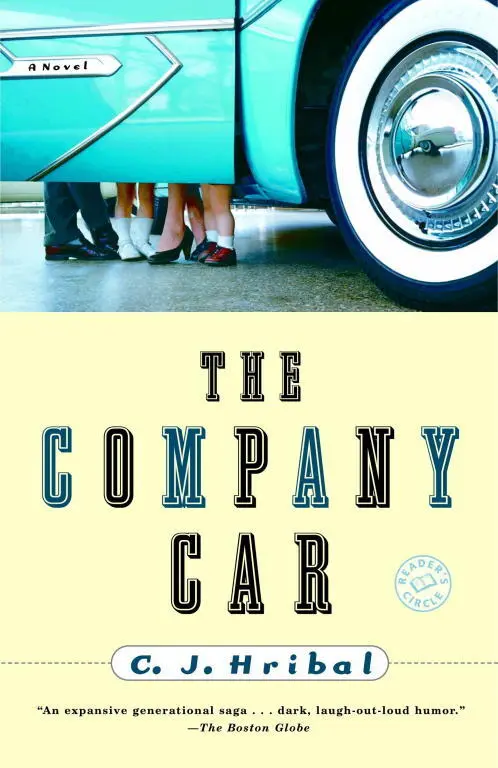
“Are we there yet?” It’s the time-honored question of kids on a long family car trip—and Emil Czabek’s children are no exception. Yet Em asks himself the same thing as the family travels to celebrate his parents’ fiftieth wedding anniversary, and he wonders if he has escaped their wonderfully bad example.
The midwestern drive is Em’s occasion to recall the Czabek clan’s amazing odyssey, one that sprawls through the second half of the twentieth century. It begins with his parents’ wedding on the TV show It’s Your Marriage, and careens from a suburban house built sideways by a drunken contractor to a farm meant to shelter the Czabeks from a country coming apart. It is the story of Em’s father, Wally—diligent, distant, hard-drinking—and his attempts to please, protect, or simply placate his nervous, restless, and sensual wife, Susan, all in plain sight of the children they can’t seem to stop having.
As the tumultuous decades merge in his mind like the cars on the highway, Em must decide whether he should take away his parents’ autonomy and place them in the Heartland Home for the Elders. Beside him, his wife, Dorie, a woman who has run both a triathlon and for public office, makes him question what he’s inherited and whether he himself has become the responsible spouse of a drifting partner—especially since she’s packing a diaphragm and he’s had a vasectomy.
Wildly comic and wrenchingly poignant, The Company Car is a special achievement, a book that drives through territory John Irving and Jonathan Franzen have made popular to arrive at a stunning destination all its own.
The Company Car — читать онлайн бесплатно полную книгу (весь текст) целиком
Ниже представлен текст книги, разбитый по страницам. Система сохранения места последней прочитанной страницы, позволяет с удобством читать онлайн бесплатно книгу «The Company Car», без необходимости каждый раз заново искать на чём Вы остановились. Поставьте закладку, и сможете в любой момент перейти на страницу, на которой закончили чтение.
Интервал:
Закладка:
“We don’t know what the deal is,” the crew chief told our father. “Usually by now we’re just gushing water.” They were at one hundred and eighty-one feet and counting.
Our father managed to escape this pounding entirely—they weren’t drilling on weekends, the only time he was home. And we kids escaped it by playing army. The enemy was shelling our base of operations—listen to that bombardment!—and day after day we fought for control of the ruined barn, poking our submachine guns out windows framed in rotting wood. We were Vic Morrow in Combat! with stubbled chins and candy cigarettes dangling from our mouths as we went from one bombed, burned-out building to the next, spraying death to the Jerries every step of the way. We fought up the rise and attacked our own backyard, whooping and hollering and spewing death to all who stood in our way. The crew drilling in a futile search for water in our backyard were not amused. “Hey, you kids, go play somewhere else.”
Why? we wondered. It was our yard. They were the interlopers. What were a few dirt hand grenades between friends? We swept and secured the area, retired to the trees. Time for a new mission, even deadlier than the last one—secure apples from Tillie Bunkas.
Tillie Bunkas scared the bejesus out of us. She was a nice old lady who gave us apples, rhubarb pie, and her son Alfred’s dandelion wine and honey, but to us she was still a witch, an old crone with a goiter who lived with her sixty-something-year-old son because she’d put him under a spell, and she’d put us under one, too, if we let her. That evil eye would get us, turn us into frogs or toads or stones or she-goats or something. And all that poison she kept stored in the bulbous lump on her throat. If any of that poison got you, you’d wind up just like her—blind and toothless and cackling, with your own gourd of poison on your neck.
Tillie liked us, I think, even when we staged commando raids on her orchard. But we didn’t trust her generosity. She shouldn’t have been so accommodating during a commando raid. There we were, liberating apples, and Tillie Bunkas would appear in our midst, apples in hand, ruining it for us. What lousy commandos we were. How did she sneak up on us? “Boys, boys,” she’d say, “come out of the trees. See what I have for you.” And like that witch in “Hansel and Gretel” she’d wave her wizened brown stick arms, the apples shiny in her claws.
It shouldn’t have been so hard to take them. But the wind screwed her hair around her head like a web and her dress blew like loose rags about her and we could see her nylon stockings only came up to her knees and the sun had turned her cataritic eyes into fish scales and her tongue flapped around her five remaining teeth, and there was no way in hell we were coming near this sweet old lady who simply wanted to keep us from ruining her fruit trees.
Our mother had no such diversions. Her job that summer was the utterly mundane one of painting a ranch house that had been built in 1956 and hadn’t been painted since. Actually, we were supposed to help her, but that was not how it turned out. The boards on the west side of the house were the color of old blood and so weather-beaten that the paint we applied soaked in as though each silvered, blood-colored board was one of those sponges they compare paper towels to in the Bounty commercials. Gallon after gallon of primer disappeared into the side of the house. We got discouraged, tired, and our mother took over for us. Inside we cleaned up, then felt reenergized enough to roam the fields and woods, leaving our mother to the hot, lonely work of painting, her brain under a constant and inescapable sonic assault.
Our mother did most of the finish painting as well. Our father was gone Sunday night to Friday night, and when he returned after a ten- or twelve-hour drive, taking brush in hand was not an option. A seven-ounce fluted glass at the local tavern was, however, a different proposition. Our mother muttered about this and kept painting. The blood-red house slowly became off-white. “Like what a bride wears for her second wedding,” said our mother.
Second wedding? Could you do that? People got married once, forever, and that was that. Uncle Louie was the exception, but his unhappiness ran deep. Already we were hearing that Uncle Louie and Shirley’s marriage was not the match made in heaven he said it was. And our mother, while certainly sad for Louie, took satisfaction in having her premonitions proved correct. Yet here was our mother suggesting that people could get married more than once, and saying it with a disturbing wistfulness. People could start over. Which made us wonder: In trading the House That God Built for God’s Green Acres, was that what our parents had done—embarked, metaphorically, on a second marriage? And what if that one didn’t work out?
These days, when people move from one identical subdivision to another, every tract mansion the same combination of mismatched architectural styles and missized styling elements, the idea of being wedded to a single, particular place seems quaint, almost comical. But our parents were of a generation for whom mobility was a new and only semidesirable thing. Mostly it was scary, engendered by a sense that they had to move out or lose what they had worked so hard to build in the first place. This was a generation that came of age during the dislocations of two wars, each preceded by a depression. The Korean War and its depression were littler than their predecessors, true, but the déjà vu sense was very strong in them. And after each dislocation, they wanted nothing more than for the boat to stop rocking.
No wonder our father was a company man. He needed someplace for all that loyalty and rootedness to go. Dinkwater Chemical helped him leave Elmhurst when everything seemed to be spinning out of control. They allowed him to realize his dream of living in the country. They also gave our father a company car—a Buick Skylark station wagon—and all the mobility he could stand. Seventy thousand miles a year worth. Therefore, Dinkwater Chemical deserved his loyalty. It was the simple arithmetic of a new marriage—get divorced from Elmhurst and Dinkwater-Adams, get married to the northern cousins.
This new marriage required, though, getting used to a new set of in-laws. Again, it was easier for our father. He no longer had the Office, but you couldn’t walk a hundred feet in Augsbury and not find a bar, a tavern, a saloon, a bar and grill, a restaurant, an inn, or a tap enticing you with its open screen door, its cool dark, its hunched patrons and grinning barkeep. Our father had done the math—thirteen bars, thirteen hundred people.
It was after our first Sunday Mass that our father decided St. Gen’s would be our regular church and Banana’s Never Inn would be his regular bar, and living here would be a very good life indeed. Immediately after the ten o’clock High Mass, everyone left St. Gen’s and went straight across the street to Banana’s Never Inn. Our parents thought a brunch would be a nice treat for us, but as new parishioners they first wanted to introduce themselves to the priest. Monsignor Kahle was a stiff-backed, grim-visaged priest with absolutely clear gray eyes behind rimless glasses. He wore his hair in a pure white brush cut and lacked, I thought, only the dueling scar on his cheek to be a full-fledged Prussian officer. During his sermon he had railed about vice and immorality, stuttering out images of hellfire and damnation like bursts from a machine gun. It had scared me, this white-haired old man with his purple face and plosives. But now Monsignor Kahle was calm, affable, almost jovial. In welcoming our parents, his eyes twinkled, and he rubbed my and my brothers’ crew cuts as though he were an uncle. He placed his fingers under Peg Leg Meg’s chin and cupped Cinderella’s cheek. He said we looked like a fine, fine family. Our father said it seemed like a nice community, and he thought it wonderful that the bar across the street offered a brunch. They certainly seemed to be doing a very good business. Monsignor Kahle said Banana’s Never Inn had no brunch. They had a toaster oven for pizza, they served pickled eggs and beef jerky out of jars, and if you could convince Banana—when he was around—to fire up the grill for a hamburger, you were a lucky man indeed.
Читать дальшеИнтервал:
Закладка:
Похожие книги на «The Company Car»
Представляем Вашему вниманию похожие книги на «The Company Car» списком для выбора. Мы отобрали схожую по названию и смыслу литературу в надежде предоставить читателям больше вариантов отыскать новые, интересные, ещё непрочитанные произведения.








Обсуждение, отзывы о книге «The Company Car» и просто собственные мнения читателей. Оставьте ваши комментарии, напишите, что Вы думаете о произведении, его смысле или главных героях. Укажите что конкретно понравилось, а что нет, и почему Вы так считаете.