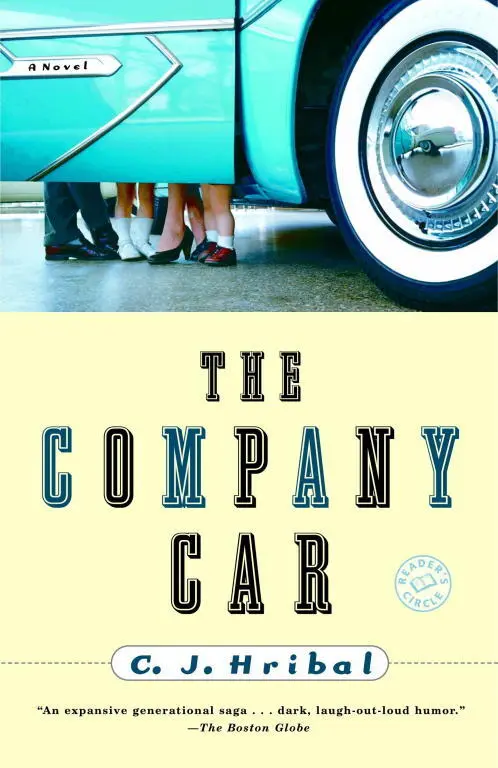
C Hribal - The Company Car
Здесь есть возможность читать онлайн «C Hribal - The Company Car» весь текст электронной книги совершенно бесплатно (целиком полную версию без сокращений). В некоторых случаях можно слушать аудио, скачать через торрент в формате fb2 и присутствует краткое содержание. Город: New York, Год выпуска: 2005, ISBN: 2005, Издательство: Random House, Жанр: Современная проза, на английском языке. Описание произведения, (предисловие) а так же отзывы посетителей доступны на портале библиотеки ЛибКат.
- Название:The Company Car
- Автор:
- Издательство:Random House
- Жанр:
- Год:2005
- Город:New York
- ISBN:1-58836-468-2
- Рейтинг книги:3 / 5. Голосов: 1
-
Избранное:Добавить в избранное
- Отзывы:
-
Ваша оценка:
The Company Car: краткое содержание, описание и аннотация
Предлагаем к чтению аннотацию, описание, краткое содержание или предисловие (зависит от того, что написал сам автор книги «The Company Car»). Если вы не нашли необходимую информацию о книге — напишите в комментариях, мы постараемся отыскать её.
“Are we there yet?” It’s the time-honored question of kids on a long family car trip—and Emil Czabek’s children are no exception. Yet Em asks himself the same thing as the family travels to celebrate his parents’ fiftieth wedding anniversary, and he wonders if he has escaped their wonderfully bad example.
The midwestern drive is Em’s occasion to recall the Czabek clan’s amazing odyssey, one that sprawls through the second half of the twentieth century. It begins with his parents’ wedding on the TV show It’s Your Marriage, and careens from a suburban house built sideways by a drunken contractor to a farm meant to shelter the Czabeks from a country coming apart. It is the story of Em’s father, Wally—diligent, distant, hard-drinking—and his attempts to please, protect, or simply placate his nervous, restless, and sensual wife, Susan, all in plain sight of the children they can’t seem to stop having.
As the tumultuous decades merge in his mind like the cars on the highway, Em must decide whether he should take away his parents’ autonomy and place them in the Heartland Home for the Elders. Beside him, his wife, Dorie, a woman who has run both a triathlon and for public office, makes him question what he’s inherited and whether he himself has become the responsible spouse of a drifting partner—especially since she’s packing a diaphragm and he’s had a vasectomy.
Wildly comic and wrenchingly poignant, The Company Car is a special achievement, a book that drives through territory John Irving and Jonathan Franzen have made popular to arrive at a stunning destination all its own.
The Company Car — читать онлайн бесплатно полную книгу (весь текст) целиком
Ниже представлен текст книги, разбитый по страницам. Система сохранения места последней прочитанной страницы, позволяет с удобством читать онлайн бесплатно книгу «The Company Car», без необходимости каждый раз заново искать на чём Вы остановились. Поставьте закладку, и сможете в любой момент перейти на страницу, на которой закончили чтение.
Интервал:
Закладка:
“Name’s Tony Dederoff. I’m with the Farm Bureau. Plus I got a farm of my own other side of the hill. I heard you were moving in today, wanted to get a look at you. Is what I heard right—you’re city folk? Moving up from Chicago? Whoo-ee, that’s a long way to go. Most we’ve got usually is somebody hightailing it from Appleton. It’s not like we even get people from Milwaukee, usually, except if they stop in town for a bite on their way up north.”
Tony Dederoff was a talker. This suited our father to a T, and we could see they were going to be at it quite a while. We took off to explore.
It was a bit like discovering yourself in Oz and the enchanted monkey forest at the same time. The barns had fallen. There were two of them, and one was completely gone except for the fieldstone walls and wooden window frames and the stanchions; the other was leaning like the Tower of Pisa, only worse. There were also two outbuildings—sheds, really, probably pressed into service after the barns collapsed. One contained a decrepit-looking tractor, the other had its corrugated sheet-metal roof partially torn away. A two-tone Chevy was listing on its side in a thicket of weeds next to the Tower of Pisa barn. It was white and the same washed-out pastel green as Tony Dederoff’s truck. Its tailpipe protruded from the trunk as though that was where it belonged. This had our clubhouse beat all hollow.
In the abandoned silo we heard the hloo hloo of pigeons and threw rocks at them, though our throws were pitifully short of the mark—the pigeons were high up, on a ledge, unperturbed and unconcerned. I was scouring the barn floor for more rocks when I heard a voice creaky with age saying, “You boys stop that.” I looked up. It was an old woman in a faded housedress, the kind our mother wore. Wisps of white hair danced around her head, and her eyes were thickened with what looked like fish-belly flesh. They were both piercing and blind-looking at the same time. And her teeth! She had maybe eight in her entire mouth, and as her lips flapped at us the teeth still remaining in her jaw protruded every which way and took up residence outside her lips. And then there was the grapefruit-size lump underneath her chin, distending it and making her head tilt back. In the sunlight it looked white and purple, like an eggplant.
“There are barn swallows up there,” she said. “Don’t be tormenting the barn swallows. They, too, are God’s creatures.” She gave us a horrible, knowing smile then, like she knew exactly what we were thinking, and what she was going to do with us. And that huge lump beneath her chin seemed to swell and breed, twitch and glow as we watched. No doubt she was a witch. And like those cacti in the Southwest that explode from overwatering and give birth to a thousand tarantulas, something evil was about to break loose from her neck. We ran screaming over to the woodpiles—all the lumber from the collapsed barns—which we jumped on.
“Hey, you kids, there’s rats in those piles,” Tony Dederoff called, and we jumped off the piles as though the rats were making for our pant legs. We ran back to our parents, breathless, wanting to tell them we had moved inside a Grimm’s fairy tale, complete with witch. Our father was telling Tony that we had bought the farm for the land, not for the house or the buildings.
“That’s a good thing,” said Tony Dederoff. “It’s real pretty land, but frankly, it’s not much for farming. You only got about fifty tillable acres—more, I suppose, if you drain that marsh”—he pointed—“but mostly it’s sand. The soil you want blew away years ago over to your neighbor’s. You knew that, right?” Our father, a little abashed, allowed that he’d seen it only in winter, when there was snow cover. Tony continued, “Well, anyway, you’re down to lake bottom now, which is what this was about two million years ago. More recently, the folks who had this before you—the Hovelings?—they did everything half-assed—pardon my French—and it shows. No soil conservation at all. Plowed vertically down this hill so what didn’t blow away eroded into that lower field. Fact is they weren’t really farmers. They half-turned these fields years ago, then left them sit for soil bank. You can take advantage of it, too, if you want.”
“Soil bank?”
“The government pays you not to grow crops. You don’t make as much as if you were farming it, but you don’t make a whole lot less, either. The Hovelings put just about everything into soil bank. Given the way they plowed, that was probably a good idea.”
“We saw their billboard on the way up,” said our father. “Did they own a waste removal business?”
“Septic tank cleaners. Those were cousins. They had enough trouble dealing with their own shit—’scuse my French—let alone handling somebody else’s. What wasn’t fallow they had in corn, which takes a terrible toll on soil, especially soil like this, if you let it. They depleted the hell out of it, then got a contract with their septic tank cousins to dump what they pumped out of the tanks onto the fields here. The bowel movements of half the county are probably fertilizing your fields even as we speak.”
“I’m not sure I wanted to hear that,” said our mother.
“Of course, you could always grow potatoes. Potatoes do well in soil like this. They like it sandy.” Tony Dederoff wiped his glasses. “Real pretty land,” he repeated, “but I wouldn’t want to make a living off it. Even if it was good soil and it was all tillable, you got about half what you need to make a go of it. You got other employment?”
“Sales rep for Dinkwater Chemical.”
“A peddler, eh? What do they sell?”
“Industrial defoamers. I sell to paper mills.”
“You’re in the right place then.” Tony looked at each of us. “I count seven,” he said. “Five on the school bus come this fall?”
“That sounds about right,” said our father. He turned to our mother. “It’s seven, right? You haven’t had any I don’t know about yet, right?” Our mother only smiled.
“I drive this route. These don’t look like they’ll give me any trouble.” He flicked Wally Jr.’s nose. “I’ve got five kids myself. I’d have more, but then I’m younger than you.”
“So you have an extra job, too.”
“Most folks do. For me it’s farm, Farm Bureau, and school bus driver—in that order. I play a little accordion on the weekends, too.”
“Really?” said our father. “I used to play accordion and sing.”
“We’ll have to get together sometime.” At that moment a rather docile and arthritic-looking dog appeared from somewhere and Tony bent down to pet him. “This is the Hovelings’ dog, Charlie. Looks like they left him. He’s a good dog, but I wouldn’t let him inside the house. Like most things they owned, the Hovelings didn’t really take care of him.” He kept petting the dog. It looked like a beagle-Lab mix and was very appreciative of Tony’s attention. It hadn’t barked once since we’d arrived. Once we started petting the dog, Tony stood up. “Church?”
“Catholic. There’s St. Stephen’s in Augsbury and St. Ambrose in Chetaqua, right?”
“Don’t forget St. Genevieve’s in Holton. That’s where me and the missus go.” Tony Dederoff shook our mother’s and our father’s hands and got back in his truck. He leaned his head out the window. “Hope to see you there. It’s a nice crowd no matter how you slice it.”
“I like him,” said our father as Tony Dederoff backed his truck down our drive.
“You like everybody,” said our mother.
Before Tony Dederoff was even out of our driveway we were imploring our mother about Charlie. “Please, Mom, can we keep him? Please, please, please, please, please ?!!!”
Читать дальшеИнтервал:
Закладка:
Похожие книги на «The Company Car»
Представляем Вашему вниманию похожие книги на «The Company Car» списком для выбора. Мы отобрали схожую по названию и смыслу литературу в надежде предоставить читателям больше вариантов отыскать новые, интересные, ещё непрочитанные произведения.







Обсуждение, отзывы о книге «The Company Car» и просто собственные мнения читателей. Оставьте ваши комментарии, напишите, что Вы думаете о произведении, его смысле или главных героях. Укажите что конкретно понравилось, а что нет, и почему Вы так считаете.