C Hribal - The Company Car
Здесь есть возможность читать онлайн «C Hribal - The Company Car» весь текст электронной книги совершенно бесплатно (целиком полную версию без сокращений). В некоторых случаях можно слушать аудио, скачать через торрент в формате fb2 и присутствует краткое содержание. Город: New York, Год выпуска: 2005, ISBN: 2005, Издательство: Random House, Жанр: Современная проза, на английском языке. Описание произведения, (предисловие) а так же отзывы посетителей доступны на портале библиотеки ЛибКат.
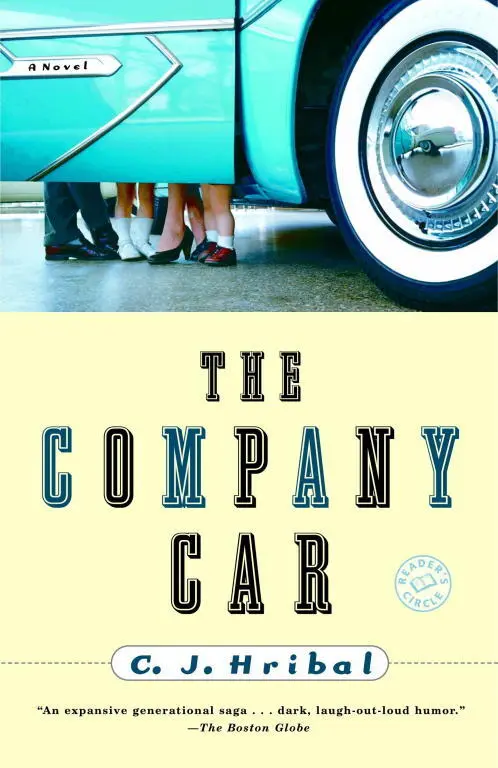
- Название:The Company Car
- Автор:
- Издательство:Random House
- Жанр:
- Год:2005
- Город:New York
- ISBN:1-58836-468-2
- Рейтинг книги:3 / 5. Голосов: 1
-
Избранное:Добавить в избранное
- Отзывы:
-
Ваша оценка:
The Company Car: краткое содержание, описание и аннотация
Предлагаем к чтению аннотацию, описание, краткое содержание или предисловие (зависит от того, что написал сам автор книги «The Company Car»). Если вы не нашли необходимую информацию о книге — напишите в комментариях, мы постараемся отыскать её.
“Are we there yet?” It’s the time-honored question of kids on a long family car trip—and Emil Czabek’s children are no exception. Yet Em asks himself the same thing as the family travels to celebrate his parents’ fiftieth wedding anniversary, and he wonders if he has escaped their wonderfully bad example.
The midwestern drive is Em’s occasion to recall the Czabek clan’s amazing odyssey, one that sprawls through the second half of the twentieth century. It begins with his parents’ wedding on the TV show It’s Your Marriage, and careens from a suburban house built sideways by a drunken contractor to a farm meant to shelter the Czabeks from a country coming apart. It is the story of Em’s father, Wally—diligent, distant, hard-drinking—and his attempts to please, protect, or simply placate his nervous, restless, and sensual wife, Susan, all in plain sight of the children they can’t seem to stop having.
As the tumultuous decades merge in his mind like the cars on the highway, Em must decide whether he should take away his parents’ autonomy and place them in the Heartland Home for the Elders. Beside him, his wife, Dorie, a woman who has run both a triathlon and for public office, makes him question what he’s inherited and whether he himself has become the responsible spouse of a drifting partner—especially since she’s packing a diaphragm and he’s had a vasectomy.
Wildly comic and wrenchingly poignant, The Company Car is a special achievement, a book that drives through territory John Irving and Jonathan Franzen have made popular to arrive at a stunning destination all its own.
The Company Car — читать онлайн бесплатно полную книгу (весь текст) целиком
Ниже представлен текст книги, разбитый по страницам. Система сохранения места последней прочитанной страницы, позволяет с удобством читать онлайн бесплатно книгу «The Company Car», без необходимости каждый раз заново искать на чём Вы остановились. Поставьте закладку, и сможете в любой момент перейти на страницу, на которой закончили чтение.
Интервал:
Закладка:
Our parents exchanged looks. Our mother sighed. We cheered.
“But he stays outside!” said our mother. “In that barrel over there. That must be where they kept him.”
Like everything else the Hovelings owned, the fifty-five-gallon drum Charlie lived in was rusted, full of holes, and obscured by weeds. There were some blankets in there, a smell of must and wet dog, and probably half a million fleas.
“We’ll start by burning that blanket, and getting this mutt to a vet.”
“Today, Wally?”
“Okay, maybe in a couple of days. Kids, don’t touch the dog, or at least don’t let him get in your lap. And wash your hands after you’ve touched him.” Our father regarded the dog, whose rheumy eyes were those of a St. Bernard. “He’s not going to be much of a watchdog, is he?”
Evidently not. While we were talking a tall, rail-thin man came over carrying a couple of grocery bags, and Charlie didn’t even sniff his pants. The man wore overalls, and his T-shirt flapped on his thin but muscular arms. There was a silvery wash of stubble on his chin and some longer hairs further down his neck. He was carrying housewarming presents: a bag of apples and a bag of tomatoes. “Them apples is last year’s from the fruit cellar,” said the man, “but the tomatoes are fresh.” He handed a bag to each of our parents. “I’m Alfred Bunkas. I live over there.” He pointed at the original farmhouse, which must have been pretty in its day but had succumbed to an asphalt siding salesman in the late forties or early fifties. It was now a nondescript blue with a pine green trim that did not match. “I seen you already met my mother.”
“We did?”
“Your kids did. Probably scared them.” He turned to us and pointed at his throat. “My mother has a goiter. That’s what you seen on her neck. And her eyes”—he pointed to his own—“them’s cataracts. It makes her eyes look funny, don’t it? All milky? Well, she sees things milky, too. It’s no fun being old when your body’s breaking down on you.” He turned back to our parents. “Not enough iodine in her diet. I told her she could get that and her cataracts taken care of, but she’s stubborn. You know how it is with old ladies.” He turned back to us. “Her name’s Tillie. You can call her Grandma Tillie if you want. She’d like that.” Alfred Bunkas then bent himself double to talk to Wally Jr. and Ike. “She won’t hurt you,” he said. “She’s a nice old lady. She just looks funny.” Wally Jr. and Ike kept their wide eyes on Alfred Bunkas as they slowly backed away and sidled themselves in behind our mother’s legs. Alfred Bunkas laughed. Our parents thanked him for the gifts, which Alfred Bunkas waved off—” ‘tweren’t nuthin’ “—then he shook their hands and loped across the field back to his house.
“What a nice man,” said our father.
“These apples are a little soft,” said our mother, “but it was a nice gesture all the same.”
Said our father, putting his arms around our mother, “I think we’re going to like it here.”
“We’ll see.”
“We shall see what we shall see,” sang our father.
A fine sand blew from the bare gulleys between each furrow. When the breeze picked up, you had to squint to keep from getting a faceful. “Let’s get started,” said our father.
The Mayflower movers had been working the whole time we’d been out exploring. They’d been consulting with our mother, too, about where she wanted things. Now they were almost done. We stayed out of their way as they brought in the big items, which they set against the walls or in open areas between the boxes. We would be days getting everything to rights, but it was July and we had eight weeks before school started to set up house, to learn our way around the place, to make friends and put our farm in order.
The house was hot, and our mother thought we should start by opening the windows. Only we couldn’t. Sand was everywhere. The window tracks were clogged with it. It was like the Dust Bowl, said our mother. “Does this all come from not knowing how to plow right?”
“Contour farming,” said our father. “Crop rotation. I bet they teach that at the high school. The Hoveling kids must have been absent that day.”
Once we got some boxes put away, we could see where the Hoveling kids had probably been instead. They’d gone through the entire house before they left, kicking in doors and ripping out woodwork. Our woodwork. The house had been built without any. Closets were open caves, the windows glassed-in holes, and floors met walls without moldings or toe rounds. Our parents had authorized workmen to measure, cut, and tack up all the trim. We’d stain, varnish, and do the final nailing ourselves. Our first family project. Trusting people, our parents had no idea what sort of people they’d bought their house from. Any trim not already nailed to the wall the Hoveling children—or, could it be, the adults?—had broken over their knees like kindling. The wreckage was total—floor moldings, toe rounds, sliding closet doors, hinged doors, edging—all of it snapped or kicked in. An obscenity in red Crayola suggesting what we could do with ourselves adorned the living room wall next to the fireplace. Our mother had missed it earlier.
Our mother put her hand over her mouth. She stood like they do in those pictures of people suffering in Asia or Africa, or standing over the ruins of some Mississippi Gulf town devastated by a hurricane. “I have to get some water,” she said, but she didn’t move. Then Charlie, who had nosed his way inside, came up the steps from the landing, put his snout between his paws, and promptly threw up at our mother’s feet. Something was alive in the vomit—a mass of tiny white worms, blind and wriggling. Our mother cupped her hand in front of her mouth, but her vomit soon joined Charlie’s.
Our father had our mother sit on a Mayflower box while he got her some water. “Jesus H. Christ,” we heard him shout from the kitchen. There was a tremendous rattling and kathunking of pipes and metal. Now what? We ran to see. Our father was holding a glass of tap water up to the light. But it was no use; you couldn’t see through it. The pipes were rattling and bonking, and orangey-brown water was shuddering out. Then the tap closed up completely. Our father unscrewed the faucet cap, and a burst of sand and water and rust cascaded into the sink. The particulate in the glass he’d set on the countertop was settling now. What we were getting from the tap appeared to be a forty-to-sixty ratio of sand and grit to well water. Our father handed this glass to Cinderella with the instructions “Give this to your mother.”
The next day we would find out that the well pipes had caved in and that we’d need to dig a new well. A week after that the septic system would back up and we would have to hire the Hoveling cousins to locate our septic tank and dig that up. At the first good rain we would discover that the flashing around the chimney leaked, and that sand was not the only thing the basement windows could not keep out. Water filtered in between the storm and the interior windows, filling the space and turning the downstairs windows into filled-but-vacant aquariums like you might find in a seafood restaurant down on its luck. Water continued to pour in after that and belled out the pink bathroom wallboard like the tummy of a pregnant cheerleader.
Given the horrors to come, our mother’s reaction—crying over a glass of tap water—was not unreasonable, particularly if she was prescient, which from time to time she claimed to be. She was no Jeane Dixon, mind you, but at various times she’d get a presentiment and tell our father, “I feel good about this,” or “I have a very bad feeling about this.” When pressed, she never elaborated, but we were given to understand that something mystical had happened inside our mother, that she simply knew something was going to happen before it did. If she’d had any such feelings about our move, she’d not voiced them to us. What she might have said to our father, of course, is another story. But we thought it telling that he could not face her with a glass of tap water just after she had vomited on her own shoes.
Читать дальшеИнтервал:
Закладка:
Похожие книги на «The Company Car»
Представляем Вашему вниманию похожие книги на «The Company Car» списком для выбора. Мы отобрали схожую по названию и смыслу литературу в надежде предоставить читателям больше вариантов отыскать новые, интересные, ещё непрочитанные произведения.











Обсуждение, отзывы о книге «The Company Car» и просто собственные мнения читателей. Оставьте ваши комментарии, напишите, что Вы думаете о произведении, его смысле или главных героях. Укажите что конкретно понравилось, а что нет, и почему Вы так считаете.