C Hribal - The Company Car
Здесь есть возможность читать онлайн «C Hribal - The Company Car» весь текст электронной книги совершенно бесплатно (целиком полную версию без сокращений). В некоторых случаях можно слушать аудио, скачать через торрент в формате fb2 и присутствует краткое содержание. Город: New York, Год выпуска: 2005, ISBN: 2005, Издательство: Random House, Жанр: Современная проза, на английском языке. Описание произведения, (предисловие) а так же отзывы посетителей доступны на портале библиотеки ЛибКат.
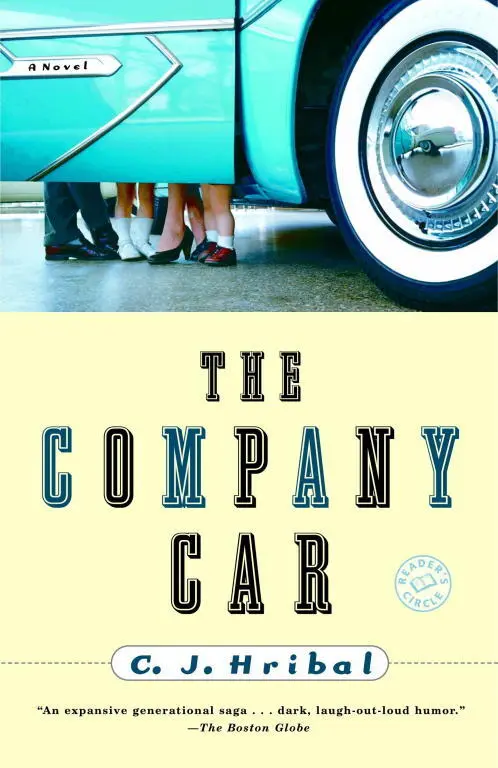
- Название:The Company Car
- Автор:
- Издательство:Random House
- Жанр:
- Год:2005
- Город:New York
- ISBN:1-58836-468-2
- Рейтинг книги:3 / 5. Голосов: 1
-
Избранное:Добавить в избранное
- Отзывы:
-
Ваша оценка:
The Company Car: краткое содержание, описание и аннотация
Предлагаем к чтению аннотацию, описание, краткое содержание или предисловие (зависит от того, что написал сам автор книги «The Company Car»). Если вы не нашли необходимую информацию о книге — напишите в комментариях, мы постараемся отыскать её.
“Are we there yet?” It’s the time-honored question of kids on a long family car trip—and Emil Czabek’s children are no exception. Yet Em asks himself the same thing as the family travels to celebrate his parents’ fiftieth wedding anniversary, and he wonders if he has escaped their wonderfully bad example.
The midwestern drive is Em’s occasion to recall the Czabek clan’s amazing odyssey, one that sprawls through the second half of the twentieth century. It begins with his parents’ wedding on the TV show It’s Your Marriage, and careens from a suburban house built sideways by a drunken contractor to a farm meant to shelter the Czabeks from a country coming apart. It is the story of Em’s father, Wally—diligent, distant, hard-drinking—and his attempts to please, protect, or simply placate his nervous, restless, and sensual wife, Susan, all in plain sight of the children they can’t seem to stop having.
As the tumultuous decades merge in his mind like the cars on the highway, Em must decide whether he should take away his parents’ autonomy and place them in the Heartland Home for the Elders. Beside him, his wife, Dorie, a woman who has run both a triathlon and for public office, makes him question what he’s inherited and whether he himself has become the responsible spouse of a drifting partner—especially since she’s packing a diaphragm and he’s had a vasectomy.
Wildly comic and wrenchingly poignant, The Company Car is a special achievement, a book that drives through territory John Irving and Jonathan Franzen have made popular to arrive at a stunning destination all its own.
The Company Car — читать онлайн бесплатно полную книгу (весь текст) целиком
Ниже представлен текст книги, разбитый по страницам. Система сохранения места последней прочитанной страницы, позволяет с удобством читать онлайн бесплатно книгу «The Company Car», без необходимости каждый раз заново искать на чём Вы остановились. Поставьте закладку, и сможете в любой момент перейти на страницу, на которой закончили чтение.
Интервал:
Закладка:
We had gone bucolic by the time the decade really exploded. Our parents watched Uncle Walt—Walter Cronkite—on TV as the marches grew in vehemence, as the riots grew worse, as the cities burned and King was assassinated, and then Bobby Kennedy, and the kids went crazy with their music and LSD and marijuana, their clothing bizarre, their hair unbelievably long, and they would say to each other, “Thank God we’re out of that mess.” As though by moving us to Wisconsin they had caused the decade to skip over us. When people say they miss the sixties, they usually mean they long for them. We simply missed them—historical Passover.
Our parents’ thinking exactly. With “room to move, room to grow,” we’d be safe. It was a noble, misguided idea, postponing the inevitable by a decade at most (in the case of some of us not even that), but credit the audacity of their undertaking. Our parents left everything and everyone they knew and hiked us two hundred miles north to give us a chance to play in unbounded space, the only boundaries being fences you crawled under or through, or creeks too wide to leap across.
It was a farm we had not seen. Our father had discovered it on one of his weekend drives without our mother. He was now working for Dinkwater Chemical, headquartered—like Dinkwater-Adams—in Dinkwater Park, N.J. (“If you ask me,” Robert Aaron whispered to me after our father had announced his new employment, “Dad’s problem is he just can’t get away from the Dinks.”) Dinkwater Chemical made water additives and defoaming agents for paper mills so they could comply with newly written government standards regarding the purity of industrial discharge. They also made paint, paint removers, thinners, varnishes, and shellacs, the leftovers of which were industrial discharge. Our father was in the Specialty Chemicals division—paper mills, not paints. He started with three states—Wisconsin, Minnesota, and Michigan. For his job he now had to haul around not pharmaceutical samples but five-gallon pails of gloppy chemicals and sample bags and collection bottles and pipettes and petri dishes and a heating oven and a small chemistry set and God knows what else. Dinkwater Chemical had no problem with our father’s request for a station wagon.
Since March he’d been living in small-town motels during the week and driving around on the weekends trying to find us a home. Sometimes, if his workweek ended in Racine or Kenosha, he’d come home, get Mom, and they’d go looking together. Once or twice we joined them, but the strain of looking at houses with seven kids put that low on the totem pole of possible options. Finally, one Sunday night our father came home and said he had found the perfect place. Subject to our mother’s approval, of course.
“I’d like to have been consulted before you get everybody’s hopes up, Wally.”
“It’s ninety-nine acres, honey! Think of it! Ninety-nine acres!”
“What’s it like? What’s it like?” we shouted.
“We shall see what we shall see,” said our father.
“But we wanna know now !”
“Oh, all right,” said our father. He got out a map. He pointed to a tiny black dot. “It’s three and a half miles from here,” he said. The town’s name was Augsbury.
“We’re three and a half miles from town?” said our mother.
“We’re going to own ninety-nine acres,” said our father. “Think of it—for the same price as this house, we’re going to have ninety-nine acres.”
“How big is Augsbury?”
“It’s got a high school and an elementary school and churches of three denominations,” said our father. “It’s got a grocery and a chiropractor’s and a bowling alley and a funeral parlor. It’s got a Dog ‘N Suds and two garages and a car dealership. It’s plenty big.”
“How big?”
“Appleton, which is nearby, has almost fifty thousand people,” said our father.
“Wally.”
“Green Bay, home of the Green Bay Packers, is forty-three miles away. Eighty-seven thousand people.”
“Wally, I’ll scream.”
“Augsbury, Wisconsin, has a population of one thousand, three hundred, and sixty-three people,” said our father, sounding like the voice-over to one of those documentary filmstrips we often saw in school.
“So all by ourselves we’re going to raise the population by”—she quickly did some math in her head—“six-tenths of a percentage point.” Our mother got that look on her face she often had when our father came home from the Office with a definite weave in his walk.
“Honey, please, just come and see. If you don’t like it we’ll keep looking.”
Our mother hesitated. It hadn’t been her idea to leave in the first place. “I’m sure it’s fine, Wally, it’s just—”
We waited, not saying a word. It some ways it was like we weren’t even in the room.
“What, Susie Q? What is it, lamby-kins?”
“It’s just—” Our mother hesitated again. Something was warring inside her. We could see it on her face. She was torn between expressing her own feelings and saying what she thought was right for the family. Our father looked at her expectantly. She said quietly, “It just seems so far away, Wally.”
“It’s not so far,” said our father. “Early on, until you get settled, we could make weekend trips back down here.”
Whatever our mother was going to say next is lost to us. She opened her mouth, started, then stopped. Her throat constricted. She put a smile on her face that looked as though she was keeping her own feces warm inside her cheeks. “I’m sure it’s very nice, Wally.”
Nothing more was said on the subject until moving day. As it got nearer, Cinderella got more and more petulant, but our mother ascribed that to “growing pains,” and aside from lecturing her about being more thankful for our parents’ sacrifice, she let Cinderella sulk to her heart’s content. Our own friends wished us well, expressed envy, gave us a few parting jabs—“Criminy, a farm. What are ya gonna do up there, Czabek, sleep with chickens? Hope you like the smell of cow shit”—and that was about it. What had attracted people to the neighborhood wasn’t in the neighborhood anymore.
Our mother did visit the farm with our father once, but she said nothing about it. She was taking the company line. Her mouth had settled into a thin gray line, and she packed and got us ready with a brusque efficiency that let us know that if this were the Charge of the Light Brigade she’d go ahead with it, but she had severe misgivings and thought the person in charge was misguided if not out-and-out delusional. The most she let slip to us was one evening as she was sorting clothes and putting them in big Mayflower boxes. She sighed, folded a pair of pants, and sighed again. “Your father has his dreams, doesn’t he?”
And that was all she’d say on the subject until Cinderella got snotty in the car. Then she vented a little—but not much—and everybody fell into a contemplative silence. We knew this was bad. Our parents were sociable people. If they were being quiet it was a sign of enmity between them. It could only be worse if our father kept talking and our mother remained silent. Fortunately our father decided that discretion was the better part of valor and shut up.
For the next fifteen or twenty miles we concentrated on the scenery. It was mostly rolling farmland. Black-and-white cows and brown cows and brown-and-white cows appeared in the fields. So did pigs, horses, even sheep. The corn was thigh high. I thought of the words to “Oklahoma!” but dared not sing them. There were other fields growing green stuff, too. We had no idea what they were. Our father, who’d studied up on these things, asking around at the diners he ate in, called them out as we passed. “Oats, wheat, alfalfa. That’s probably soybeans.” One field was thick with sunflowers. “You wait, that’s going to look gorgeous in another month.” Other fields didn’t seem to be growing anything but stubble. “They’re leaving that fallow so it regenerates. It’s a way of letting the fields recuperate.” Some hillsides had two or three crops on them, done in rings like colored Easter eggs. “Contour planting,” our father explained and told us they did that to stop erosion. In one plowed field that hadn’t been planted, he pointed out the gulley that had washed out because there were no plant roots to hold the soil. He was feeling okay again. He knew things. He was heading to his new life and taking us with him.
Читать дальшеИнтервал:
Закладка:
Похожие книги на «The Company Car»
Представляем Вашему вниманию похожие книги на «The Company Car» списком для выбора. Мы отобрали схожую по названию и смыслу литературу в надежде предоставить читателям больше вариантов отыскать новые, интересные, ещё непрочитанные произведения.





Обсуждение, отзывы о книге «The Company Car» и просто собственные мнения читателей. Оставьте ваши комментарии, напишите, что Вы думаете о произведении, его смысле или главных героях. Укажите что конкретно понравилось, а что нет, и почему Вы так считаете.