C Hribal - The Company Car
Здесь есть возможность читать онлайн «C Hribal - The Company Car» весь текст электронной книги совершенно бесплатно (целиком полную версию без сокращений). В некоторых случаях можно слушать аудио, скачать через торрент в формате fb2 и присутствует краткое содержание. Город: New York, Год выпуска: 2005, ISBN: 2005, Издательство: Random House, Жанр: Современная проза, на английском языке. Описание произведения, (предисловие) а так же отзывы посетителей доступны на портале библиотеки ЛибКат.
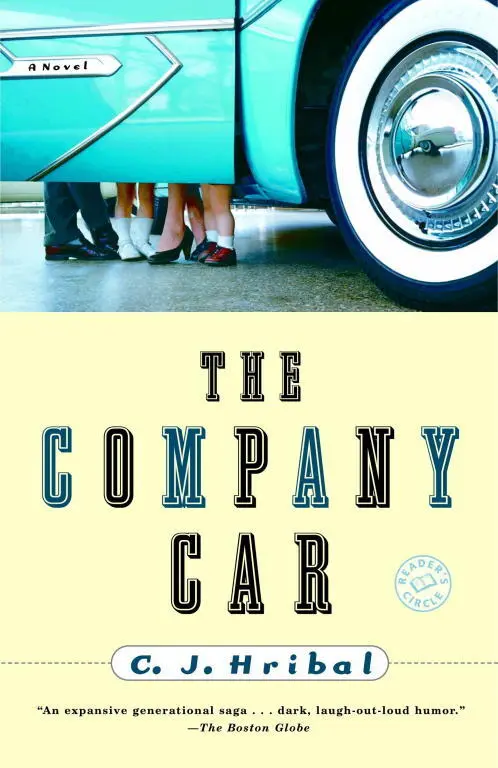
- Название:The Company Car
- Автор:
- Издательство:Random House
- Жанр:
- Год:2005
- Город:New York
- ISBN:1-58836-468-2
- Рейтинг книги:3 / 5. Голосов: 1
-
Избранное:Добавить в избранное
- Отзывы:
-
Ваша оценка:
The Company Car: краткое содержание, описание и аннотация
Предлагаем к чтению аннотацию, описание, краткое содержание или предисловие (зависит от того, что написал сам автор книги «The Company Car»). Если вы не нашли необходимую информацию о книге — напишите в комментариях, мы постараемся отыскать её.
“Are we there yet?” It’s the time-honored question of kids on a long family car trip—and Emil Czabek’s children are no exception. Yet Em asks himself the same thing as the family travels to celebrate his parents’ fiftieth wedding anniversary, and he wonders if he has escaped their wonderfully bad example.
The midwestern drive is Em’s occasion to recall the Czabek clan’s amazing odyssey, one that sprawls through the second half of the twentieth century. It begins with his parents’ wedding on the TV show It’s Your Marriage, and careens from a suburban house built sideways by a drunken contractor to a farm meant to shelter the Czabeks from a country coming apart. It is the story of Em’s father, Wally—diligent, distant, hard-drinking—and his attempts to please, protect, or simply placate his nervous, restless, and sensual wife, Susan, all in plain sight of the children they can’t seem to stop having.
As the tumultuous decades merge in his mind like the cars on the highway, Em must decide whether he should take away his parents’ autonomy and place them in the Heartland Home for the Elders. Beside him, his wife, Dorie, a woman who has run both a triathlon and for public office, makes him question what he’s inherited and whether he himself has become the responsible spouse of a drifting partner—especially since she’s packing a diaphragm and he’s had a vasectomy.
Wildly comic and wrenchingly poignant, The Company Car is a special achievement, a book that drives through territory John Irving and Jonathan Franzen have made popular to arrive at a stunning destination all its own.
The Company Car — читать онлайн бесплатно полную книгу (весь текст) целиком
Ниже представлен текст книги, разбитый по страницам. Система сохранения места последней прочитанной страницы, позволяет с удобством читать онлайн бесплатно книгу «The Company Car», без необходимости каждый раз заново искать на чём Вы остановились. Поставьте закладку, и сможете в любой момент перейти на страницу, на которой закончили чтение.
Интервал:
Закладка:
It wasn’t until our father launched into the Green Acres theme song nearing Oshkosh that we actually heard our mother weeping, and we probably wouldn’t have noticed that had our mother not done the unthinkable. She asked our father to stop singing. “Wally,” she wailed, “would you please stop that infernal racket?” Our mother? Asking our father to stop singing? The man who wooed her with song? Telling him to shut up? This was a breach. Our father was trying to inject some levity into the drive. He was trying to calm Cinderella. Granted, he’d gone about it all wrong, teasing her and spewing out facts as we drove—“That’s the Evinrude plant,” he’d said a while ago as we passed a building that looked like the world’s largest pole shed. “Our boat’s motor came from there”—but at least he was trying. He just wasn’t particularly sensitive.
That was when we heard it. Quiet sobbing from our mother. Who knew how long she’d been holding a tissue up to her eyes, staring out her window, sniffling as the scenery passed by?
“What?” our father asked. “What? I was just—”
“She doesn’t want to hear that song, Wally, and neither do I.” Our mother blew her nose, and I thought that was going to be the end of it. But then our father did a curious thing. He drove in silence for a bit, then he began to sing, very quietly, “I’ve Got Sixpence.” The song is meant to be a round, and our father’s sotto voce “jolly jolly sixpence” was meant to entice us into singing along. Our father no doubt thought he was teasing our mother, but this was a rebellion, boys against the girls (the ratio in the car was two to one in favor of the males), and if we joined in the singing it would soon become a crashing, crescendoing wave of rebuke. Gleeful and naÏve on our part, more pointed on our father’s, the message would be “Lighten up, we win.” Of course, we didn’t know this at the time. Or we thought it wasn’t the battle it actually was. We were just teasing, too. No cares had we. Poor wife, poor wife.
We didn’t realize the seriousness of the game until our mother screamed, “What are you teaching them? The same irresponsibility that you enjoy, is that what you want?” She was huddled up against the side door weeping, “It’s over, it’s all over”—just has she had done a dozen years ago when they drove away from San Diego, but none of us knew that. She was weeping so hard our father had to pull off the road to console her. “It’s over,” our mother kept repeating as she wept. “It’s over, it’s all over.”
Once again our father hadn’t a clue. “What?” he asked. “What in Sam Hill is all over?”
Between bouts of weeping our mother sobbed, “E-e-e-e-e-ver-ry-y-y-y-thi-i-i-i-ing.”
Our father was exasperated. “Everything is not all over. Everything is just beginning. You’ll see, honey, you’ll see.”
“Yeah, Dad, everything is all over,” said Cinderella. “Why don’t you just turn this beast around and head us back home?”
Our father’s backhand caught her flush on the cheek. “Another county heard from, and yet we didn’t hear a thing.” And with that he put the station wagon back into drive.
In the wayback, you always see most clearly where you’ve been. We knew why we were moving, and it wasn’t just that Halloween party, the Duckwa marriage exploding in our upstairs hallway. It wasn’t just Mr. Plewa’s suicide, either. It was everything. Our father’s frustrations, his desire for more space, his fear of what the world was becoming. Our parents tried to pretend that none of this mattered, but it did. The summer before their Halloween party, Richard Speck had murdered eight student nurses in a Chicago dormitory. He’d used a knife, and he would have gotten away with it except a ninth nurse had managed to escape. The night was no longer safe. The streets were no longer safe. There were people out there loaded up on drugs and armed with knives and they meant to do you harm. Cities were burning, emptying out. The suburbs were getting more crowded, and who knew who these new people were? And people in those suburbs were leaving for suburbs further out, one ring around another, where the houses were newer, the garages more spacious, where the backyards rolled into fences and the treeless streets curved from one bulbous cul-de-sac into another. Our parents said the hell with all that. The steady progression of sprawl sprawling—it solved nothing. So they leapfrogged all of it, quitting their suburb of Chicago, where there were drugs and divorces and even suicides, where the last lot had been purchased and built on two or three years previous, and quite literally bought the farm.
This made our parents back-to-the-landers and put them unknowingly at the vanguard of a hippie movement they vehemently disdained. It fact it was partly because of the hippies—“Hippies, yippies, zippies, whatever the hell they call themselves, I don’t like ’em,” pronounced our father—that we were moving. “Their free love stuff is probably what got Patty Duckwa in trouble,” said our mother. Given the trouble Patty had gotten into, I wondered how you could call it free. She had been sent away to have her baby in the middle of May. When she came back she was puffy in the face and sullen. She didn’t hang out in the backyard anymore. She was gone a lot at night. We could hear her and her mother screaming at each other all through June on hot nights. “You can’t make me, you can’t make me” was Patty’s refrain. Mrs. Duckwa’s was “You little tramp, as long as you live in my house—” Then Patty would yell, “Dry up and blow away, you old biddy!” and there’d be a slap, then silence, then the banging of the screen door as Patty went out once again to join her friends, who came to pick her up in a Volkswagen van. We didn’t see her much anymore, just witnessed the fury of her comings and goings.
We moved in July, midway through the Summer of Love, though you wouldn’t have known it by us. Like lots of families that got started in the fifties, we missed the sixties entirely. Or at least our parents were hell-bent on our avoiding it. We were just old enough to know something was going on, but too naÏve to know we wanted to be a part of it. Sarah was the exception, but at fourteen, what did she know, really? She tried, of course—a few years earlier she and her friends got taxis to take them into the Loop to see A Hard Day’s Night and Help! when they first came out—but Cinderella was a compliant soul, and her heart wasn’t in it. Later, when Yellow Submarine came out, we were already in Wisconsin. Sarah went to visit friends in Elmhurst, and for old times’ sake they took a taxi to the new Oak Brook Shopping Center. They could just as easily have ridden bikes. “I rode my bike to the revolution”—that doesn’t sound so hot in comparison with Watts burning, or marching for civil rights or to protest the war, or to espouse free love and “contemplating your navel,” as our father put it. No Molotov cocktails for Sarah. No storming the barricades, no protests, no tear gas, nothing like that. She ironed her hair flat as a sheet and let it hang down one side of her face like a curtain. “Veronica Lake,” said our father. “Except her hair was wavy.” Sarah cut her skirts as short as the nuns would allow (Sister PMS—Peter Mary Stephen—checked with a ruler when the girls entered school), she wore paisley or giant daisy jumpers, and sometimes she didn’t wear hose to church, but that and lipping off were the extent of her rebellion.
But why single out Cinderella? Sure, she was the oldest, seven already when the decade started, but by most people’s accounts the decade didn’t really start for a few years after that. So it’s probably wrong to put everything on her, as though she could lightning-rod the decade for us, let us know it was coming, and ground the rest of us. At fourteen she was with the crowd of quiet, “good kids”—what Nixon might have called the silent majority of teens—who kept their rebellions to themselves, who didn’t make public nuisances of themselves.
Читать дальшеИнтервал:
Закладка:
Похожие книги на «The Company Car»
Представляем Вашему вниманию похожие книги на «The Company Car» списком для выбора. Мы отобрали схожую по названию и смыслу литературу в надежде предоставить читателям больше вариантов отыскать новые, интересные, ещё непрочитанные произведения.







Обсуждение, отзывы о книге «The Company Car» и просто собственные мнения читателей. Оставьте ваши комментарии, напишите, что Вы думаете о произведении, его смысле или главных героях. Укажите что конкретно понравилось, а что нет, и почему Вы так считаете.