C Hribal - The Company Car
Здесь есть возможность читать онлайн «C Hribal - The Company Car» весь текст электронной книги совершенно бесплатно (целиком полную версию без сокращений). В некоторых случаях можно слушать аудио, скачать через торрент в формате fb2 и присутствует краткое содержание. Город: New York, Год выпуска: 2005, ISBN: 2005, Издательство: Random House, Жанр: Современная проза, на английском языке. Описание произведения, (предисловие) а так же отзывы посетителей доступны на портале библиотеки ЛибКат.
- Название:The Company Car
- Автор:
- Издательство:Random House
- Жанр:
- Год:2005
- Город:New York
- ISBN:1-58836-468-2
- Рейтинг книги:3 / 5. Голосов: 1
-
Избранное:Добавить в избранное
- Отзывы:
-
Ваша оценка:
The Company Car: краткое содержание, описание и аннотация
Предлагаем к чтению аннотацию, описание, краткое содержание или предисловие (зависит от того, что написал сам автор книги «The Company Car»). Если вы не нашли необходимую информацию о книге — напишите в комментариях, мы постараемся отыскать её.
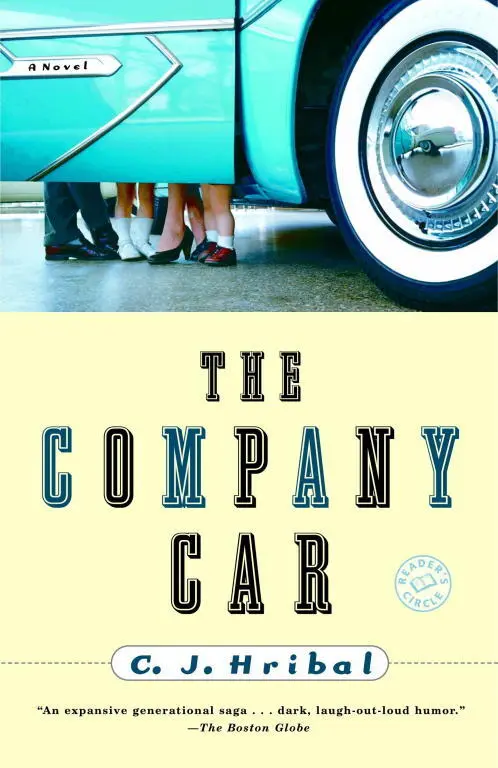
“Are we there yet?” It’s the time-honored question of kids on a long family car trip—and Emil Czabek’s children are no exception. Yet Em asks himself the same thing as the family travels to celebrate his parents’ fiftieth wedding anniversary, and he wonders if he has escaped their wonderfully bad example.
The midwestern drive is Em’s occasion to recall the Czabek clan’s amazing odyssey, one that sprawls through the second half of the twentieth century. It begins with his parents’ wedding on the TV show It’s Your Marriage, and careens from a suburban house built sideways by a drunken contractor to a farm meant to shelter the Czabeks from a country coming apart. It is the story of Em’s father, Wally—diligent, distant, hard-drinking—and his attempts to please, protect, or simply placate his nervous, restless, and sensual wife, Susan, all in plain sight of the children they can’t seem to stop having.
As the tumultuous decades merge in his mind like the cars on the highway, Em must decide whether he should take away his parents’ autonomy and place them in the Heartland Home for the Elders. Beside him, his wife, Dorie, a woman who has run both a triathlon and for public office, makes him question what he’s inherited and whether he himself has become the responsible spouse of a drifting partner—especially since she’s packing a diaphragm and he’s had a vasectomy.
Wildly comic and wrenchingly poignant, The Company Car is a special achievement, a book that drives through territory John Irving and Jonathan Franzen have made popular to arrive at a stunning destination all its own.
The Company Car — читать онлайн бесплатно полную книгу (весь текст) целиком
Ниже представлен текст книги, разбитый по страницам. Система сохранения места последней прочитанной страницы, позволяет с удобством читать онлайн бесплатно книгу «The Company Car», без необходимости каждый раз заново искать на чём Вы остановились. Поставьте закладку, и сможете в любой момент перейти на страницу, на которой закончили чтение.
Интервал:
Закладка:
Only not just any military. They joined the Marines.
“Why’d we do that?” asks Ike.
“Which—walk across a windshield at sixty miles an hour or join the Marines?”
“Either.”
“You think it matters now?”
“No, I was just wondering.”
“Well,” says Wally Jr., “I’m sure we had a fucking good reason.”
“And what reason was that?”
Wally Jr. laughs. “I forget. But it was a fucking good one, I know that.”
If you pressed them on it, they would tell you they joined the Marines for the bucks, and because there was nothing to do in Augsbury. While both those reasons were true, particularly the latter—how else do you explain naked windshield walking as a participatory sport?—it wasn’t just that. Like our father, Ike had musical talent up the wazoo, but he turned down scholarship offers from two or three music schools—granted, none of them was Juilliard, but they all would have paid for college—to play in the Marine Corps Band. Which would have been fine had he not forgotten that the Marine Corps Band was a combat unit, too. And Wally Jr. after high school had a decent job welding at the Neenah Foundry. It was hot, dirty work, but it paid well. So what was the real reason?
Well, patriotism, of course, but Robert Aaron’s wife, Audrey, who being outside the family could see us more clearly than we saw ourselves, laughed when she heard that. “They’re trying to outdo your father, you nitwits. He was in the Navy and the Coast Guard. He was in WW Two and Korea. And it’s not just them. It’s all of you. All of you boys think you’re the black sheep—you know that? Every family has at least one black sheep, and each of you thinks you’re it. And you know what? None of you is. You’re all too busy pleasing your mother”— she looked at me—“or your father”—she looked at her husband—“to be a black sheep. Even when you’re not pleasing them you’re still worried about it. I’ll tell you something, you numbnuts—black sheep don’t feel guilty. That’s why they’re black sheep.”
We felt abashed. I had to admit I liked Audrey. She was one of those big, no-nonsense, rutabaga-like midwestern girls, the kind who take their men in hand and mold them into the men they want their husbands to be.
What a pathetic, nervous, striving pack of siblings were we. “Look at me, look at me!” Flailing our arms in the only ways we knew how—getting ourselves or our girlfriends pregnant, marrying early, running off to join the Marines. That’ll show them. They’ll pay attention to me now. Pay attention to what? Show them what?
Ike toes Ernie on the arm. “Don’t you think we should tell Cindy?” Cindy—Ernie’s wife. Like most spouses, she takes a dim view of her mate’s excesses. In the Czabek family, that covers just about all of us.
Dorie at the roof edge: “She told me she was going to bed, she was pooped.”
Wally Jr.: “How pooped can she be? She doesn’t have any kids.”
“She’s pregnant.”
“I’ll be damned.” Wally Jr. rolls to a cooler and opens a Mountain Dew, the only thing he’ll drink now that he’s on the wagon. “Kids wear you out even when they’re still inside you? I thought they had to be running amok outside to do that.”
“We wore out Mom, didn’t we?” Looking down, I see a bald spot is taking root on the back of Wally Jr.’s head.
“Speaking of kids, your own are way hungry. I came up for hot dogs.” Ike squats by Ernie. “This puppy all right?”
Wally Jr. glugs down his Mountain Dew. “Just counting stars in his sleep.”
Dorie announces that she and I will bring down the hot dogs, make sure the kids are fed. Then she turns to me. “What do you say, hon? You want to come along?”
The history of our marriage writ small: Dorie decides what she and I are going to do, then asks if I want to come along. It’s petty of me, I know, but I don’t much want to be alone with Dorie right now, even for only the few minutes it would take to walk down to the woods. “No thanks,” I say. “If you want company take Audrey. And Jake and Jennifer.” Jake, four, is Audrey and Robert Aaron’s youngest, a surprise baby they had after they thought they’d stopped having kids. Jennifer, twenty-two and engaged, is their oldest. I heard about her conception the same night Robert Aaron did, up on this very roof. Audrey and Robert Aaron were just dating then. Jennifer’s wedding will be in September.
Dorie goes down the aerial tower a few steps. I love the way her biceps jump, the way her forearms flex. For a second I reconsider. Her head even with my knees, she looks up and grins. “You sure you don’t want to come along?”
I do but shake my head. She gets this look on her face. I’m being petulant. She knows it, I know it. “Suit yourself,” she says (translation: “fuck you”), and down she goes.
Wally Jr. shakes his head. “Man, what is wrong with you?”
“What? We were having a powwow here, weren’t we?”
“Right. Your wife wants to take a walk in the dark with you, batta-bing, batta-bing, and you turn her down?”
“Another county heard from. Can we start or not?”
“Cinderella’s still out with her Prince,” Robert Aaron says. Her Prince—that’s what we call her beau, Mel. Owns a catering firm, seems like a nice enough guy, but like Meg’s beau, makes himself scarce around us. Cinderella and the Prince left at the end of the croquet game.
“So we just need to get Sleeping Beauty here awake and we’ve got everybody,” says Ike.
“I can handle that.” Wally Jr. pffssst s open another Dew and pours it on Ernie’s face. Ernie comes to with a start, his chest heaving up from the deck like those of patients in hospital shows when they apply the heart resuscitation paddles.
“Ow!” he says, sitting up. “I think I broke my butt!”
Wally Jr. keeps his arm moving in a spiral. Mountain Dew splashes off Ernie’s head. “Another county heard from,” says Wally Jr. He sounds remarkably like our father.
Piled like cordwood in the wayback and beating on each other as only kids in cramped confines can do without drawing the wrath of their parents, we had not noticed the slow dissolution of our mother from stoic wife and mother to weeping, distraught woman keening over her loss. Such was the hubbub of chatter that it took some miles before any of us heard her. The center of our attention had been Cinderella, who unlike her namesake was bereaved about being yanked away from her ball. “My life is over,” she kept repeating. “My life is over.”
“Your life is not over,” said our father irritably. “It’s just beginning in a new place. You’ll make new friends. You’ll have a ball.” Stony silence from Cinderella. “Look, you’d have to make new friends regardless of where you went to high school.”
“I’d at least know somebody !” Cinderella protested, then went back to muttering about hick towns and Hooterville Junction. Green Acres and Petticoat Junction were both popular shows then, and the idea of moving into a sitcom seemed to please only our father. Myself, I was curious about the girls in the water tower, and what you might see there—they left everything to your imagination in the opening credits of Petticoat Junction. I couldn’t wait to get there.
But then, like our father, I was thinking about only myself. We were leaving our friends, sure, but we were all in the same boat on that score, and we were all close enough in age that we could keep each other company if worst came to worst. Except for Cinderella, who was too busy experimenting with hemlines and makeup and huddling with our mother over deep, dark secrets to have time to play with us. Cinderella’s feelings about the move probably ran parallel to our mother’s, only our mother had put on a happy face while we were packing and Cinderella had balked at every step, even claiming, “You don’t love me,” as though putting everything we owned into a Mayflower truck was an exercise designed to prove exactly that.
Читать дальшеИнтервал:
Закладка:
Похожие книги на «The Company Car»
Представляем Вашему вниманию похожие книги на «The Company Car» списком для выбора. Мы отобрали схожую по названию и смыслу литературу в надежде предоставить читателям больше вариантов отыскать новые, интересные, ещё непрочитанные произведения.





Обсуждение, отзывы о книге «The Company Car» и просто собственные мнения читателей. Оставьте ваши комментарии, напишите, что Вы думаете о произведении, его смысле или главных героях. Укажите что конкретно понравилось, а что нет, и почему Вы так считаете.