J.G. Ballard - Cocaine Nights
Здесь есть возможность читать онлайн «J.G. Ballard - Cocaine Nights» — ознакомительный отрывок электронной книги совершенно бесплатно, а после прочтения отрывка купить полную версию. В некоторых случаях можно слушать аудио, скачать через торрент в формате fb2 и присутствует краткое содержание. Жанр: Современная проза, на английском языке. Описание произведения, (предисловие) а так же отзывы посетителей доступны на портале библиотеки ЛибКат.
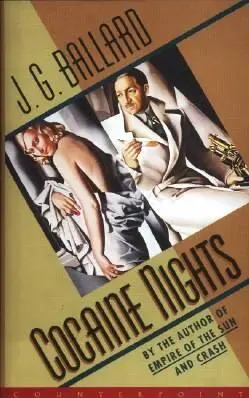
- Название:Cocaine Nights
- Автор:
- Жанр:
- Год:неизвестен
- ISBN:нет данных
- Рейтинг книги:5 / 5. Голосов: 1
-
Избранное:Добавить в избранное
- Отзывы:
-
Ваша оценка:
Cocaine Nights: краткое содержание, описание и аннотация
Предлагаем к чтению аннотацию, описание, краткое содержание или предисловие (зависит от того, что написал сам автор книги «Cocaine Nights»). Если вы не нашли необходимую информацию о книге — напишите в комментариях, мы постараемся отыскать её.
Outward appearances suggest the wholesale adoption of a new ethos of high-spirited, well-controlled collective exuberance. But there’s the matter of the fire: The house and household of an aged, wealthy industrialist has gone up in flames, claiming five lives, while virtually the entire town stood and watched. There’s the matter of the petty crime, the burglaries, muggings, and auto thefts which have begun to nibble away at the edges of Estrella Del Mar’s security despite the guardhouses and surveillance cameras. There’s the matter of the new, flourishing trade in drugs and pornography. And there’s the matter of Frank Prentice, who sits in Marbella jail awaiting trial for arson and five counts of murder, and who, despite being clearly innocent, has happily confessed.
It is up to Charles Prentice, Frank’s brother, to peel away the onionlike layers of denial and deceit which hide the rather ugly truth about this seaside idyll, its residents, and the horrific crime which brought him here. But as is usually the case in a J.G. Ballard book, the truth comes with a price tag attached, and likely without any easing of discomfort for his principal characters.
Cocaine Nights marks a partial return on Ballard’s part to the provocative, highly-successful mid-career methodology employed in novels such as Crash and High Rise: after establishing himself as a science fiction guru in the 1960s, Ballard stylistically shifted gears towards an unnerving, futuristic variant on social realism in the 1970s. Both Crash and High Rise were what-if novels, posing questions as to what the likely results would be if our collective fascination with such things as speed, violence, status, power, and sex were carried just a little bit further: How insane, how brutal could our world become if we really cut loose?
Cocaine Nights asks a question better suited to the ’90s, the age of gated communities and infrared home security systems: Does absolute security guarantee isolation and cultural death? Conversely, is a measure of crime an essential ingredient in a vibrant, living, properly functioning social system? Is it true, as a character asserts, that “Crime and creativity go together, always have done,” and that “total security is a disease of deprivation”? Suffice to say that the answers presented in Nights will be anathema to moral absolutists; the world of Ballard’s fiction, like life in the hyperkinetic, relativistic 1990s, abounds with uncomfortable grey areas.
On the surface, Cocaine Nights is a whodunit and a race against time, but as it proceeds – and as preconceived conceptions of good and evil begin to dissolve – it evolves into a thoughtful, faintly frightening look at under-examined aspects of 1990s western society. As is his wont, Ballard confronts his readers with some faintly outlandish hypotheses unlikely to be embraced by many, but which nonetheless serve to provoke both thought and a bit of paranoia; it’s a method that Ballard has developed and refined on his own, and as usual, it propels his novel along marvellously.
Cocaine Nights doesn’t have either the broad sweep or brute impact of the landmark Crash, but it retains enough social relevance and low-key creepiness to more than satisfy Ballardphiles. As is often the case in Ballard’s alternate reality, it’s a given that his most appealing, human characters turn out to be the most twisted, and that even the most normal of events turn out to be governed by a perverse, malformed logic; that this logic turns out to be grounded in sound sociological and psychological principles is its most horrific feature.
David B. Livingstone
Cocaine Nights — читать онлайн ознакомительный отрывок
Ниже представлен текст книги, разбитый по страницам. Система сохранения места последней прочитанной страницы, позволяет с удобством читать онлайн бесплатно книгу «Cocaine Nights», без необходимости каждый раз заново искать на чём Вы остановились. Поставьте закладку, и сможете в любой момент перейти на страницу, на которой закончили чтение.
Интервал:
Закладка:
'Of course. His confession is so out of character. Inevitably, as the older brother you hold yourself responsible. Do sit down, and I'll bring you some mineral water.'
He excused himself, smoothing his silver hair in a mirror as he set off for the kitchen. I tried to visualize him living in this airless villa with the sedated Bibi Jansen, a curious menage even by the standards of Estrella de Mar. There was something almost feminine about Sanger, a constant attentiveness that might have reassured the dazed drug-addict and persuaded her to invite him into her bed. I imagined him making love with all the unobtrusiveness of a ghost.
At the same time there was an evasive strain running through him that roused my suspicions. Sanger, too, had a motive for setting fire to the Hollinger house-the foetus in Bibi's womb. The discovery that he had made one of his patients pregnant would have led to him being struck from the medical register.
Yet he had clearly cared for the young woman, and had mourned her in his ambiguous way, braving the hostile crowd at the funeral and then flushing with embarrassment when I caught him alone by the headstone. Vanity and self-reproach shared the same suede glove, and despite myself I wondered if he had selected the exact shade of silver marble to match his suit and hair.
I searched for a telephone, eager to call a taxi. The excitements of chasing Crawford around Estrella de Mar, the discovery of the keys, and my duel with the hang-glider had left me ready for even more action. I walked to the garden windows and peered down at the drained pool. Someone had thrown a can of yellow paint over the wall, and a canary sunburst leaked towards the drainage vent.
'Another abstract painting,' I remarked to Sanger when he returned with the mineral water. 'I can understand why you're moving.'
'There's a time to stay and a time to leave.' He shrugged, resigned to his own rationalizations. 'I own some property in the Costasol development along the coast, a few bungalows I let out in the summer. I've decided to take one of them for myself.'
'The Residencia Costasol? It's very quiet…'
'Of course, practically somnambulistic. But that's what I'm looking for. The security arrangements are more advanced than anywhere else on the coast.' Sanger opened a window and listened to the evening sounds of Estrella de Mar, like an exiled political leader resigned to his heavily-guarded villa and the company of his books. 'I won't say I've been driven out, but I'm looking forward to a quieter life.'
'Will you practise there? Or are the people of the pueblos beyond psychiatric help?'
'That's a little unfair.' Sanger waited for me to return to the armchair. 'No one would ever dare to retire if dozing in the sun was forbidden.'
I sipped the tepid water, thinking of Frank's bracing malts. 'Strictly speaking, Doctor, few of the people in the Residencia Costasol are retired. They're mostly in their forties and fifties.'
'Everything comes sooner these days. The future rushes towards us like a tennis player charging the net. People in the new professions peak in their late thirties. As it happens, I've a fair number of Costasol patients. It makes sense to move now that my practice here has dried up.'
'So the residents of Estrella de Mar are made of sturdier stuff? Few conflicts or psychic stresses?'
'Very few. They're too busy with their theatre clubs and choral societies. One needs a great deal of idle time to feel really sorry for oneself. There's something special in the air here – and I'm not thinking of your hang-glider.'
'But you do mean Bobby Crawford?'
Sanger stared at the rim of his glass, as if searching for his reflection in the crazed surface. 'Crawford, yes. He's a remarkable man, as you've seen. He has certain dangerous qualities, of which he isn't really aware. He excites people, and stirs them in ways they don't understand. But on the whole he's a force for good. He's put so much energy into Estrella de Mar, though not everyone can stand the pace. Some have to retreat to the sidelines.'
'Someone like Bibi Jansen?'
Sanger turned to stare at the patio, where a deckchair waited by the pool. Here, I guessed, the young Swede had relaxed in the sun under her psychiatrist's melancholy and wistful gaze. At the mention of her name he seemed to slip into a shallow reverie of happier times.
'Bibi… I was very fond of her. Before she was taken in by the Hollingers she would often ring my door-bell and ask if she could stay with me. I'd treated her for one addiction after another and always let her in. It was a chance to wean her from everything that was crippling her mind. She knew the beach bars were too much for her to take. Crawford and his friends were testing her to destruction, as if she were a Piaf or Billie Holiday with a huge talent to sustain her. In fact she was desperately vulnerable.'
'Everyone seems to have liked her – I saw that at the funeral.'
'The funeral?' Sanger re-focused his eyes, returning himself to the present. 'Not one of Andersson's better days. A sweet boy, the last of the hippies who found that he was a talented mechanic. She reminded him of his teenage years, backpacking in Nepal. He wanted Bibi to remain a child, living on the beach like a gypsy.'
'He felt she belonged there. Perhaps the world needs a few people ready to burn themselves out. By the way, Andersson thinks you were the father of her child.'
Sanger smoothed his silver hair with the back of his hand. 'So does everyone else at Estrella de Mar. I tried to protect her, but we were never lovers. Sadly, I don't think I ever touched her.'
'They say you sleep with your patients.'
'But, Mr Prentice…' Sanger seemed surprised by my naivete. 'My patients are my friends. I came here six years ago when my wife died. The women I met asked me for help-they were drinking too much, addicted to sleeping pills but never getting any real sleep. Some of them had travelled to the far side of boredom. I went after them and brought them back, and tried to give their lives some meaning. For one or two, that meant a personal involvement. With others – Bibi, and the Hollingers' niece – I was no more than a guide and counsellor.'
'Anne Hollinger?' I grimaced at the memory of the gutted bedroom. 'You didn't bring her back – she was a heroin addict.'
'Absolutely not.' Sanger spoke sharply, as if correcting an incompetent junior. 'She was completely clear. One of the Clinic's few successes, I can assure you.'
'Doctor, she was shooting up at the time of the fire. They found her in the bathroom with a needle in her arm.'
Sanger raised his pale hands to silence me. 'Mr Prentice, you rush to judgement. Anne Hollinger was a diabetic. What she injected into herself was not heroin, but insulin. Her death was tragedy enough without further stigmatizing her 'I'm sorry. For some reason I took it for granted. Paula Hamilton and I visited the house with Cabrera. She assumed that Anne had relapsed.'
'Dr Hamilton no longer treated her. There was a coldness between the two women, which I can't explain. Anne's diabetes was diagnosed in London six months ago.' Sanger stared bleakly at the sun setting above the miniature garden, with its drained pool like a sunken altar. 'After all she endured, she had to die with Bibi in that senseless fire. It's still hard to believe that it ever happened.'
'And even harder to believe that Frank was behind it?'
'Impossible.' Sanger spoke in measured tones, watching me for my response. 'Frank is the last person in Estrella de Mar who could have started that fire. He loved ambiguity, and sentences that end in question marks. The fire was too definite an act, it stops all further discussion of anything. I knew Frank well – we played bridge together at the Club Nautico in the early days. Tell me, did Frank steal as a child?'
Читать дальшеИнтервал:
Закладка:
Похожие книги на «Cocaine Nights»
Представляем Вашему вниманию похожие книги на «Cocaine Nights» списком для выбора. Мы отобрали схожую по названию и смыслу литературу в надежде предоставить читателям больше вариантов отыскать новые, интересные, ещё непрочитанные произведения.











Обсуждение, отзывы о книге «Cocaine Nights» и просто собственные мнения читателей. Оставьте ваши комментарии, напишите, что Вы думаете о произведении, его смысле или главных героях. Укажите что конкретно понравилось, а что нет, и почему Вы так считаете.