J.G. Ballard - Cocaine Nights
Здесь есть возможность читать онлайн «J.G. Ballard - Cocaine Nights» — ознакомительный отрывок электронной книги совершенно бесплатно, а после прочтения отрывка купить полную версию. В некоторых случаях можно слушать аудио, скачать через торрент в формате fb2 и присутствует краткое содержание. Жанр: Современная проза, на английском языке. Описание произведения, (предисловие) а так же отзывы посетителей доступны на портале библиотеки ЛибКат.
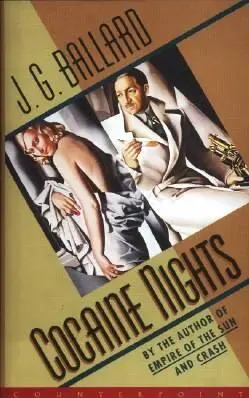
- Название:Cocaine Nights
- Автор:
- Жанр:
- Год:неизвестен
- ISBN:нет данных
- Рейтинг книги:5 / 5. Голосов: 1
-
Избранное:Добавить в избранное
- Отзывы:
-
Ваша оценка:
Cocaine Nights: краткое содержание, описание и аннотация
Предлагаем к чтению аннотацию, описание, краткое содержание или предисловие (зависит от того, что написал сам автор книги «Cocaine Nights»). Если вы не нашли необходимую информацию о книге — напишите в комментариях, мы постараемся отыскать её.
Outward appearances suggest the wholesale adoption of a new ethos of high-spirited, well-controlled collective exuberance. But there’s the matter of the fire: The house and household of an aged, wealthy industrialist has gone up in flames, claiming five lives, while virtually the entire town stood and watched. There’s the matter of the petty crime, the burglaries, muggings, and auto thefts which have begun to nibble away at the edges of Estrella Del Mar’s security despite the guardhouses and surveillance cameras. There’s the matter of the new, flourishing trade in drugs and pornography. And there’s the matter of Frank Prentice, who sits in Marbella jail awaiting trial for arson and five counts of murder, and who, despite being clearly innocent, has happily confessed.
It is up to Charles Prentice, Frank’s brother, to peel away the onionlike layers of denial and deceit which hide the rather ugly truth about this seaside idyll, its residents, and the horrific crime which brought him here. But as is usually the case in a J.G. Ballard book, the truth comes with a price tag attached, and likely without any easing of discomfort for his principal characters.
Cocaine Nights marks a partial return on Ballard’s part to the provocative, highly-successful mid-career methodology employed in novels such as Crash and High Rise: after establishing himself as a science fiction guru in the 1960s, Ballard stylistically shifted gears towards an unnerving, futuristic variant on social realism in the 1970s. Both Crash and High Rise were what-if novels, posing questions as to what the likely results would be if our collective fascination with such things as speed, violence, status, power, and sex were carried just a little bit further: How insane, how brutal could our world become if we really cut loose?
Cocaine Nights asks a question better suited to the ’90s, the age of gated communities and infrared home security systems: Does absolute security guarantee isolation and cultural death? Conversely, is a measure of crime an essential ingredient in a vibrant, living, properly functioning social system? Is it true, as a character asserts, that “Crime and creativity go together, always have done,” and that “total security is a disease of deprivation”? Suffice to say that the answers presented in Nights will be anathema to moral absolutists; the world of Ballard’s fiction, like life in the hyperkinetic, relativistic 1990s, abounds with uncomfortable grey areas.
On the surface, Cocaine Nights is a whodunit and a race against time, but as it proceeds – and as preconceived conceptions of good and evil begin to dissolve – it evolves into a thoughtful, faintly frightening look at under-examined aspects of 1990s western society. As is his wont, Ballard confronts his readers with some faintly outlandish hypotheses unlikely to be embraced by many, but which nonetheless serve to provoke both thought and a bit of paranoia; it’s a method that Ballard has developed and refined on his own, and as usual, it propels his novel along marvellously.
Cocaine Nights doesn’t have either the broad sweep or brute impact of the landmark Crash, but it retains enough social relevance and low-key creepiness to more than satisfy Ballardphiles. As is often the case in Ballard’s alternate reality, it’s a given that his most appealing, human characters turn out to be the most twisted, and that even the most normal of events turn out to be governed by a perverse, malformed logic; that this logic turns out to be grounded in sound sociological and psychological principles is its most horrific feature.
David B. Livingstone
Cocaine Nights — читать онлайн ознакомительный отрывок
Ниже представлен текст книги, разбитый по страницам. Система сохранения места последней прочитанной страницы, позволяет с удобством читать онлайн бесплатно книгу «Cocaine Nights», без необходимости каждый раз заново искать на чём Вы остановились. Поставьте закладку, и сможете в любой момент перейти на страницу, на которой закончили чтение.
Интервал:
Закладка:
Towards the end he parked again in the Plaza Iglesias, left the Saab and plunged into the crowds that overflowed the pavements outside the galleries and bookstores. Ever-smiling, his face as open as a friendly adolescent's, he seemed popular with everyone he met. Storekeepers offered him a pastis, shop assistants were happy to flirt with him, people rose from their café tables to banter and jest. As always I was struck by how generous he was, giving of himself as if drawing on a limitless source of warmth and goodwill.
Yet just as freely he. stole and shoplifted. I watched him pocket an atomizer from a perfumery on the Calle Molina, then skip along the sidewalk, spraying scent at the feral cats.
He supervised a streetwalker's make-up in the Gallería Don Carlos, examining her eyeliner with the seriousness of a beauty specialist, then slipped past her into the nearby bodega and helped himself to two bottles of Fundador that he placed between the feet of the winos dozing in a nearby alley. With the deftness of a conjuror he spirited a pair of crocodile shoes from a display stand under the nose of the store's manager, and minutes later emerged from a busy jewellery shop with a small diamond on his little finger.
I assumed that he was unaware of my presence twenty yards behind him, but as we crossed the gardens of the Plaza Iglesias he waved to Sonny Gardner, who stood on the steps of the Anglican church, mobile phone to his plump lips. The sometime barman and sail-rigger nodded to me when I walked past him, and I realized that others had probably joined Crawford on his evening crime spree.
Returning to the battered Saab, Crawford waited for me to take the wheel of the Citroen and start the overheated engine. Tired of the town and its tourist crowds, he left the plaza and drove past the last of the shops towards the residential streets on the wooded slopes below the Hollinger mansion. He led me in and out of the palm-lined roads, always keeping me in sight, and I wondered if he intended to break into one of the villas.
Then, as we circled the same traffic island for the third time, he suddenly accelerated away from me, lapped the Citroen and sat on my tail before swerving off into the maze of avenues. His horn sounded a series of cheery toots that faded across the hillside, the friendliest of goodbyes.
Twenty minutes later I found the Saab outside the drive of a large, half-timbered villa two hundred yards from the gates of the Hollinger estate. Beyond the high walls and security cameras an elderly woman watched me from an upstairs window. Crawford, I decided, had caught a lift from a passing driver, and the inspirational tour of Estrella de Mar had ended for the day.
I walked over to the Saab and gazed at its battered bodywork and by-passed ignition system. Crawford's fingerprints would be all over the vehicle, but I was sure that the owner would not report the theft to the Guardia Civil. As for the volunteer police force, its main function seemed to be the preservation of the existing criminal order, rather than the tracking down of miscreants. Twice during Crawford's jaunt around Estrella de Mar the police patrol's Range Rovers had provided him with an escort and kept an eye on the stolen Saab while he shoplifted in the Plaza Iglesias.
Exhausted by the effort of chasing Crawford, I sat down on the wooden bench beside a nearby bus stop and gazed at the battered car. A few feet from me a flight of stone steps climbed the hillside towards the rocky summit above the Hollinger house. Whether or not by coincidence, Crawford had left the Saab at almost the exact spot where Frank's Jaguar had been found with its incriminating flask of ether and gasoline. It occurred to me that the arsonist had reached the lemon orchard by climbing the steps. On his return, seeing the Jaguar by the bus stop, he had seized the opportunity to implicate its owner by leaving the unused flask on its rear seat.
Consigning the Citroen to the care of the elderly woman's security cameras, I began to mount the worn limestone steps. Centuries older than Estrella de Mar, according to a local guidebook I had read, they led to an observation post constructed during the Napoleonic wars. The perimeter walls of the adjacent villas reduced their width to little more than my shoulders. Beyond the encroaching shrubbery a hang-glider turned in the cloudless sky, the pilot's vizored helmet silhouetted against the rustling canopy.
The last of the villas fell below me as I climbed the final steps to the observation platform. Sitting on the castellated wall, I caught my breath in the cool air. Stretched out beneath me were the peninsular heights of Estrella de Mar. Ten miles to the east the hotel towers of Fuengirola faced the sinking sun, their curtain walls like huge screens waiting for the evening's son et lumiére performance. From the stone platform the ground sloped down to the blackened grove of lemon trees and then to the rear gate and the garage apartment beside the fire-swept house.
I left the platform and walked towards the orchard, searching the stony soil for any trace of the arsonist's footprints. Above my head sounded the leathery flutter of canvas. Curious to see who I was, the glider pilot hovered in the air above me, so close that his booted foot almost touched my head, his vizor masking his eyes. Too distracted to wave to him, I stepped through the charred stumps of the lemon trees, my shoes crushing the flakes of charcoal that covered the ground.
Thirty yards away the Hollingers' chauffeur stood by the gate, his back to the old Bentley in the drive. He watched me in the same fixed and half-threatening way, hands clasped across his chest. He stepped forward as I approached, his boots a few inches from a shallow pit excavated in the soil.
A tag of yellow police tape flew from a wooden stump, and I assumed that it marked the hollow where the arsonist had hidden his incendiary flagons on the night before the fire. As if out of respect, the hang-glider withdrew from the hill-crest, its canvas cracking in the air. Miguel stood at the pit's edge, the calcinated soil crumbling under his feet. Despite his aggressive stance, he was waiting for me to speak to him. Had he, conceivably, caught even the briefest glimpse of the arsonist…?
'Miguel…' I walked up to him, a hand raised in greeting. 'I came to the house with Inspector Cabrera. I'm Frank Prentice's brother. I wanted to talk to you.'
He lowered his eyes and stared at the pit, then turned on his heel and walked back to the gate. He closed it behind him and moved quickly down the steps, shoulders hunched as he disappeared into the garage.
'Miguel…?'
Irritated by the persistent hang-glider, I looked down at my feet. Two silver coins lay in the charcoal-covered soil, pieces of silver presumably intended to express the chauffeur's contempt for the family that had murdered his employers.
I knelt down and prodded the coins with my fountain pen, then realized that I was touching a pair of car keys, linked together by a small metal chain and partly buried in the earth. Without thinking, I accepted that the keys were those of the Bentley, dropped by the chauffeur as he waited for me. I wiped them and brushed away the dirt, ready to return them to Miguel. But the Bentley's engine was turning, vapour rising from the exhaust, and the keys had no doubt been dropped by a member of the police forensic team. I held them in my hand, trying to identify the make of car, but the flat chrome was unmarked. Already I suspected that the keys might belong to the arsonist, lost or forgotten by him when he retrieved the buried flasks.
The hang-glider hovered over my head, its steel guy-ropes singing in the air. The pilot's gloved hands clasped the control bar, as if reining in a winged horse. The craft banked steeply and dived across the orchard, its left wing nearly striking my face.
Читать дальшеИнтервал:
Закладка:
Похожие книги на «Cocaine Nights»
Представляем Вашему вниманию похожие книги на «Cocaine Nights» списком для выбора. Мы отобрали схожую по названию и смыслу литературу в надежде предоставить читателям больше вариантов отыскать новые, интересные, ещё непрочитанные произведения.








Обсуждение, отзывы о книге «Cocaine Nights» и просто собственные мнения читателей. Оставьте ваши комментарии, напишите, что Вы думаете о произведении, его смысле или главных героях. Укажите что конкретно понравилось, а что нет, и почему Вы так считаете.