J.G. Ballard - Cocaine Nights
Здесь есть возможность читать онлайн «J.G. Ballard - Cocaine Nights» — ознакомительный отрывок электронной книги совершенно бесплатно, а после прочтения отрывка купить полную версию. В некоторых случаях можно слушать аудио, скачать через торрент в формате fb2 и присутствует краткое содержание. Жанр: Современная проза, на английском языке. Описание произведения, (предисловие) а так же отзывы посетителей доступны на портале библиотеки ЛибКат.
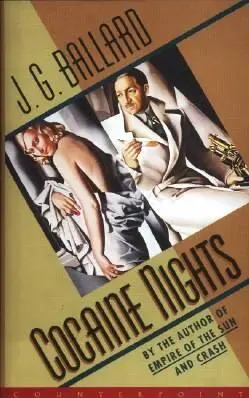
- Название:Cocaine Nights
- Автор:
- Жанр:
- Год:неизвестен
- ISBN:нет данных
- Рейтинг книги:5 / 5. Голосов: 1
-
Избранное:Добавить в избранное
- Отзывы:
-
Ваша оценка:
Cocaine Nights: краткое содержание, описание и аннотация
Предлагаем к чтению аннотацию, описание, краткое содержание или предисловие (зависит от того, что написал сам автор книги «Cocaine Nights»). Если вы не нашли необходимую информацию о книге — напишите в комментариях, мы постараемся отыскать её.
Outward appearances suggest the wholesale adoption of a new ethos of high-spirited, well-controlled collective exuberance. But there’s the matter of the fire: The house and household of an aged, wealthy industrialist has gone up in flames, claiming five lives, while virtually the entire town stood and watched. There’s the matter of the petty crime, the burglaries, muggings, and auto thefts which have begun to nibble away at the edges of Estrella Del Mar’s security despite the guardhouses and surveillance cameras. There’s the matter of the new, flourishing trade in drugs and pornography. And there’s the matter of Frank Prentice, who sits in Marbella jail awaiting trial for arson and five counts of murder, and who, despite being clearly innocent, has happily confessed.
It is up to Charles Prentice, Frank’s brother, to peel away the onionlike layers of denial and deceit which hide the rather ugly truth about this seaside idyll, its residents, and the horrific crime which brought him here. But as is usually the case in a J.G. Ballard book, the truth comes with a price tag attached, and likely without any easing of discomfort for his principal characters.
Cocaine Nights marks a partial return on Ballard’s part to the provocative, highly-successful mid-career methodology employed in novels such as Crash and High Rise: after establishing himself as a science fiction guru in the 1960s, Ballard stylistically shifted gears towards an unnerving, futuristic variant on social realism in the 1970s. Both Crash and High Rise were what-if novels, posing questions as to what the likely results would be if our collective fascination with such things as speed, violence, status, power, and sex were carried just a little bit further: How insane, how brutal could our world become if we really cut loose?
Cocaine Nights asks a question better suited to the ’90s, the age of gated communities and infrared home security systems: Does absolute security guarantee isolation and cultural death? Conversely, is a measure of crime an essential ingredient in a vibrant, living, properly functioning social system? Is it true, as a character asserts, that “Crime and creativity go together, always have done,” and that “total security is a disease of deprivation”? Suffice to say that the answers presented in Nights will be anathema to moral absolutists; the world of Ballard’s fiction, like life in the hyperkinetic, relativistic 1990s, abounds with uncomfortable grey areas.
On the surface, Cocaine Nights is a whodunit and a race against time, but as it proceeds – and as preconceived conceptions of good and evil begin to dissolve – it evolves into a thoughtful, faintly frightening look at under-examined aspects of 1990s western society. As is his wont, Ballard confronts his readers with some faintly outlandish hypotheses unlikely to be embraced by many, but which nonetheless serve to provoke both thought and a bit of paranoia; it’s a method that Ballard has developed and refined on his own, and as usual, it propels his novel along marvellously.
Cocaine Nights doesn’t have either the broad sweep or brute impact of the landmark Crash, but it retains enough social relevance and low-key creepiness to more than satisfy Ballardphiles. As is often the case in Ballard’s alternate reality, it’s a given that his most appealing, human characters turn out to be the most twisted, and that even the most normal of events turn out to be governed by a perverse, malformed logic; that this logic turns out to be grounded in sound sociological and psychological principles is its most horrific feature.
David B. Livingstone
Cocaine Nights — читать онлайн ознакомительный отрывок
Ниже представлен текст книги, разбитый по страницам. Система сохранения места последней прочитанной страницы, позволяет с удобством читать онлайн бесплатно книгу «Cocaine Nights», без необходимости каждый раз заново искать на чём Вы остановились. Поставьте закладку, и сможете в любой момент перейти на страницу, на которой закончили чтение.
Интервал:
Закладка:
After lunch a replacement Citroen arrived at the Club Nautico, and the gutted wreck of its predecessor was hoisted on to the back of a breakdown truck. I signed the papers and then, out of curiosity, walked down the ramp to the basement garage. Frank's Jaguar sat in the pale light under its dust-sheet, police tapes around its fenders. A spare set of keys was in the concierge's office, but the thought of sitting behind the wheel made me uneasy. I took the service lift to the lobby, glad to leave the car to its dim underworld.
The tennis machine sounded across the lawns as the afternoon's practice sessions began. As ever, Bobby Crawford was busy with his trainees. Undeterred by his bandaged hand and arm, he moved restlessly around the courts, vaulting the net to retrieve a stray ball, skipping from one baseline to the next, cajoling and encouraging.
I thought of him sitting beside Paula on the balcony of his apartment on the morning after the speedboat chase in the harbour. I took for granted that he had set fire to the craft, not out of malice but to provide a handsome spectacle for the evening crowds, and that he or some collaborator had torched my rented Renault.
His motive, if any, seemed obscure, less an attempt to force me to leave Estrella de Mar than to integrate me into its inner life. I replayed the cassette of the porno-film shot in his apartment, still convinced that he was too committed to his fellow-residents in the resort to have taken any part in the brutal rape.
But had he murdered the Hollingers? So many witnesses had seen him at the Club Nautico's tennis courts at the time of the fire, but others could have acted for him. Someone with a taste for fire presided over the secret spaces of Estrella de Mar.
15 The Cheerleader's Cruise
The tennis machine had fallen silent. Soon after four o'clock the players began to leave the courts and make their way home to a late siesta. Waiting for Bobby Crawford, I sat in the Citroen outside the bar where the amateur whores patrolled the night. One by one, the cars turned through the gates of the Club Nautico, drivers happily exhausted, dreaming of the perfect backhand brought to them by this handsome evangel of the baseline.
Crawford was the last to leave. At five-fifteen the shark-like snout of his Porsche appeared at the gates. It paused as he scanned the road, then accelerated past me with a throaty burble. He had changed from his tennis gear into a leather jacket, gangster-black against his white shirt, and his blow-dried blond hair gleamed from the shower. With his dark shades, he resembled a likeable young actor in his James Dean phase, chewing a knuckle as he pondered his next film role. Behind his head the torn roof liner fluttered in the wind.
I let a few cars pass and followed him towards the Plaza Iglesias. The Porsche waited at the traffic lights, exhaust thrumming among the motor-scooters and diesel taxis. With the sun vizor lowered, I pulled in behind a bus to Fuengirola packed with British tourists clutching their souvenirs of Estrella de Mar – miniaturized busts of the Apollo Belvedere, art deco lampshades and videos of Stoppard and Rattigan productions.
Untouched by snobbery, Crawford waved to the tourists, giving a cheerful thumbs-up to their choices. When the lights changed he pulled sharply to the right in front of the bus, barely missing the bull-bars of an oncoming truck, and set off down the Calle Molina for the old town.
For the next hour I trailed him around Estrella de Mar, along an itinerary that seemed to trace a secret map of this impulsive man's mind. He drove almost without thinking, and I guessed that he took the same route every evening when he finished his duties as the Club Nautico's tennis coach and set off to visit the outposts of a very different kingdom.
After a quick circuit of the Paseo Maritimo, he returned to the Plaza Iglesias and left the Porsche with its engine idling. He crossed the central gardens to the open-air café beside a newspaper kiosk, and joined the two brothers who spent their nights outside the doors of the Club Nautico disco. Edgy but affable, these former East End car-dealers sometimes offered me a generous discount on a new shipment of Moroccan hashish brought in by the powerful speedboat whose engines Gunnar Andersson tuned so expertly.
Leaving their iced tea, they stood up to greet Crawford with the deference of experienced NCOs towards a trusted young officer. They spoke softly as Crawford scanned his diary, ticking off entries in what seemed to be his order book. When they returned to their tea, supplies assured, Crawford signalled to a beefy Maghrebian in a dark uniform who sat at the shoe-shine stand.
This was Elizabeth Shand's chauffeur, Mahoud, who had watched me with his sour gaze while logging my licence number into his electronic notepad. After pressing a roll of pesetas into the shoe-shine boy's blackened hand, he joined Crawford in the Porsche. They circled the plaza, turned into a narrow side-street and stopped outside the Baalbeck Lebanese restaurant, a popular rendezvous and pick-up point for rich Arabs sailing down the coast from Marbella.
While Crawford waited in the Porsche the chauffeur entered the restaurant, and emerged moments later with two fair-haired women in gaudy tops, leather micro-skirts and white stilettos. They pretended to blink at the open air, as if sunlight was a phenomenon they had never experienced at first-hand. With their patent handbags they were dressed in a high-style pastiche of Pigalle streetwalkers, their garish garb incongruously assembled from the racks of Estrella de Mar's most expensive boutiques.
As the taller of the two hobbled along the narrow sidewalk I recognized under the platinum wig another of the mourners at Bibi Jansen's funeral, the English wife of a yacht-broker with offices at the marina. She was doing her best to play the whore, fleshing out her mouth and rolling her hips, and I wondered if this was all the whim of some avant-garde theatre director staging a street production of Mahagonny or Irma la Douce.
The women joined Mahoud in the back of a taxi, which sped towards the luxury apartment houses of the high corniche. Satisfied to see them off to work, Crawford stepped from the Porsche and locked its doors. He strolled past the parked cars in the side-street, right hand hidden in the folds of his jacket, testing the door latches. When the passenger door of a silver Saab opened to him he slipped into the driver's seat and reached under the steering wheel shroud.
I watched from the doorway of a tapas bar as he expertly jumped the car's ignition circuits. When the engine began to turn he pulled the Saab out of the parking lane and accelerated down the cobbled street, clipping the wing mirrors of the stationary cars.
By the time I returned to the Citroen I had lost him. I drove around the plaza, and then searched the harbour and the old town, waiting for him to reappear. I was about to give up and set off for the Club Nautico when I saw a group of tourists outside the Lyceum theatre club in the Calle Domínguez trying to calm an impatient driver. Crawford's stolen Saab was boxed into the kerb by an unattended pick-up van loaded with Egyptian costumes for a forthcoming production of Aida.
Before anyone could find the driver, Crawford shouted his thanks and drove forward, ramming the Saab into the space between the van and the car parked ahead of him. There was a rasp of torn metal as a wing buckled, and a headlamp shattered and fell between the wheels. The costumes danced on their hangers, a line of drunken pharaohs. Smiling to the startled tourists, Crawford reversed and then threw the Saab forward again, his arms raised as the van's crushed wing stripped the paint from his door.
No longer bothering to conceal myself, I followed Crawford when he broke free and resumed his circuit of Estrella de Mar. Part inspection tour and part criminal jaunt, his route took him through a hidden Estrella de Mar, a shadow world of backstreet bars, hard-core video-stores and fringe pharmacies. Not once did money change hands, and I assumed that this whirlwind cruise was primarily inspirational, an extension of his cheerleader's role at the Club Nautico.
Читать дальшеИнтервал:
Закладка:
Похожие книги на «Cocaine Nights»
Представляем Вашему вниманию похожие книги на «Cocaine Nights» списком для выбора. Мы отобрали схожую по названию и смыслу литературу в надежде предоставить читателям больше вариантов отыскать новые, интересные, ещё непрочитанные произведения.









Обсуждение, отзывы о книге «Cocaine Nights» и просто собственные мнения читателей. Оставьте ваши комментарии, напишите, что Вы думаете о произведении, его смысле или главных героях. Укажите что конкретно понравилось, а что нет, и почему Вы так считаете.