Orhan Pamuk - My Name is Red
Здесь есть возможность читать онлайн «Orhan Pamuk - My Name is Red» весь текст электронной книги совершенно бесплатно (целиком полную версию без сокращений). В некоторых случаях можно слушать аудио, скачать через торрент в формате fb2 и присутствует краткое содержание. Жанр: Современная проза, на английском языке. Описание произведения, (предисловие) а так же отзывы посетителей доступны на портале библиотеки ЛибКат.
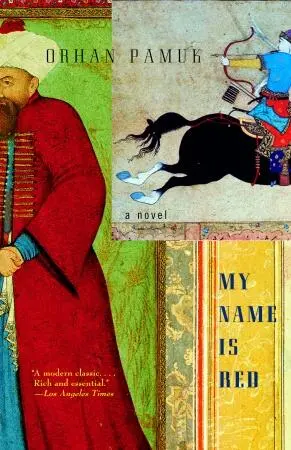
- Название:My Name is Red
- Автор:
- Жанр:
- Год:неизвестен
- ISBN:нет данных
- Рейтинг книги:5 / 5. Голосов: 1
-
Избранное:Добавить в избранное
- Отзывы:
-
Ваша оценка:
My Name is Red: краткое содержание, описание и аннотация
Предлагаем к чтению аннотацию, описание, краткое содержание или предисловие (зависит от того, что написал сам автор книги «My Name is Red»). Если вы не нашли необходимую информацию о книге — напишите в комментариях, мы постараемся отыскать её.
When the Sultan commissions a great book to celebrate his royal self and his extensive dominion, he directs Enishte Effendi to assemble a cadre of the most acclaimed artists in the land. Their task: to illuminate the work in the European style. But because figurative art can be deemed an affront to Islam, this commission is a dangerous proposition indeed, and no one in the elite circle can know the full scope or nature of the project.
Panic erupts when one of the chosen miniaturists disappears, and the Sultan demands answers within three days. The only clue to the mystery-or crime?-lies in the half-finished illuminations themselves. Has an avenging angel discovered the blasphemous work? Or is a jealous contender for the hand of Enishte’s ravishing daughter, the incomparable Shekure, somehow to blame?
Orhan Pamuk’s My Name Is Red is at once a fantasy and a philosophical puzzle, a kaleidoscopic journey to the intersection of art, religion, love, sex, and power.
"Pamuk is a novelist and a great one…My Name is Red is by far the grandest and most astonishing contest in his internal East-West war…It is chock-full of sublimity and sin…The story is told by each of a dozen characters, and now and then by a dog, a tree, a gold coin, several querulous corpses and the color crimson ('My Name is Red')…[Readers will] be lofted by the paradoxical lightness and gaiety of the writing, by the wonderfully winding talk perpetually about to turn a corner, and by the stubborn humanity in the characters' maneuvers to survive. It is a humanity whose lies and silences emerge as endearing and oddly bracing individual truths."- Richard Eder, New York Times Book Review
"A murder mystery set in sixteenth-century Istanbul [that] uses the art of miniature illumination, much as Mann's 'Doctor Faustus' did music, to explore a nation's soul… Erdag Goknar deserves praise for the cool, smooth English in which he has rendered Pamuk's finespun sentences, passionate art appreciations, sly pedantic debates, [and] eerie urban scenes."- John Updike, The New Yorker
"The interweaving of human and philosophical intrigue is very much as I remember it in The Name of the Rose, as is the slow, dense beginning and the relentless gathering of pace… But, in my view, his book is by far the better of the two. I would go so far as to say that Pamuk achieves the very thing his book implies is impossible… More than any other book I can think of, it captures not just Istanbul's past and present contradictions, but also its terrible, timeless beauty. It's almost perfect, in other words. All it needs is the Nobel Prize."-Maureen Freely, New Statesman (UK)
"A perfect example of Pamuk's method as a novelist, which is to combine literary trickery with page-turning readability… As a meditation on art, in particular, My Name is Red is exquisitely subtle, demanding and repaying the closest attention.. We in the West can only feel grateful that such a novelist as Pamuk exists, to act as a bridge between our culture and that of a heritage quite as rich as our own."-Tom Holland, Daily Telegraph (UK)
"Readers… will find themselves lured into a richly described and remarkable world… Reading the novel is like being in a magically exotic dream…Splendidly enjoyable and rewarding… A book in which you can thoroughly immerse yourself." -Allan Massie, The Scotsman (UK)
"A wonderful novel, dreamy, passionate and august, exotic in the most original and exciting way. Orhan Pamuk is indisputably a major novelist."-Philip Hensher, The Spectator (UK)
"[In this] magnificent new novel… Pamuk takes the reader into the strange and beautiful world of Islamic art,in which Western notions no longer make sense… In this world of forgeries, where some might be in danger of losing their faith in literature, Pamuk is the real thing, and this book might well be one of the few recent works of fiction that will be remembered at the end of this century."-Avkar Altinel, The Observer (UK)
My Name is Red — читать онлайн бесплатно полную книгу (весь текст) целиком
Ниже представлен текст книги, разбитый по страницам. Система сохранения места последней прочитанной страницы, позволяет с удобством читать онлайн бесплатно книгу «My Name is Red», без необходимости каждый раз заново искать на чём Вы остановились. Поставьте закладку, и сможете в любой момент перейти на страницу, на которой закончили чтение.
Интервал:
Закладка:
I turned the pages, gazing hurriedly but with rapt attention upon thousands of birds, horses, soldiers, lovers, camels, trees and clouds, while the Treasury’s happy dwarf, like a shah of elder days given the opportunity to exhibit his riches and wealth, proudly and undauntedly removed volume after volume from chests and placed them before me. From two separate corners of an iron chest stuffed with amazing tomes, common books and disorderly albums, there emerged two extraordinary volumes-one bound in the Shiraz style with a burgundy cover, the other bound in Herat and finished with a dark lacquer in the Chinese fashion-which contained pages so resembling each other that at first I thought they were copies. While I was trying to determine which book was the original and which the copy, I examined the names of the calligraphers on the colophons, looked for hidden signatures, and finally came to the realization, with a shudder, that these two volumes of Nizami were the legendary books that Master Sheikh Ali of Tabriz had made, one for the Khan of the Blacksheep, Jihan Shah, and the other for the Khan of the Whitesheep, Tall Hasan. After he was blinded by the Blacksheep shah to prevent him from making another version of the first volume, the great master artist took refuge with the Whitesheep khan and created a superior copy from memory. To see that the pictures in the second of the legendary books, made when he was blind, were simpler and purer, while the colors in the first volume were more lively and invigorating, reminded me that the memory of the blind exposes the merciless simplicity of life but also deadens its vigor.
Since I myself am a genuine great master, so acknowledged by Almighty Allah, who sees and knows all, I knew that one day I would go blind, but is this what I wanted now? Since His presence could be sensed quite nearby in the exquisite and terrifying darkness of the cluttered Treasury, like a condemned man who wishes to look upon the world one last time before he is beheaded, I asked Him: “Allow me to see all these illustrations and have my fill of them.”
As I turned the pages, by the force of God’s inscrutable wisdom, I frequently came across legends and matters of blindness. In the famous scene showing Shirin on a countryside outing falling in love with Hüsrev after seeing his picture on the branch of a plane tree, Sheikh Ali Rıza from Shiraz had drawn distinctly all the leaves of the tree one by one so they filled the entire sky. In answer to a fool who saw the work and commented that the true subject of the illustration wasn’t the plane tree, Sheikh Ali replied that the true subject wasn’t the passion of the beautiful young maiden either, it was the passion of the artist, and to proudly prove his point he attempted to paint the same plane tree with all its leaves on a grain of rice. If the signature hidden beneath the beautiful feet of Shirin’s darling lady attendants hadn’t misled me, I was of course seeing the magnificent tree made by the blind master on paper-not the tree made on a grain of rice, which he left half finished, having gone blind seven years and three months after he started the task. On another page, Rüstem blinding Alexander with his forked arrow was depicted in the manner of artists who knew the Indian style, so vivaciously and colorfully, that blindness, the ageless sorrow and secret desire of the genuine miniaturist, appeared to the observer as the prologue to a joyous celebration.
My eyes wandered over these pictures and volumes, no less with the excitement of one who wanted to behold for himself these legends he’d heard about for years than with the worry of an old man who sensed he would soon enough never see anything more. There, in the cold Treasury room suffused with a dark red that I’d never seen before-caused by the color of the cloth and dust within the peculiar light of the candles-I would occasionally cry out in admiration, whereupon Black and the dwarf would rush to my side and look over my shoulder at the magnificent page before me. Unable to restrain myself, I’d begin to explain:
“This color red belongs to the great master Mirza Baba Imami from Tabriz, the secret of which he took with him to the grave. He’s used it for the edges of the carpet, the red of Alevi allegiance on the Persian Shah’s turban, and look, it’s here on the belly of the lion on this page and on this pretty boy’s caftan. Allah never directly revealed this fine red except when He let the blood of his subjects flow. So that we might wearily strive to find this variety of red that is only visible to the naked eye on man-made cloth and in the pictures of the greatest of masters, God did, however, consign its secret to the rarest of insects living beneath stones,” I said and added, “Thanks be to Him who has now revealed it to us.”
“Look at this,” I said much later, once again unable to refrain from showing them a masterpiece-this one could’ve belonged in any collection of ghazals, which spoke of love, friendship, spring and happiness. We looked at the trees of springtime blooming in an array of color, the cypresses in a garden reminiscent of Heaven and the elation of the beloveds reclining in that garden as they drank wine and recited poetry; it was as if we in the moldy, dusty and icy Treasury could also smell those spring blossoms and the delicately scented skin of the joyous revelers. “Notice how the same artist who rendered the forearms of the lovers, their beautiful naked feet, the elegance of their stances and the lazy delight of the birds fluttering about them with such sincerity, also made the crude shape of the cypress in the background!” I said, “This is the work of Lütfi of Bukhara whose ill-temper and belligerence caused him to leave each of his illustrations half finished; he fought with every shah and khan claiming that they understood nothing of painting, and he never remained in one city for long. This great master went from one shah’s palace to another, from city to city, quarreling all the way, never able to find a ruler whose book was deserving of his talents, until he ended up in the workshop of an inconsequential chieftain who ruled over nothing but bare mountaintops. Claiming that ”the khan’s dominions might be small but he knows painting,“ he spent the remaining twenty-five years of his life there. Whether he ever knew that this inconsequential lord was blind remains, even today, a subject of conjecture and a source of humor.”
“Do you see this page?” I said well into the night, and this time they both rushed to my side, candlesticks aloft. “From the time of Tamerlane’s grandchildren to the present, this volume has seen ten owners on its way here from Herat over a span of one hundred fifty years.” Using my magnifying lens, the three of us read the signatures, dedications, historical information and names of sultans-who’d strangled one another-filling every corner of the colophon page, pinched together, between and on top of each other: “This volume was completed in Herat, with the help of God, by the hand of Calligrapher Sultan Veli, son of Muzaffer of Herat, in the year of the Hegira 849 for Ismet-üd Dünya, the wife of Muhammad Juki the victorious brother of the Ruler of the World, Baysungur.” Later still, we read that the book had passed into the possession of the Whitesheep Sultan Halil, thence to his son Yakup Bey, and thence to the Uzbek sultans in the North, each of whom happily amused himself with the book for a time, removing or adding one or two pictures; beginning with the first owner, they added the faces of their beautiful wives to the illustrations and appended their names proudly to the colophon page; afterward, it passed to Sam Mirza who’d conquered Herat, and he made a present of it, with a separate dedication, for his elder brother, Shah Ismail, who in turn brought it to Tabriz and had it prepared as a gift with yet another dedication. When the denizen of paradise Sultan Selim the Grim defeated Shah Ismail at Chaldiran and plundered the Seven Heavens Palace in Tabriz, the book ended up here in this Treasury in Istanbul, after traveling across deserts, mountains and rivers along with the victorious sultan’s soldiers.
Читать дальшеИнтервал:
Закладка:
Похожие книги на «My Name is Red»
Представляем Вашему вниманию похожие книги на «My Name is Red» списком для выбора. Мы отобрали схожую по названию и смыслу литературу в надежде предоставить читателям больше вариантов отыскать новые, интересные, ещё непрочитанные произведения.










Обсуждение, отзывы о книге «My Name is Red» и просто собственные мнения читателей. Оставьте ваши комментарии, напишите, что Вы думаете о произведении, его смысле или главных героях. Укажите что конкретно понравилось, а что нет, и почему Вы так считаете.