Orhan Pamuk - My Name is Red
Здесь есть возможность читать онлайн «Orhan Pamuk - My Name is Red» весь текст электронной книги совершенно бесплатно (целиком полную версию без сокращений). В некоторых случаях можно слушать аудио, скачать через торрент в формате fb2 и присутствует краткое содержание. Жанр: Современная проза, на английском языке. Описание произведения, (предисловие) а так же отзывы посетителей доступны на портале библиотеки ЛибКат.
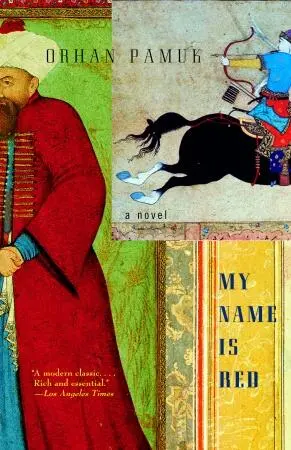
- Название:My Name is Red
- Автор:
- Жанр:
- Год:неизвестен
- ISBN:нет данных
- Рейтинг книги:5 / 5. Голосов: 1
-
Избранное:Добавить в избранное
- Отзывы:
-
Ваша оценка:
My Name is Red: краткое содержание, описание и аннотация
Предлагаем к чтению аннотацию, описание, краткое содержание или предисловие (зависит от того, что написал сам автор книги «My Name is Red»). Если вы не нашли необходимую информацию о книге — напишите в комментариях, мы постараемся отыскать её.
When the Sultan commissions a great book to celebrate his royal self and his extensive dominion, he directs Enishte Effendi to assemble a cadre of the most acclaimed artists in the land. Their task: to illuminate the work in the European style. But because figurative art can be deemed an affront to Islam, this commission is a dangerous proposition indeed, and no one in the elite circle can know the full scope or nature of the project.
Panic erupts when one of the chosen miniaturists disappears, and the Sultan demands answers within three days. The only clue to the mystery-or crime?-lies in the half-finished illuminations themselves. Has an avenging angel discovered the blasphemous work? Or is a jealous contender for the hand of Enishte’s ravishing daughter, the incomparable Shekure, somehow to blame?
Orhan Pamuk’s My Name Is Red is at once a fantasy and a philosophical puzzle, a kaleidoscopic journey to the intersection of art, religion, love, sex, and power.
"Pamuk is a novelist and a great one…My Name is Red is by far the grandest and most astonishing contest in his internal East-West war…It is chock-full of sublimity and sin…The story is told by each of a dozen characters, and now and then by a dog, a tree, a gold coin, several querulous corpses and the color crimson ('My Name is Red')…[Readers will] be lofted by the paradoxical lightness and gaiety of the writing, by the wonderfully winding talk perpetually about to turn a corner, and by the stubborn humanity in the characters' maneuvers to survive. It is a humanity whose lies and silences emerge as endearing and oddly bracing individual truths."- Richard Eder, New York Times Book Review
"A murder mystery set in sixteenth-century Istanbul [that] uses the art of miniature illumination, much as Mann's 'Doctor Faustus' did music, to explore a nation's soul… Erdag Goknar deserves praise for the cool, smooth English in which he has rendered Pamuk's finespun sentences, passionate art appreciations, sly pedantic debates, [and] eerie urban scenes."- John Updike, The New Yorker
"The interweaving of human and philosophical intrigue is very much as I remember it in The Name of the Rose, as is the slow, dense beginning and the relentless gathering of pace… But, in my view, his book is by far the better of the two. I would go so far as to say that Pamuk achieves the very thing his book implies is impossible… More than any other book I can think of, it captures not just Istanbul's past and present contradictions, but also its terrible, timeless beauty. It's almost perfect, in other words. All it needs is the Nobel Prize."-Maureen Freely, New Statesman (UK)
"A perfect example of Pamuk's method as a novelist, which is to combine literary trickery with page-turning readability… As a meditation on art, in particular, My Name is Red is exquisitely subtle, demanding and repaying the closest attention.. We in the West can only feel grateful that such a novelist as Pamuk exists, to act as a bridge between our culture and that of a heritage quite as rich as our own."-Tom Holland, Daily Telegraph (UK)
"Readers… will find themselves lured into a richly described and remarkable world… Reading the novel is like being in a magically exotic dream…Splendidly enjoyable and rewarding… A book in which you can thoroughly immerse yourself." -Allan Massie, The Scotsman (UK)
"A wonderful novel, dreamy, passionate and august, exotic in the most original and exciting way. Orhan Pamuk is indisputably a major novelist."-Philip Hensher, The Spectator (UK)
"[In this] magnificent new novel… Pamuk takes the reader into the strange and beautiful world of Islamic art,in which Western notions no longer make sense… In this world of forgeries, where some might be in danger of losing their faith in literature, Pamuk is the real thing, and this book might well be one of the few recent works of fiction that will be remembered at the end of this century."-Avkar Altinel, The Observer (UK)
My Name is Red — читать онлайн бесплатно полную книгу (весь текст) целиком
Ниже представлен текст книги, разбитый по страницам. Система сохранения места последней прочитанной страницы, позволяет с удобством читать онлайн бесплатно книгу «My Name is Red», без необходимости каждый раз заново искать на чём Вы остановились. Поставьте закладку, и сможете в любой момент перейти на страницу, на которой закончили чтение.
Интервал:
Закладка:
One hundred and twenty years ago, there being no coffee then, the respected Hoja, whose story we’ve begun, was simply steaming with rage.
“Hey, Frank infidel, why are you drawing these two?” he was saying. “These wretched Kalenderi dervishes wander around thieving and begging, they take hashish, drink wine, bugger each other, and as is evident from the way they look, know nothing of performing or reciting prayers, nothing of house, or home, or family; they’re nothing but the dregs of this good world of ours. And you, why are you painting this picture of disgrace when there’s so much beauty in this great country? Is it to disgrace us?”
“Not at all, it’s simply because illustrations of your bad side bring in more money,” said the infidel. We two dervishes were dumbfounded at the soundness of the painter’s reasoning.
“If it brought you more money, would you paint the Devil in a favorable light?” the Hoja Effendi said, coyly trying to start an argument, but as you can see from this picture, the Venetian was a genuine artist, and he’d focused upon the work before him and the money it’d bring rather than heeding the Hoja’s empty prattle.
He did indeed paint us, and then slid us into the leather portfolio on the back of his horse’s saddle, and returned to his infidel city. Soon afterward, the victorious armies of the Ottomans conquered and plundered that city on the banks of the Danube, and the two of us ended up coming back this way to Istanbul and the Royal Treasury. From there, copied over and over, we moved from one secret book to another, and finally arrived at this joyous coffeehouse where coffee is drunk like a rejuvenating, invigorating elixir. Now then:
A Brief Treatise on Painting, Death and Our Place in the World
The Hoja Effendi from Konya, whom we’ve just mentioned, has made the following claim somewhere in one of his sermons, which are written out and collected in a thick tome: Kalenderi dervishes are the unnecessary dross of the world because they don’t belong to any of the four categories into which men are divided: 1. notables, 2. merchants, 3. farmers and 4. artists; thus, they are superfluous.
Additionally, he said the following: “These two always tramp about as a pair and always argue about which of them will be the first to eat with their only spoon, and those who don’t know that this is a sly allusion to their true concern-who’ll be the first to bugger the other-find it amusing and laugh. His Excellency Please-Don’t-Take-It-Wrong Hoja has uncovered our secret because he, along with us, the pretty young boys, apprentices and miniaturists, are all fellow travelers on the same path.”
However, the real secret is this: While the Frank infidel was making our picture, he gazed at us so sweetly and with such attention to detail that we took a liking to him and enjoyed being depicted by him. But, he was committing the error of looking at the world with his naked eye and rendering what he saw. Thus, he drew us as if we were blind although we could see just fine, but we didn’t mind. Now, we’re quite content, indeed. According to the Hoja, we’re in Hell; according to some unbelievers we’re nothing but decayed corpses and according to you, the intelligent society of miniaturists gathered here, we’re a picture, and because we’re a picture, we stand here before you as though we were alive and well. After our run-in with the respected Hoja Effendi and after walking from Konya to Sivas in three nights, through eight villages, begging all the way, one night we were beset by such cold and snow that we two dervishes, hugging each other tightly, fell asleep and froze to death. Just before dying I had a dream: I was the subject of a painting that entered Heaven after thousands and thousands of years.
IT IS I, MASTER OSMAN
They tell a story in Bukhara that dates back to the time of Abdullah Khan. This Uzbek Khan was a suspicious ruler, and though he didn’t object to more than one artist’s brush contributing to the same illustration, he was opposed to painters copying from one another’s pages-because this made it impossible to determine which of the artists brazenly copying from one another was to blame for an error. More importantly, after a time, instead of pushing themselves to seek out God’s memories within the darkness, pilfering miniaturists would lazily seek out whatever they saw over the shoulder of the artist beside them. For this reason, the Uzbek Khan joyously welcomed two great masters, one from Shiraz in the South, the other from Samarkand in the East, who’d fled from war and cruel shahs to the shelter of his court; however, he forbade the two celebrated talents to look at each other’s work, and separated them by giving them small workrooms on opposite ends of his palace, as far from each other as possible. Thus, for exactly thirty-seven years and four months, as if listening to a legend, these two great masters each listened to Abdullah Khan recount the magnificence of the other’s never-to-be-seen work, how it differed from or was oddly similar to the other’s. Meanwhile, they both lived dying of curiosity about each other’s paintings. After the Uzbek Khan’s life had run its long tortoiselike course, the two old artists ran to each other’s rooms to see the paintings. Later still, sitting upon either edge of a large cushion, holding each other’s books on their laps and looking at the pictures that they recognized from Abdullah Khan’s fables, both the miniaturists were overcome with great disappointment because the illustrations they saw weren’t nearly as spectacular as those they’d anticipated from the stories they’d heard, but instead appeared, much like all the pictures they’d seen in recent years, rather ordinary, pale and hazy. The two great masters didn’t then realize that the reason for this haziness was the blindness that had begun to descend upon them, nor did they realize it after both had gone completely blind, rather they attributed the haziness to having been duped by the Khan, and hence they died believing dreams were more beautiful than pictures.
In the dead of night in the cold Treasury room, as I turned pages with frozen fingers and gazed upon the pictures in books that I’d dreamed of for forty years, I knew I was much happier than the artists in this pitiless story from Bukhara. It gave me such a thrill to know, before going blind and passing into the Hereafter, that I was handling the very books whose legends I’d heard about my whole life, and at times I would murmur, “Thank you, God, thank you” when I saw that one of pages I was turning was even more marvelous than its legend.
For instance, eighty years ago Shah Ismail crossed the river and by the sword reconquered Herat and all of Khorasan from the Uzbeks, whereupon he appointed his brother Sam Mirza governor of Herat; to celebrate this joyous occasion, his brother, in turn, had a manuscript prepared, an illuminated version of a book entitled The Convergence of the Stars , which recounted a story as witnessed by Emir Hüsrev in the palace of Delhi. According to legend, one illustration in this book showed the two rulers meeting on the banks of a river where they celebrated their victory. Their faces resembled the Sultan of Delhi, Keykubad, and his father, Bughra Khan, the Ruler of Bengal, who were the subjects of the book; but they also resembled the faces of Shah Ismail and his brother Sam Mirza, the men responsible for the book’s creation. I was absolutely certain that the heroes of whichever story I conjured while looking at the page would appear there in the sultan’s tent, and I thanked God for giving me the chance to see this miraculous page.
In an illustration by Sheikh Muhammad, one of the great masters of the same legendary era, a poor subject whose awe and affection for his sultan had reached the level of pure love was desperately hoping, as he watched the sultan play polo, that the ball would roll toward him so he could grab it and present it to his sovereign. After he’d waited long and patiently, the ball did indeed come to him, and he was depicted handing it to the sultan. As had been described to me thousands of times, the love, awe and submission that a poor subject aptly feels toward a great khan or an exalted monarch, or that a handsome young apprentice feels toward his master, was rendered here with such delicacy and deep compassion, from the extension of the subject’s fingers holding the ball to his inability to summon the courage to look at the sovereign’s face, that while looking at this page, I knew there was no greater joy in the world than to be apprentice to a great master, and that such submissiveness verging on servility was no less a pleasure than being master to a young, pretty and intelligent apprentice-and I grieved for those who would never know this truth.
Читать дальшеИнтервал:
Закладка:
Похожие книги на «My Name is Red»
Представляем Вашему вниманию похожие книги на «My Name is Red» списком для выбора. Мы отобрали схожую по названию и смыслу литературу в надежде предоставить читателям больше вариантов отыскать новые, интересные, ещё непрочитанные произведения.







Обсуждение, отзывы о книге «My Name is Red» и просто собственные мнения читателей. Оставьте ваши комментарии, напишите, что Вы думаете о произведении, его смысле или главных героях. Укажите что конкретно понравилось, а что нет, и почему Вы так считаете.