Orhan Pamuk - My Name is Red
Здесь есть возможность читать онлайн «Orhan Pamuk - My Name is Red» весь текст электронной книги совершенно бесплатно (целиком полную версию без сокращений). В некоторых случаях можно слушать аудио, скачать через торрент в формате fb2 и присутствует краткое содержание. Жанр: Современная проза, на английском языке. Описание произведения, (предисловие) а так же отзывы посетителей доступны на портале библиотеки ЛибКат.
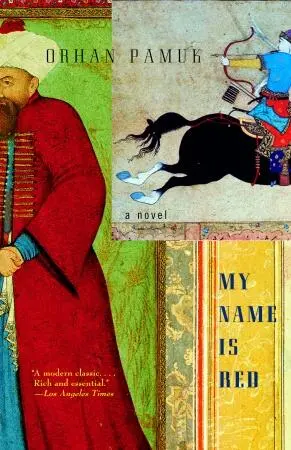
- Название:My Name is Red
- Автор:
- Жанр:
- Год:неизвестен
- ISBN:нет данных
- Рейтинг книги:5 / 5. Голосов: 1
-
Избранное:Добавить в избранное
- Отзывы:
-
Ваша оценка:
My Name is Red: краткое содержание, описание и аннотация
Предлагаем к чтению аннотацию, описание, краткое содержание или предисловие (зависит от того, что написал сам автор книги «My Name is Red»). Если вы не нашли необходимую информацию о книге — напишите в комментариях, мы постараемся отыскать её.
When the Sultan commissions a great book to celebrate his royal self and his extensive dominion, he directs Enishte Effendi to assemble a cadre of the most acclaimed artists in the land. Their task: to illuminate the work in the European style. But because figurative art can be deemed an affront to Islam, this commission is a dangerous proposition indeed, and no one in the elite circle can know the full scope or nature of the project.
Panic erupts when one of the chosen miniaturists disappears, and the Sultan demands answers within three days. The only clue to the mystery-or crime?-lies in the half-finished illuminations themselves. Has an avenging angel discovered the blasphemous work? Or is a jealous contender for the hand of Enishte’s ravishing daughter, the incomparable Shekure, somehow to blame?
Orhan Pamuk’s My Name Is Red is at once a fantasy and a philosophical puzzle, a kaleidoscopic journey to the intersection of art, religion, love, sex, and power.
"Pamuk is a novelist and a great one…My Name is Red is by far the grandest and most astonishing contest in his internal East-West war…It is chock-full of sublimity and sin…The story is told by each of a dozen characters, and now and then by a dog, a tree, a gold coin, several querulous corpses and the color crimson ('My Name is Red')…[Readers will] be lofted by the paradoxical lightness and gaiety of the writing, by the wonderfully winding talk perpetually about to turn a corner, and by the stubborn humanity in the characters' maneuvers to survive. It is a humanity whose lies and silences emerge as endearing and oddly bracing individual truths."- Richard Eder, New York Times Book Review
"A murder mystery set in sixteenth-century Istanbul [that] uses the art of miniature illumination, much as Mann's 'Doctor Faustus' did music, to explore a nation's soul… Erdag Goknar deserves praise for the cool, smooth English in which he has rendered Pamuk's finespun sentences, passionate art appreciations, sly pedantic debates, [and] eerie urban scenes."- John Updike, The New Yorker
"The interweaving of human and philosophical intrigue is very much as I remember it in The Name of the Rose, as is the slow, dense beginning and the relentless gathering of pace… But, in my view, his book is by far the better of the two. I would go so far as to say that Pamuk achieves the very thing his book implies is impossible… More than any other book I can think of, it captures not just Istanbul's past and present contradictions, but also its terrible, timeless beauty. It's almost perfect, in other words. All it needs is the Nobel Prize."-Maureen Freely, New Statesman (UK)
"A perfect example of Pamuk's method as a novelist, which is to combine literary trickery with page-turning readability… As a meditation on art, in particular, My Name is Red is exquisitely subtle, demanding and repaying the closest attention.. We in the West can only feel grateful that such a novelist as Pamuk exists, to act as a bridge between our culture and that of a heritage quite as rich as our own."-Tom Holland, Daily Telegraph (UK)
"Readers… will find themselves lured into a richly described and remarkable world… Reading the novel is like being in a magically exotic dream…Splendidly enjoyable and rewarding… A book in which you can thoroughly immerse yourself." -Allan Massie, The Scotsman (UK)
"A wonderful novel, dreamy, passionate and august, exotic in the most original and exciting way. Orhan Pamuk is indisputably a major novelist."-Philip Hensher, The Spectator (UK)
"[In this] magnificent new novel… Pamuk takes the reader into the strange and beautiful world of Islamic art,in which Western notions no longer make sense… In this world of forgeries, where some might be in danger of losing their faith in literature, Pamuk is the real thing, and this book might well be one of the few recent works of fiction that will be remembered at the end of this century."-Avkar Altinel, The Observer (UK)
My Name is Red — читать онлайн бесплатно полную книгу (весь текст) целиком
Ниже представлен текст книги, разбитый по страницам. Система сохранения места последней прочитанной страницы, позволяет с удобством читать онлайн бесплатно книгу «My Name is Red», без необходимости каждый раз заново искать на чём Вы остановились. Поставьте закладку, и сможете в любой момент перейти на страницу, на которой закончили чтение.
Интервал:
Закладка:
We entered, passing between chiefs standing at either side. Inside, it was ice cold. When the door closed behind us, we were enveloped in blackness. I smelled a combination of mildew, dust and humidity that drove deep into my nasal passages. Everywhere the clutter of objects, chests and helmets intermingled in a huge chaotic jumble. I had the feeling that I was witness to a great battle.
My eyes adjusted to the odd light that fell over the entire space, which filtered through the thick bars of the high windows, through the balustrades of the stairs along the high walls and the railing of the second-floor wooden walkways. This chamber was red, tinged with the color of the velvet cloth, carpets and kilims hanging on the walls. With due reverence, I considered how the accumulation of all this wealth was the consequence of wars waged, blood spilt and cities and treasuries plundered.
“Frightened?” asked the elderly dwarf, giving voice to my feelings. “Everybody is frightened on their first visit. At night the spirits of these objects whisper to each other.”
What was frightening was the silence in which this abundance of incredible objects was interred. Behind us we heard the clattering of the seal being affixed to the lock on the door, and we looked around in awe, motionless.
I saw swords, elephant tusks, caftans, silver candlesticks and satin banners. I saw mother-of-pearl inlaid boxes, iron trunks, Chinese vases, belts, long-necked lutes, armor, silk cushions, model globes, boots, furs, rhinoceros horns, ornamented ostrich eggs, rifles, arrows, maces and cabinets. There were heaps of carpets, cloth and satin everywhere, seemingly cascading over me from the wood-paneled upper floors, from the balustrades, the built-in closets and small storage cells built into the walls. A strange light, the likes of which I’d never seen, shone on the cloth, the boxes, the caftans of sultans, swords, the huge pink candles, the wound turbans, pillows embroidered with pearls, gold filigree saddles, diamond-handled scimitars, ruby-handled maces, quilted turbans, turban plumes, curious clocks, ewers and daggers, ivory statues of horses and elephants, narghiles with diamond-studded tops, mother-of-pearl chests of drawers, horse aigrettes, strands of large prayer beads, and helmets adorned with rubies and turquoise. This light, which filtered faintly down from the high windows, illuminated floating dust particles in the half-darkened room like the summer sunlight that streams in from the glass skylight atop the dome of a mosque-but this wasn’t sunlight. In this peculiar light, the air had become palpable and all the objects appeared as if made from the same material. After we apprehensively experienced the silence in the room for a while longer, I knew it was as much the light as the dust covering everything that dimmed the red color reigning in the cold room, melding all the objects into an arcane sameness. And as the eye swam over these strange and indistinct items, unable to distinguish one from another at even the second or third glance, this great profusion of objects became even more terrifying. What I thought was a chest, I later decided was a folding worktable, and later still, some strange Frankish device. I saw that the mother-of-pearl inlaid chest among the caftans and plumes pulled out of their boxes and hastily tossed hither and yon was actually an exotic cabinet sent by the Muscovite Czar.
Jezmi Agha placed the brazier in the fire niche that had been cut into the wall.
“Where are the books located?” whispered Master Osman.
“Which books?” said the dwarf. “The ones from Arabia, the Kufic Korans, those that His Excellency Sultan Selim the Grim, Denizen of Paradise, brought back from Tabriz, the books of pashas whose property was seized when they were condemned to death, the gift volumes brought by the Venetian ambassador to Our Sultan’s grandfather, or the Christian books from the time of Sultan Mehmet the Conqueror?”
“The books that Shah Tahmasp sent His Excellency Sultan Selim, Denizen of Paradise, as a present twenty-five years ago,” said Master Osman.
The dwarf brought us to a large wooden cabinet. Master Osman grew impatient as he opened the doors and cast his eyes on the volumes before him. He opened one, read its colophon and leafed through its pages. Together, we gazed in astonishment at the carefully drawn illustrations of khans with slightly slanted eyes.
“”Genghis Khan, Chagatai Khan, Tuluy Khan and Kublai Khan the Ruler of China,“” read Master Osman before closing the book and taking up another.
We came across an incredibly beautiful illustration depicting the scene in which Ferhad, empowered by love, carries his beloved Shirin and her horse away on his shoulder. To convey the passion and woe of the lovers, the rocks on the mountain, the clouds and the three noble cypresses witnessing Ferhad’s act of love were drawn with a trembling grief-stricken hand in such agony that Master Osman and I were instantly affected by the taste of tears and sorrow in the falling leaves. This touching moment had been depicted-as the great masters intended-not to signify Ferhad’s muscular strength, but rather to convey how the pain of his love was felt at once throughout the entire world.
“A Bihzad imitation made in Tabriz eighty years ago,” Master Osman said as he replaced the volume and opened another.
This was a picture that showed the forced friendship between the cat and the mouse from Kelile and Dimne . Out in the fields, a poor mouse, caught between the attacks of a marten on the ground and a hawk in the air, finds his salvation in an unfortunate cat caught in a hunter’s trap. They come to an agreement: The cat, pretending to be the mouse’s friend, licks him, thereby scaring away the marten and the hawk. In turn, the mouse cautiously frees the cat from the snare. Even before I could understand the painter’s sensibility, the master had stuffed the book back beside the other volumes and had randomly opened another.
This was a pleasant picture of a mysterious woman and a man: The woman had elegantly opened one hand while asking a question, holding her knee with the other over her green cloak, as the man turned to her and listened intently. I looked at the picture avidly, jealous of the intimacy, love and friendship between them.
Putting that book down, Master Osman opened to a page from another book. The cavalry of Persian and Turanian armies, eternal enemies, had donned their full panoply of armor, helmets, greaves, bows, quivers and arrows and had mounted those magnificent, legendary and fully armored horses. Before they engaged one another in a battle to the death, they were arrayed in orderly ranks facing each other on a dusty yellow steppe holding the tips of their lances upright, bedecked in an array of colors and patiently watching their commanders, who’d rushed to the fore and begun to fight. I was about to tell myself that regardless of whether the illustration was made today or a hundred years ago, whether it’s a depiction of war or love, what the artist of absolute faith actually paints and conveys is a battle with his will and his love for painting; I was going to declare further that the miniaturist actually paints his own patience, when Master Osman said:
“It’s not here either,” and shut the heavy tome.
In the pages of an album we saw high mountains interwoven with curling clouds in a landscape illustration that seemed to go on forever. I thought how painting meant seeing this world yet depicting it as if it were the Otherworld. Master Osman recounted how this Chinese illustration might’ve traveled from Bukhara to Herat, from Herat to Tabriz, and at last, from Tabriz to Our Sultan’s palace, moving from book to book along the way, bound and unbound, finally to be rebound with other paintings at the end of the journey from China to Istanbul.
Читать дальшеИнтервал:
Закладка:
Похожие книги на «My Name is Red»
Представляем Вашему вниманию похожие книги на «My Name is Red» списком для выбора. Мы отобрали схожую по названию и смыслу литературу в надежде предоставить читателям больше вариантов отыскать новые, интересные, ещё непрочитанные произведения.







Обсуждение, отзывы о книге «My Name is Red» и просто собственные мнения читателей. Оставьте ваши комментарии, напишите, что Вы думаете о произведении, его смысле или главных героях. Укажите что конкретно понравилось, а что нет, и почему Вы так считаете.